Overview
Overview
Transparency International's (TI) 2025 Corruption Perceptions Index (CPI) reveals continued volatility across the Asia-Pacific (APAC) region.
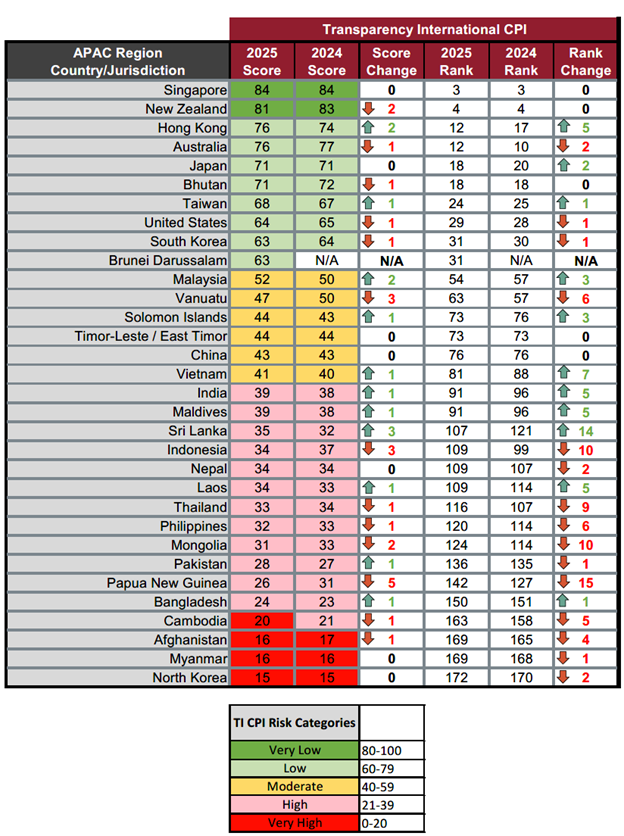
While several countries demonstrated incremental improvements, others remain persistently challenged by structural corruption, limited enforcement, and governance instability. Overall, the regional average CPI score improved by only one point from last year to 45, as improvements in some countries' scores were offset by continued low scores in others. Thus, the CPI indicates that slightly more than half of the countries in the region are perceived as being at high to very high risk for bribery and corruption. The 2025 CPI is available here.
Summary
CPI scores countries on a scale of zero to 100, where 100 indicates very low perceived corruption and zero indicates extremely high perceived corruption. The CPI assesses public corruption perceptions based on 13 data sources and excludes certain factors like private sector corruption, financial secrecy, or transnational corruption.
In 2025, the highest‑scoring country (least corrupt) in the APAC region is Singapore, ranking third globally with a score of 84. By contrast, North Korea remains the lowest‑scoring country in the region, ranking 172 with a score of 15.
Slightly more than one-third of the countries in the APAC region improved their CPI scores, and nearly all of them also rose in rankings. Notably, Sri Lanka showed one of the region's strongest improvements, gaining three points and jumping 14 places. However, Papua New Guinea, which was a high-risk category last year, fell by five points and dropped 15 places. The regional risk scale remained largely unchanged, with only one country, Cambodia, shifting from high risk to very high risk after declining by one point and falling five places.
Other Jurisdictions of Note
China showed no year‑on‑year change, maintaining both its score and global ranking compared to 2024, indicating a continuation of existing perceptions of public sector corruption despite China's measures to improve its antibribery measures. Such efforts included the Sky Net 2025 campaign, which repatriated 782 corruption fugitives and recovered significant illicit assets, new sector‑specific compliance measures, including new guidelines for healthcare companies, and high‑profile prosecutions of senior banking executives. Regulatory updates included amendments to the Supervision Law Implementing Rules, revisions to the Anti‑Unfair Competition Law strengthening commercial bribery provisions, and new evidence guidelines addressing disguised forms of corruption.
Singapore's continued high scoring was strengthened this year when the Ministry of Defense issued updated zero‑tolerance measures and whistleblower protections. Active enforcement included a significant fine imposed on a businessman Ong Beng Seng for abetting the former Transport Minister in obstructing justice over a 2022 sponsored trip, and the first deferred prosecution agreement with Seatrium over alleged Brazil‑related bribery, requiring substantial financial penalties and compliance enhancements.
South Korea showed marginal changes, declining by one point and one rank. Despite this modest change, TI highlighted South Korea—alongside Estonia and Seychelles—as one of the strongest improvers since 2021, noting its upward trajectory over the longer term. According to TI's analysis, "[t]he long-term improvements in democratic countries like these reflect sustained momentum with reforms, strengthened oversight institutions and broad political consensus in favor of clean governance. Success in these areas has been attributed to digitizing public services, professionalizing the civil service, and embedding regional and global governance standards."
Japan maintained its CPI score and rose two ranks. The CPI ranking has not been impacted by the five-year investigation of Toyota Motor Corporation by the US Securities and Exchange Commission (SEC) and US Department of Justice (DOJ) of possible anti‑bribery violations involving a Thai subsidiary. Perhaps because Toyota reported the potential violations in 2020 and has been cooperating in the investigative process, DOJ reportedly closed its investigation in June 2025.
India improved on the CPI, gaining one point and five ranks, reflecting broader efforts to strengthen its anti‑corruption framework. In 2025, these included enhancing its ability to advance graft cases that had previously stalled due to a limited caseload. Moreover, it should be noted that the SEC and DOJ dropped their cases against two former Cognizant executives accused of bribing an Indian official. Separately, in August 2025, the DOJ declined to prosecute Liberty Mutual despite evidence that its Indian subsidiary paid bribes to officials at six state‑owned banks. However, the SEC's investigation into two renewable energy companies involved in a bribery scheme of over USD 250 million in bribes to Indian officials is still ongoing, with a former Azure Power board member charged with FCPA violations.
Indonesia declined three points and 10 ranks. On August 25, 2025, thousands of students, workers, and activists protested in Jakarta against lawmakers' lavish housing allowances, which amounted to roughly ten times the Jakarta minimum wage, triggering widespread anger amid ongoing austerity measures. When police deployed tear gas and water cannons, killing at least 10 people with thousands detained, TI condemned the crackdown, urging independent investigations, the protection of civic freedoms, and an end to disinformation campaigns targeting civil society organizations, including its Indonesian chapter.
Vietnam improved by one point and seven ranks, supported by continued anti‑corruption momentum in 2025. Authorities intensified investigations and disciplinary actions, targeting senior‑level misconduct and business collusion. Over 330 Party organizations and 9,600 members were disciplined. Law enforcement opened 3,325 cases involving corruption and economic crimes.
Philippines declined one point and six ranks—its lowest score since 2012—as the country faced a surging flood‑control corruption scandal involving billions in alleged losses. Testimony from contractors and engineers revealed systemic kickback schemes and collusion among politicians, engineers, and private contractors, with estimates suggesting losses that could reach into the multi‑trillion‑peso range. High‑profile figures—including the House Speaker and Senate leaders—were implicated, leading to resignations, suspensions, project cancellations, and corruption investigations.
Thailand also declined one point in its scores and dropped nine ranks, showing a downward trend since 2012. Dr Mana Nimitmongkol of the Anti‑Corruption Organization of Thailand reportedly warned that the score—Thailand's worst in 19 years—reflects a lack of serious anti‑corruption policy across three successive governments, allowing both public officials and private actors to become increasingly emboldened. He stressed that corruption has become structural, rooted in weak governance, opaque bureaucracy, and a justice system unable to reliably hold offenders accountable.
Conclusion
In APAC countries, The CPI shows modest regional improvement alongside persistent divergence, with more than half of jurisdictions still perceived as high to very high risk. As it reflects only public sector corruption perceptions, the index should be regarded as directional rather than determinative.
Additionally, the DOJ issued new FCPA Guidelines in June 2025, marking an early end to the administrative "pause" on FCPA enforcement, and APAC jurisdictions continue active anti‑corruption enforcement, so companies should maintain robust anti‑corruption due diligence programs to support sustainable development and societal trust.