Overview
While the European Union Deforestation Regulation (EUDR) has grabbed headlines and dominated complex overseas deforestation and human rights due diligence efforts for the past few years, the United States' own extraterritorial anti-deforestation law has substantial bite - and is an increasing federal enforcement priority. The EUDR is, at its core, a trade law and a barrier, preventing the importation and sale in the EU of goods that are not "deforestation free" to help reduce deforestation. (We have discussed the EUDR here and here.) The Lacey Act (16 U.S.C. §§ 3371–3378), on the books in the US for more than 125 years, has civil and criminal penalties, and broadly prohibits selling, transporting or importing plants, timber, and their derivative products that are harvested in violation of US or foreign laws.
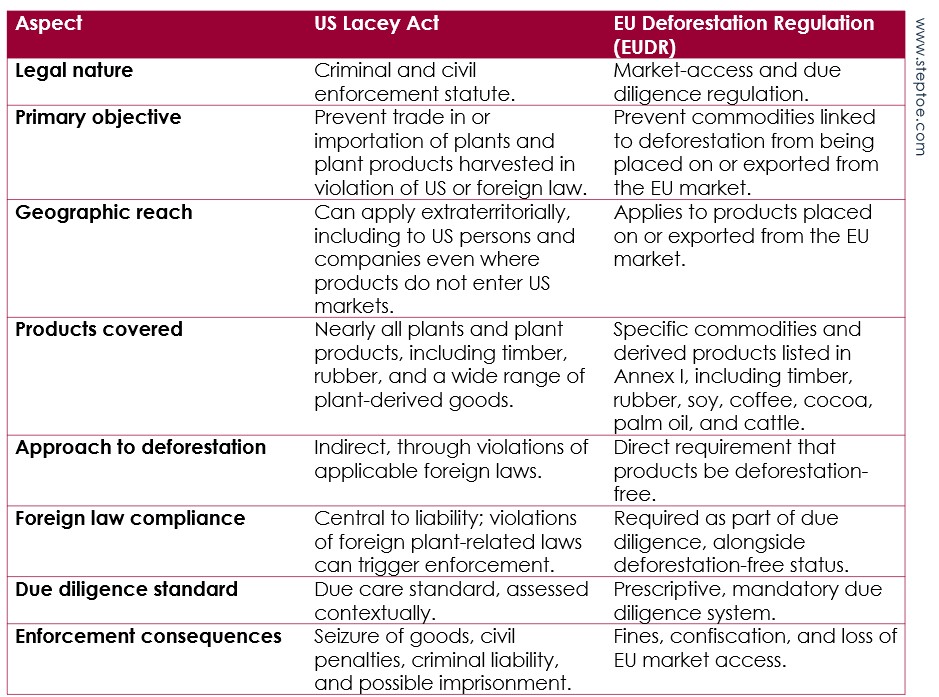
The Lacey Act is broader than the EUDR in some respects and narrower in others, but both laws cover wood products and rubber and compel – through mandate or the prospect of civil and criminal risk – due diligence into whether they have been gathered, sold and transported consistent with host country biodiversity, deforestation and other relevant laws. Given the intense US attention on imports with undervalued components, the Lacey Act's severe penalties, and the anticipated application of the EUDR at the end of this year, integrated compliance measures addressing both regimes' requirements would maximize efficiencies and help limit legal and operational risks.
1. The Broad Scope of the Lacey Act
Background and relevant terms. Originally passed in 1900 to combat the feather trade for ladies' hats, the Lacey Act has been amended several times, and today is remarkably broad in scope. More than just a trade law, it makes it illegal for any person to import, export, transport, sell, receive or purchase:
- any plant in violation of any US law or treaty, or
- in a way that impacts US interstate or foreign commerce,
- any plant created or transported in violation of foreign laws that regulate plant theft,
- plant harvesting from a protected area,
- plant taking without authorization, and
- plants possessed, sold or transported in a manner that violates export, tax or royalty regulations.
Unlike the EUDR, focusing on covered goods imported into or sold on the EU market, the Lacey Act includes extraterritorial violations, encompassing US citizens and companies even where covered goods themselves do not touch US markets.
Foreign law compliance. As with the EUDR, the Lacey Act mandates that covered goods are produced in compliance with relevant requirements of the country of origin, including laws and administrative regulations. The Lacey Act is less specific than the EUDR: it does not categorize the type of foreign law violation that can trigger liability, demanding only that the law address plants or timber. In practice, however, the EUDR and Lacey Act both cover host country environmental, deforestation, biodiversity, land use, tax, and customs laws, as well as other relevant legislation. Both laws also contemplate anti-corruption, the EUDR directly by its terms, the Lacey Act where the corrupt act causes a violation of a local law to be breached, such as paying a bribe for a harvest permit, to circumvent an export ban, or to enable harvesting beyond permit limits. (Unlike the EUDR, the Lacey Act itself does not include indigenous or labor rights in its scope, but is intended to siphon funds from illegal logging and farming where forced labor is endemic.)
Products in scope. There are also key points of overlap regarding the specific products being addressed. The Lacey Act covers nearly all "plants" and "plant products." Like the EUDR, that includes timber and other wood-based materials, as well as rubber, and derivative products from both, such as paper, packaging, furniture, clothing and other products with wood pulp. The Lacey Act also covers a strikingly wide variety of other commercial products derived from harvested wild plants, such as bamboo fabrics, flooring and kitchenware, herbal supplements like ginseng and echinacea, sisal in rugs, essential oils, food and beverages like mushrooms, maple syrup, nuts and berries, and musical instruments that include ebony and mahogany. However, the Lacey Act does not cover "common food crops" within the EUDR's scope, such as soy, coffee, cocoa or palm oil, while cattle is not a plant-based product.
Penalties. While more limited than those under the EUDR, penalties under the Lacey Act can be significant. They include seizure of goods, civil and criminal liability, and government-overseen compliance plans. The penalties can vary in severity based on the violator's level of knowledge about the illegal origin of the plant or plant product. Felony criminal penalties, including fines and up to five years in prison, may be imposed on those who traffic in plants or plant products that they know to be illegally harvested. Criminal or civil penalties may be imposed on an individual or company that fails to exercise "due care" to determine whether the plant or plant product was legally harvested. Due care in this instance means "the degree of care which a reasonably prudent person would exercise under the same or similar circumstance." Importantly, under the Alternative Fines Act (18 U.S.C. § 3571), which applies across federal criminal offenses, offenders may be fined up to twice the value of the gain acquired through a Lacey Act violation. On this basis, a Florida couple was fined almost $45 million in 2024 for importing and selling illegal plywood products. That same year, Tip the Scale LLC pleaded guilty to making false declarations under the Lacey Act and agreed to implement a rigorous compliance plan subject to third-party auditing, including structured compliance oversight, risk-based supplier screening, and in-person supplier audits. Further, while most cases involve attempted importations into the US, other Lacey Act prosecutions have been exclusively extraterritorial, focusing on the foreign sale of covered products harvested illegally under domestic laws.
Commonalities between the EUDR and Lacey Act. Although the two laws reflect different regulatory philosophies, they share significant substantive points of overlap. Both apply to wood, rubber and the numerous products derived from them, including furniture, paper, pulp, packaging, industrial goods, apparel, and other products. Both also create legal consequences for violations of similar foreign laws, including deforestation and biodiversity requirements, with significant ramifications for companies and individuals. While EUDR breaches can lead to market-access restrictions and substantial penalties, the Lacey Act creates civil and criminal risk.
2. Due Diligence Responses
Given the substantive overlap and significant impacts created by the two laws, companies with ties to the US and EU that operate in foreign markets, and are purchasing, transporting, importing or selling at least goods involving wood, rubber and derivate products, should consider implementing rigorous due diligence systems to verify the legality and traceability of their raw materials.
In practice, due diligence under one regime may also be relevant under the other, and non‑compliance or regulatory scrutiny in one jurisdiction may trigger scrutiny in the other. For example, if companies identify a potential risk, but establish that the product is not placed on the market in the EU or is not in the scope of EUDR, they should assess their position in light of the extra-territoriality provisions in the Lacey Act. Equally, findings of non‑compliance or regulatory scrutiny in one jurisdiction may trigger further review in the other.
A well-designed due diligence system includes:
- Determine your entity’s role. Understand how the company may be implicated by both laws, including whether it qualifies is an operator or trader under the EUDR.
- Identify in-scope products. Use the Harmonized System (HS) codes in Annex I of the EUDR and the APHIS implementation schedule for the Lacey Act to determine the company products, such as rubber, timber, cocoa, that are being regulated.
- Gather information. Collect data for every shipment to satisfy both regulations. While the EUDR contemplates geolocation of every plot of land where the commodity was produced, compliance under both laws would contemplate gathering verifiable evidence that production complied with the laws of the country of origin, covering land tenure, labor rights, environmental protection, anti-corruption, tax, export and other laws. That will include supplier certifications, engagement with trade associations, local stakeholders and local counsel, public information searches for potential negative reports, and other risk identification steps.
- Conduct Risk Assessment. In conjunction with both laws, it would be prudent to evaluate the risks of deforestation and illegal harvesting based on the country of origin's risk level, corruption indices, and supply chain complexity. Using the European Commission's Country Classification List to identify high-risk versus low-risk sourcing regions may be helpful in that respect.
- Implement Risk Mitigation. Under both laws, do not proceed unless the risk of non-compliance is "negligible," and where risks are identified, take mitigation steps, such as on-site audits, satellite monitoring, or switching to certified/verified suppliers.
- Retaining Records. Both regulations have five-year statutes of limitations, and thus retaining all compliance documentation (satellite imagery, supplier declarations, permits, audits) for at least five years is prudent.
At a Glance Comparison of the US Lacey Act and the EU Deforestation Regulation (EUDR)