Overview
US Customs and Border Protection (CBP) has broad authority to search electronic devices at US borders, including land crossings, international airports, and seaports, without a warrant and, in many instances, without probable cause or even reasonable suspicion. This authority derives from the "border search exception" to the Fourth Amendment, which the Supreme Court has long recognized as permitting warrantless and sometimes suspicionless inspections of luggage and electronic devices at these locations.[1]
The increasing use of this authority has raised significant privacy concerns. CBP reported conducting 41,767, 47,047, and 55,318 electronic device searches in Fiscal Year 2023, 2024, and 2025, respectively, reflecting year-over-year increases of approximately 12.6% from 2023 to 2024 and 17.6% from 2024 to 2025.[2] A substantial majority of these searches involved non-US citizens, who accounted for roughly 79.3%, 77.6%, and 75.4% of searches during those years.[3] There has also been a notable increase in inspections involving Chinese nationals even before the pre-pandemic period.[4] This trend has drawn scrutiny and concern, including statements from Chinese authorities cautioning travelers about what they describe as a pattern of heightened questioning and device searches by CBP officials at certain US ports of entry.[5]
Given the increase in electronic device searches at US borders, multinational companies should carefully assess the information stored on employees' devices when traveling to or from the United States. Even a single, poorly timed search of an executive's laptop, particularly one containing years of sensitive corporate data, can create significant legal and business risks. Companies should therefore take proactive steps to prepare for the possibility of device searches and seizures.
This article provides an overview of the types of electronic device searches that business travelers may encounter at US borders and airports. It also offers practical guidance on responding to such searches and protecting sensitive information. More broadly, business travelers should remain mindful of the risks associated with cross-border travel and implement appropriate measures to secure their electronic data.
Overview of Electronic Device Searches at US Borders
CBP plays a key role at US borders and airports in furtherance of its broad mission to prevent terrorism, secure the borders, interdict illegal immigration and narcotics, and protect agriculture and the economy from external threats. Under 19 C.F.R. § 162.6, CBP has extensive authority to inspect travelers and their belongings. Electronic device searches are conducted to detect and prevent a wide range of illicit activities and to assess a traveler's intent upon entry, including admissibility under US immigration laws.[6]
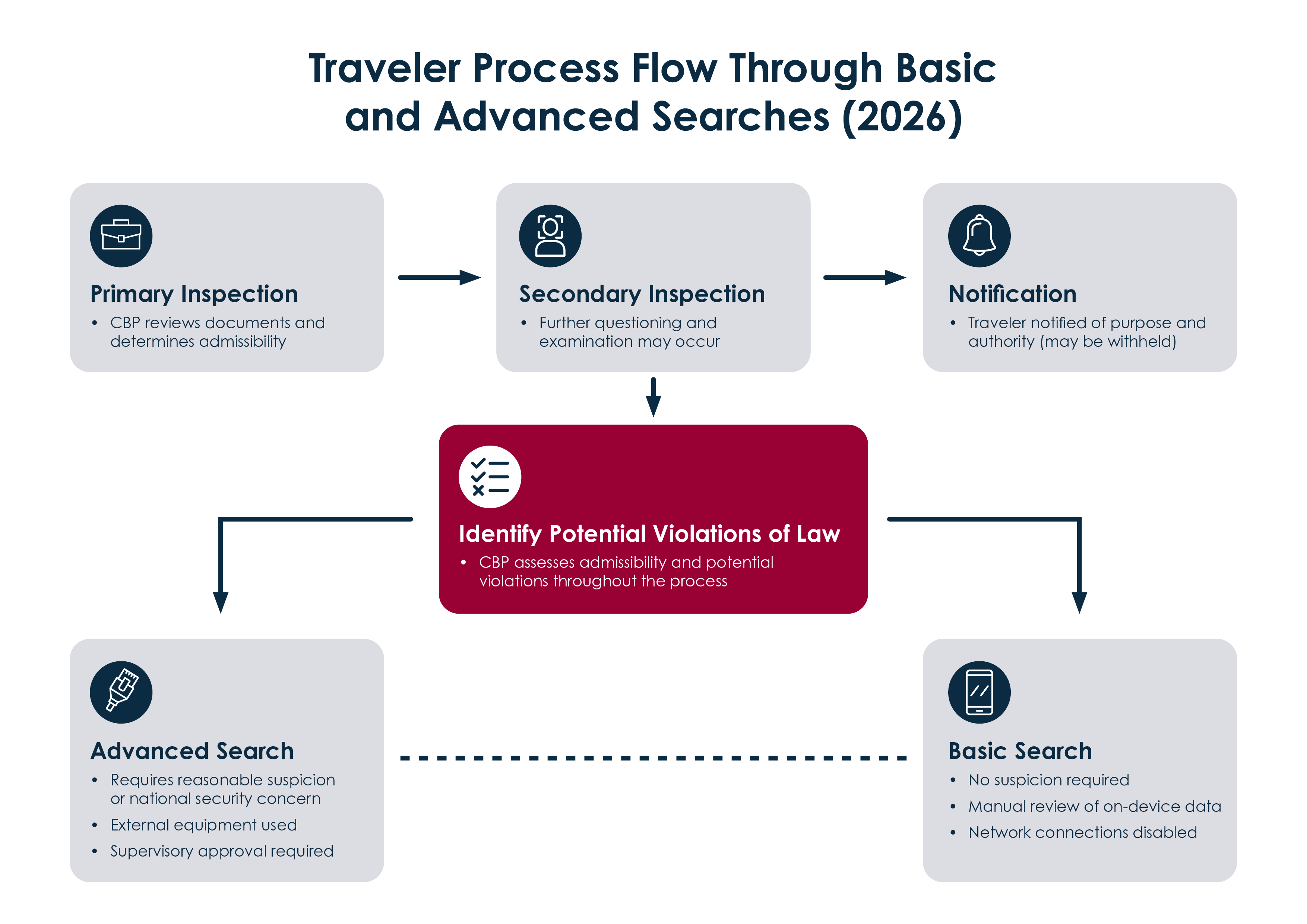
Upon arrival at a port of entry, travelers undergo primary inspection, during which CBP officers review documentation and determine admissibility. While most travelers are cleared at this stage, some are referred to secondary inspection for further questioning or a more detailed examination of their belongings. Referrals may be random or based on specific concerns, such as incomplete documentation or unusual travel activity, although CBP is not required to disclose the reasons for the referral. Although these criteria have not been updated by CBP in several years, the CBP website states that a traveler may be selected for an electronic device inspection for the following reasons:[7]
- Your travel documents are incomplete or you do not have the proper documents or visa.
- You have previously violated one of the US laws that CBP enforces.
- Your name matches a person of interest in a government database.
- You have been selected for a random search. No search will be made on the basis of race, gender, religion or ethnicity.
Of the more than 419 million travelers processed by CBP at ports of entry in Fiscal Year 2025, approximately 3% were referred for secondary inspection.[8]
During secondary inspection, CBP may search or seize electronic devices. Officers may access specific files, request passwords, review information stored on or linked to the device, or copy its contents. CBP follows a directive, most recently updated in January 2026, Border Search of Electronic Devices, which sets forth the procedures officers must follow when conducting such searches.[9]
The directive permits officers to access information stored directly on the device. By contrast, data stored in cloud services generally may not be accessed unless the officer obtains a warrant or the traveler provides consent.[10] To avoid retrieving or accessing remotely stored data not otherwise present on the device, CBP officers are instructed to disable network connectivity before beginning the search.[11]
Pursuant to this updated directive, individuals generally will be notified in advance of a border search of their electronic device. However, notification may be withheld where disclosure would impair national security, law enforcement interests, officer safety, or other operational concerns, and where such a determination has been approved by an appropriate supervisor.[12] Officers may provide notice by distributing an approved tear sheet, as appropriate. The tear sheet explains the purpose of border searches and CBP's authority to inspect electronic devices, and outlines what travelers may expect during the process, including possible requests for access to device contents, the potential copying and retention of data, and the circumstances under which a device may be seized.[13] The scope and intrusiveness of a CBP search of a digital device generally depend on the level of suspicion, particularly where national security concerns are implicated. Under CBP policy, officers may conduct a "basic search" without any individualized suspicion. A basic search typically involves examining a device and reviewing information stored directly on it at the border.
Although a traveler's refusal to consent will not prevent a basic search, officers may request that the traveler provide passcodes or other means of access. Travelers may decline to provide such information; however, doing so may lead to practical consequences, including extended detention, seizure of the device, and, in the case of visa holders or tourists, potential denial of entry based on admissibility determinations.
With reasonable suspicion that a device contains evidence of a violation of law enforced or administered by CBP, or in the absence of such suspicion where a national security concern is present, a CBP officer may conduct an "advanced" (or forensic) search. An advanced search involves connecting external equipment, whether wired or wireless, to copy and/or analyze the contents of an electronic device. However, the use of external equipment solely to render the contents of a device accessible for inspection does not, by itself, constitute an advanced search. All advanced searches require prior supervisory approval and where conducted based solely on a national security concern, additional higher-level approval may be required.[14]
Separately, CBP may seize an electronic device where, based on a review of the device or other facts and circumstances, there is probable cause to believe that it contains digital contraband or evidence of a violation of law that CBP is authorized to enforce or administer.[15]
The 2026 CBP Directive, compared to the 2018 Directive, refines the definition of an advanced search, clarifies that certain uses of external equipment do not constitute advanced searches, eliminates prior illustrative factors, and updates the standards governing probable cause for seizure.
The figure below illustrates the process flow for travelers undergoing basic and advanced electronic device searches. In Fiscal Year 2023, 2024, and 2025, the majority of CBP's electronic device searches were basic searches, with advanced searches accounting for approximately 9.6%, 9.2%, and 7.9% of the total, respectively.
Privileged and Confidential Information
Sensitive information, including material protected by the attorney-client privilege, remains vulnerable at the border. CBP acknowledges that electronic devices may contain privileged or otherwise sensitive information, including legal materials, medical records, journalistic content, and confidential business information. Under the CBP 2026 Directive, such materials are not exempt from border searches.
However, the Directive establishes specific procedures when an officer encounters information that is identified as, or asserted to be, protected by attorney-client privilege or work-product doctrine. In such cases, the officer must seek clarification from the traveler and consult with CBP Associate or Assistant Chief Counsel prior to reviewing the potentially privileged materials. CBP may also implement segregation procedures, including the use of a filter team or other appropriate safeguards, to isolate privileged content from the broader search.[16]
Despite these procedural protections, the threshold for triggering review of legal or other sensitive information remains relatively low. The Directive does not impose a heightened evidentiary standard before privileged materials may be examined for border search purposes, and the mechanics of counsel review and filter team processes are not fully transparent to the traveler.
With respect to other categories of sensitive information, such as commercial or proprietary data, CBP instructs officers to treat such materials as confidential and handle them in accordance with applicable federal law, including restrictions on unauthorized disclosure. Officers are directed to seek legal guidance where appropriate. Nonetheless, the Directive provides limited operational detail for frontline officers in assessing and safeguarding such information in real time.
As a practical matter, once information is accessed during a border search, it may be reviewed by the government even if it is ultimately determined to be privileged or otherwise sensitive. Although the Directive imposes limits on retention and use, including requirements to segregate or delete certain materials, it does not preclude initial access.
Travelers are therefore advised to proactively identify and assert claims of privilege or sensitivity during an inspection. Doing so triggers consultation and handling requirements under CBP policy, though it does not prevent the search itself.
Finally, under the Directive, CBP may retain copies of information where there is probable cause to believe the data contains digital contraband or evidence of a violation of law. Absent such probable cause, CBP generally limits retention of data, including requirements to delete non-retained information after a defined review period (typically up to 21 days). However, officers may retain notes, observations, and other records of the search in CBP systems.
What Should Chinese Companies and Their Employees Do
While CBP's electronic device searches represent only a small fraction of the total number of travelers processed,[17] the potentially significant consequences caused by disclosure merit taking protective measures. Chinese companies whose employees travel internationally should implement data protection strategies:
- Develop and Implement an International Travel Protocol: Formulate and implement a comprehensive international travel protocol that addresses data security, legal compliance, and emergency procedures. This protocol should be tailored to the needs and risks specific to the company and the countries involved in travel. Educate employees about the established protocol for international travel, emphasizing the importance of data security and compliance with legal requirements.
- Use Clean Devices for Travel: Require employees to travel with devices that do not contain sensitive information. Instead, they can access necessary data remotely once they reach their destination.
- Secure Sensitive Information: If an employee must travel with sensitive data, ensure that it is encrypted and password protected, to add an additional layer of security beyond the device's unlocking password.
- Backup Important Files: Ensure employees back up all files before travel. This step is crucial in case the device is detained or confiscated by customs officials.
- Guidance on Responding to CBP Demands: Instruct employees on how to appropriately respond to CBP demands for device access. It's important to note that refusal to comply can lead to detention and, for non-US citizens, potentially result in denial of entry into the United States.
- Establish Incident Reporting Protocols: Require prompt internal reporting of any device search, detention, or seizure. Legal or compliance teams should assess exposure and determine appropriate mitigation steps.
Executives and employees of Chinese companies should:
- Travel Lightly with Data and Devices: Travel with the minimal amount of data and as few devices as necessary.
- Be Aware of US Preclearance Locations: Device searches may occur at US preclearance facilities outside the United States (e.g., certain international airports), where the same considerations apply.
- Use Travel-Only Devices: Utilize devices specifically designated for travel, ensuring they do not contain sensitive information.
- Prepare Personal Devices: If traveling with personal devices, consider removing company apps, clearing browser history, and uninstalling social media apps.
- Encrypt Devices and Power Down: Encrypt devices and shut them down when crossing the border to enhance security.
- Use Secure Cloud Storage: Store sensitive data in a secure cloud-storage account and disable any apps connected to these accounts.
- Back Up and Delete Sensitive Photos: Back up sensitive photos from digital cameras and then delete them from the device.
- Enable Airplane Mode: Switch devices to airplane mode before crossing a border to comply with CBP's policy on cloud-stored data searches.
- Maintain a Cooperative Stance: Approach interactions with CBP agents cooperatively, while understanding your rights.
- Be Aware of Travel History Scrutiny: Travel to countries regarded by the United States as problematic may attract additional scrutiny from border agents.
- Be Prepared for Additional Screening: Frequent international travelers or those on extended trips may be subject to more thorough screenings.
- Handle Password Requests Carefully: If asked for passwords, enter them personally to minimize the risk of them being stored or misused.
- Declare Sensitive Information: Inform CBP agents of any sensitive information on the device, especially if it is protected by attorney-client privilege or other confidentiality doctrines.
- Request Legal Counsel: Ask to contact company or outside counsel if necessary, though be aware this request may be denied.
- Understand Compliance Implications: US citizens can refuse access to protect company information but should not physically withhold the device. Non-compliance might lead to prolonged detention and device confiscation.
- Consider Refusal Implications for Non-US Citizens: Non-US citizens should be aware that refusal to comply could lead to prolonged detention, device confiscation, and potential exclusion from the United States.
- Request CBP Supervisor and Documentation: If a device is detained, ask to speak with a CBP supervisor and obtain a Customs receipt (Form 6051D) for documentation.
- Understand and Clarify Consent: Be cautious about implicit consent. If a border agent's request to unlock your device, provide a password, or give social media identifiers is ambiguous, politely clarify whether it is a request or a command.
- Avoid Providing False Information: Always avoid providing false information to border agents and do not physically interfere with their official duties.
- Avoid Concealing Data on Devices: Refrain from using "hidden volume" features or other techniques that conceal data on your devices. These methods present different data depending on the password entered. Be aware that border agents may interpret the use of such data concealment techniques as making a false or fraudulent statement, obstructing their investigation, or hindering the proper administration of their duties. Each of these actions can be considered a serious federal criminal offense.
- Choose Your Port of Entry Strategically: Media reports and anecdotal accounts, including traveler experiences shared on social platforms, suggest that some ports of entry may be associated with more frequent questioning or electronic device searches by CBP officials. While CBP does not publish port-specific search data and practices may vary based on operational needs, travelers may wish to conduct advance research and consider routing options when feasible. If the company has external immigration counsel, it may be advisable to check with counsel regarding a better port of entry. Selecting a port of entry with lower reported scrutiny may help reduce the likelihood of electronic device searches.
- Know Who to Contact: Executives and employees should have immediate access to a company contact (legal/compliance/IT) in case of a border issue.
Conclusion
As border authorities increasingly scrutinize electronic devices as part of their security, customs, and immigration enforcement functions, understanding the scope of US border search authorities has become increasingly important for international travelers and the companies that employ them. The continued use of electronic device searches by CBP underscores the need for organizations, particularly those that routinely transfer personnel and data across borders, to take proactive steps to protect sensitive information.
Travelers should minimize the amount of sensitive data they carry, understand the procedures governing electronic device searches, and be aware of the potential consequences of refusing requests for access to devices or their contents. Companies, in turn, should implement comprehensive travel protocols, provide regular training, and ensure that employees are prepared to respond appropriately to border inspections involving electronic devices.
Ultimately, effective preparation requires balancing legitimate business needs with evolving border security requirements. By adopting practical data-minimization measures, maintaining robust cybersecurity controls, and educating employees on applicable legal and compliance considerations, companies can reduce the risks associated with cross-border travel while better protecting privileged, confidential, and proprietary information.
[1] See United States v. Flores-Montano, 541 US 149 (2004); United States v. Montoya de Hernandez, 473 US 531
(1985).
[2] See CBP Border Search of Electronic Devices at Ports of Entry, https://www.cbp.gov/travel/cbp-search-authority/border-search-electronic-devices
[3] Id.
[4] According to CBP data, US border agents carried out 1,147 searches of Chinese nationals' electronic devices in 2019, a rise of 66 per cent from the previous year. More Chinese nationals searched at US customs, government data shows, South China Morning Post, Aug. 5 , 2020, https://www.scmp.com/news/china/article/3096206/more-chinese-nationals-searched-us-customs-government-data-shows
[5] China urges travelers to avoid Seattle airport after 20 scholars were denied entry to the US, Apr. 17, 2026, https://apnews.com/article/china-scholars-denied-enry-seattle-airport-63162a0e4c74b50180a7e8121938afd5
[6] See CBP Memorandum for Distribution of Updated Directive on Border Search of Electronic Devices, US Customs and Border Protection, Jan. 12, 2026, https://www.cbp.gov/sites/default/files/2026-02/intc-48876_-_memo_for_distribution_redacted_1.pdf
[7] See Securing America's Borders: The CBP Screening Process, https://www.cbp.gov/sites/default/files/documents/securing-americas-borders_0.pdf
[8] See CBP Border Search of Electronics at Port of Entry FY25 Stats, https://www.cbp.gov/document/stats/border-search-electronic-media-fy25
[9] Border Search of Electronic Device, CBP Directive No. 3340-049B, US Customs and Border Protection, Jan. 1, 2026, https://www.cbp.gov/sites/default/files/2026-01/cbp_directive_3340-049b_jan_2026_508.pdf
[10] See Privacy Impact Assessment for the US Border Patrol Digital Forensics Programs, US Dept. of Homeland Security, DHS Reference No. DHS/CBP/PIA-053(a), July 30, 2020, https://www.dhs.gov/sites/default/files/publications/privacy-pia-cbp053a-digitalforensics-july2020.pdf
[11] CBP Directive No. 3340-049B at 5.1.2
[12] CBP Directive No. 3340-049B at 5.1.7
[13] See Border Search of Electronic Devices Tear Sheet, CBP Publication No. 3160-0423, US Customs and Border Protection, April 2023 revised, https://www.cbp.gov/sites/default/files/assets/documents/2023-Oct/Border%20Search%20of%20Electronic%20Devices%20Tearsheet.pdf
[14] CBP Directive No. 3340-049B at 5.1.4
[15] CBP Directive No. 3340-049B at 5.7.1
[16] CBP Directive No. 3340-049B at 5.2.1
[17] In Fiscal Year 2025, CBP processed over 419 million travelers, out of which approximately 55,318 underwent basic and advanced electronic device searches, amounting to about 0.01 percent of inbound travelers