Overview
The Federal Communications Commission (FCC) has released a draft order (to be voted on at the October 2026 meeting) that would make compliance with new Covered List restrictions a condition of holding an international Section 214 authorization. The proposed order would prohibit carriers receiving new Section 214 authorizations from using certain covered equipment or services and prohibit existing authorization holders from adding covered equipment or services. Authorization holders would also have to disclose their use of covered equipment and services. The accompanying Further Notice of Proposed Rulemaking (FNPRM) seeks comment on enacting even broader restrictions on equipment sourcing and commercial arrangements involving Covered List entities.
These developments reinforce the importance of obtaining a conditional approval to exempt products from the Covered List pending completion of a US onshoring plan and other requirements. As the FCC increasingly ties import, licensing, deployment, reporting, and commercial arrangements to the Covered List, companies who rely on Covered List products face ever-growing compliance burdens and hesitancy from customers concerned about their own regulatory obligations. Conditional approval can therefore offer a commercial advantage by reducing barriers to the US market and providing customers with greater regulatory certainty. Although the draft order’s use and addition restrictions are limited to producer/provider-based entries, the broader regulatory trend gives manufacturers additional reason to pursue conditional approval proactively. As carriers scrutinize their equipment, facility owners, and service providers (and face proposals extending restrictions to downstream commercial arrangements) suppliers able to secure a conditional approval will be better positioned to retain customers and compete for new business.
Section 214 Covered List Restrictions
The Covered List identifies communications equipment determined to pose an unacceptable risk to US national security. The order would use the Covered List to establish restrictions on equipment and services used to provide telecommunications services pursuant to international Section 214 authority. The requirements would apply to both facilities-based carriers and resellers.
Specifically, the new rules would apply to covered equipment identified through "producer/provider-based determinations," meaning the Covered List entries tied to specific named entities, rather than where equipment is produced (such as the restrictions on routers, UAS, or advanced robots).
Different requirements for new and existing authorizations
The draft order would establish the following framework:
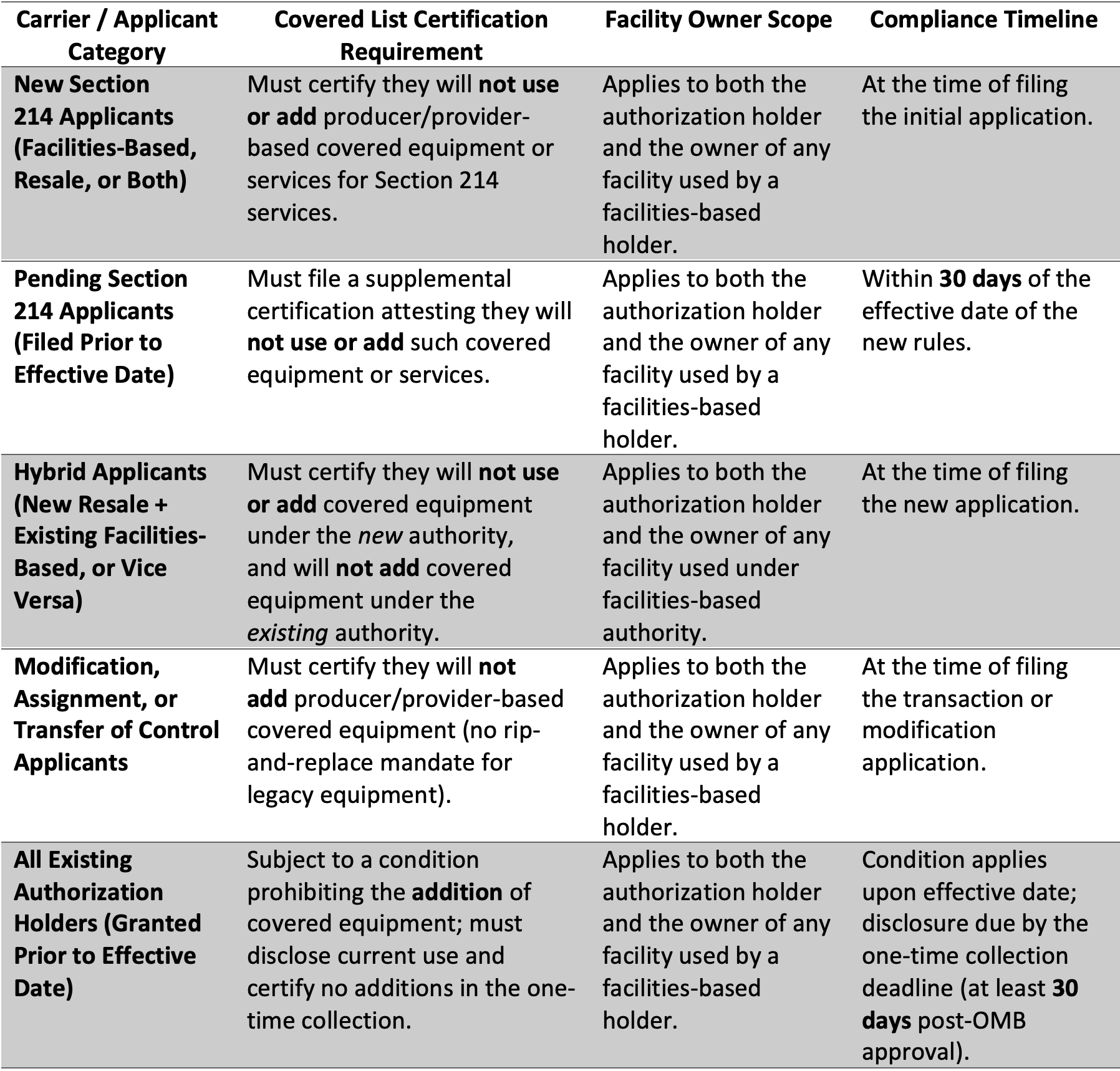
- New authorizations: Applicants for facilities-based or resale-based international Section 214 authority would have to certify that they will not use or add covered equipment or services subject to the producer/provider-based restrictions. New facilities-based authorization holders would also have to ensure that the owner of any facility they use does not use or add such equipment to provide the carrier’s authorized services. Applicants whose applications remain pending when the new rules take effect would have 30 days to submit the required certification.
- Existing authorizations: Existing authorization holders would be prohibited from adding such covered equipment or services. Existing facilities-based authorization holders would also have to ensure that the owner of any facility they use does not add such equipment to provide the carrier’s authorized services. However, the order would not require existing authorization holders to certify in applications for modification, assignment, or transfer of control that they will replace or no longer use existing covered equipment.
- Additional authority: A carrier seeking a new authorization while retaining an existing authorization would face different obligations. For example, a facilities-based carrier seeking new resale authority would have to certify against using or adding covered equipment under the new resale authority, while certifying that neither it nor the owner of a facility it uses will add such equipment under the existing facilities-based authority. Conversely, a resale carrier seeking new facilities-based authority would have to certify that neither it nor the facility owner will use or add such equipment under the new authority, while certifying against adding them under its existing resale authority.
In short, the draft order would restrict further deployment of covered equipment without creating an obligation to remove existing equipment. That treatment would not establish an exemption from other applicable restrictions.
Disclosure and ongoing reporting
The order would require existing authorization holders to disclose whether they use covered equipment and identify any such equipment. They would also have to certify that no additional covered equipment or services will be added. These disclosures would be part of a one-time information collection. Authorization holders would need to report material changes to their Covered List certification or disclosure within 30 days.
The order would also require two additional disclosures about Covered List entities. First, applicants would have to disclose whether they use or plan to use a Covered List entity as a third-party service provider with access to telecommunications networks, systems, or records to provide managed services supporting domestic or international telecommunications operations. This requirement would apply to applications for new authority, modifications, assignments, and transfers of control; existing authorization holders would provide corresponding disclosures through the one-time information collection. Second, applicants would have to disclose whether principal equipment or devices currently used or planned to be used to forward traffic at facilities crossing the US-Canada or US-Mexico border are produced or provided by a Covered List entity. This inquiry focuses on the identity of the producer or provider, rather than solely on whether the particular equipment itself is listed. The third-party disclosure requirement would not prohibit such relationships; the FCC would generally refer applications disclosing them to the Executive Branch agencies for review. A separate prohibition is proposed in the FNPRM.
The following table summarizes the new Covered List use, addition, and certification requirements, if adopted:
 The FCC is considering broader requirements. The accompanying Further Notice of Proposed Rulemaking would go beyond the draft order’s restrictions. It proposes to require new applicants to certify that they will not use any equipment or services produced or provided by a Covered List entity—or by an entity owned by, controlled by, or subject to the jurisdiction or direction of a foreign adversary—to provide services under international Section 214 authority. "Produced" would encompass manufacturing, assembly, design, and development. Existing authorization holders would face a prohibition on adding such equipment or services, together with disclosure and certification requirements.
Other proposals would:
- Establish a rebuttable presumption against granting international Section 214 authority to applicants identified on the Covered List.
- Restrict new or extended capacity, fiber, spectrum, and similar arrangements that give Covered List entities specified ownership, management, or operational control over telecommunications infrastructure, with contractual restrictions extending to downstream customers. Related reporting would identify arrangements and counterparties.
- Restrict the use of Covered List entities as third-party service providers, including prohibiting existing authorization holders from entering into new arrangements or extending existing arrangements with those providers.
Comments on these proposals will be due in Docket IB 23-119 thirty days after the Further Notice is published in the Federal Register.
For questions about this item, contact one of Steptoe’s Telecom attorneys specializing in Covered List matters.