Overview
A recent dispute involving a Mickey Mantle trading card highlights the increasing legal risks surrounding the use of name, image, and likeness rights. On September 24, the owner and licensor of the intellectual property rights for the late baseball star Mickey Mantle filed a trademark infringement lawsuit against the collectibles company Cardsmiths, alleging that the card company made and sold unauthorized trading cards featuring Mantle. The owner of the licensing rights claims that a card based on Mantle's famous 1952 Topps "Rookie" trading card was produced and sold without authorization.[1] This case is the latest litigation involving trading cards allegedly using athletes' names, images, and likenesses without authorization, raising licensing, trademark, rights-of-publicity, and unfair competition claims.[2]
The Lawsuit
Mantle I.P. Holdings, Ltd. (Mantle I.P.) and Major League Alumni Marketing Inc. (MLAM)[3], the companies that control the licensing rights to Mickey Mantle's name, image, and likeness (collectively, the Plaintiffs), brought an action in the Southern District of New York against Cardsmiths, LLC, its parent company, Toynk Toys, LLC, and Steven Loney, the co-founder and CEO of both companies (collectively, the Defendants) for various trademark‑infringement claims.[4]
The Plaintiffs seek (1) $750 million in damages for the allegedly infringing and unfair activities, plus attorneys' fees and costs; (2) all profits the Defendants obtained from their sales of the allegedly infringing product; and (3) an injunction prohibiting further production, distribution, marketing, and sale of the card.[5] Alternatively, the Plaintiffs seek statutory damages of at least $2 million per counterfeit mark.[6] The Plaintiffs also seek an order requiring the Defendants to turn over for destruction all products in their possession that allegedly infringe on the Mantle trademark.[7]
The Allegations in the Complaint
According to the Complaint, Mantle I.P. is the owner of registered trademarks for the "Mickey Mantle" and "The Mick" marks, and MLAM is the exclusive licensing agent for Mantle.[8] Mantle I.P. inherited the rights from Mantle's estate, and now owns the rights to these registered trademarks and possesses right-of-publicity rights in the image and likeness of Mantle.[9] The Complaint alleges that Mantle's Topps 1952 "Rookie" card (the 1952 Card)—two versions of which are depicted below[10]—is among the most, if not the most, "iconic baseball card" in history and sold for $12.6 million in 2022. According to Sportico, this remains the highest sale price for a baseball card of all time.[11]
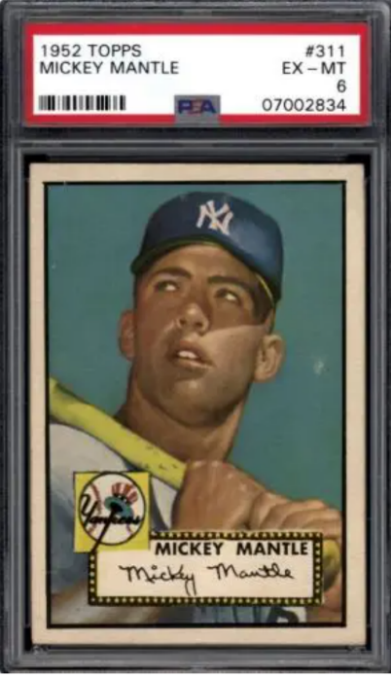
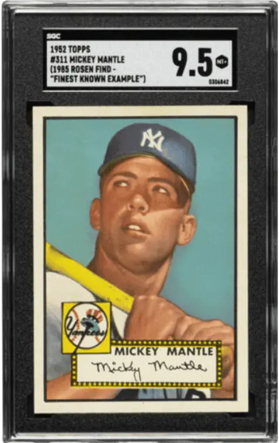
This action arises from a dispute that began in or around May 2026 when Plaintiffs became aware of card No. 118 in the 2025 Cardsmiths Currency Series 5 set (the 2025 Card), which incorporated a similar portrait, design elements, Yankees logo, and signature as the 1952 Card.[12] In early June 2026, counsel for the Plaintiffs sent a cease-and-desist letter to Cardsmiths, demanding that Cardsmiths and Toynk recall Series 5 to remove the 2025 Card, redesign the packaging and promotional material, and destroy remaining copies and digital files.[13] The letter stated that the 2025 card—a photo of which is included below[14]—reproduced the front and back of the 1952 Card identically to how Topps created and published it, including Topps' colorized portrait, trade dress, Mantle's name, image, and likeness, and the New York Yankees logo.[15]
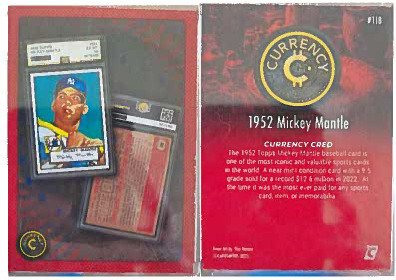
According to the Complaint, counsel for Defendants responded a few days later, indicating that they would continue to sell the product.[16]
The Complaint alleges that Defendants "willfully and without authorization reproduced the Topps 1952 'Rookie' card."[17] The Complaint then claimed that the Defendants sold the 2025 Card through eBay, Amazon, Best Buy, Target, and Walmart.[18] According to the Complaint, the 2025 Card sold for between $29.99 and $2,500.00.[19] Plaintiffs contend that they did not license or authorize the Defendants to use the Mantle trademarks nor are the Defendants "authorized retailers" of any of the Mantle trademarks.[20]
The Complaint cites various social media discussions regarding the rarity and value of the 2025 Card, arguing that these comments reflect "consumer confusion" about the authenticity of the product.[21] For instance, Reddit users questioned whether the 2025 Card was an original or a reprint, "[w]ondering how you got an authentic auto from the Mic." And "Is this rare? Wondering if this any value higher than a regular."[22]
Plaintiffs allege that Defendants' actions "constitute a flagrant violation of Mantle's rights of publicity, as Defendants have misappropriated, for their own commercial purposes, the valuable name and likeness of Mickey Mantle."[23] By "deceptively" using the name "Mickey Mantle" which is part of Mantle's registered trademarks, Plaintiffs further allege that the 2025 card intentionally gives the "public the false impression" that Plaintiffs licensed, approved, or endorsed the 2025 Card, and thus, Defendants have violated federal and common law trademark and unfair competition laws.[24] In particular, Plaintiffs believe the 2025 Card to be a "commercial product[] of inferior quality," which has "diluted and continues to dilute the goodwill associated with Mickey Mantle and Mantle's valuable Trademarks."[25]
According to Sports Collectors Daily, while the Mantle image no longer appears on the front of the Series 5 box, Cardsmiths continued to list the product on its website even after the Plaintiffs commenced the litigation, and other hobby retailers continue to sell the product.[26] Based on reports from Sportico, counsel for Cardsmiths will file a responsive pleading and seek dismissal of the action.[27]
Potential Defenses
Cardsmiths' defenses could be based on the First Amendment—for example, that the 2025 Card likely offered commentary regarding the historical or cultural significance of the 1952 card. The Defendants might also argue that their product is protected by the fair‑use doctrine, potentially contending that the 2025 Card is meaningfully different from the Topps card, since the back of the 2025 card includes a reference to "currency cred," a type of card series, and an informational statement about the original card and its value.[28] Finally, the Defendants likely will challenge the alleged consumer confusion, arguing that the social media comments cited in the Complaint do not suggest that these users thought the 2025 Card was—or was not—licensed by the Plaintiffs.[29]
Other Trading Card Licensing Litigations
Lawsuits involving unauthorized trading cards are not new but have increasingly higher stakes in recent years as the value of sports memorabilia and athletes' NIL rights has skyrocketed.
In a noteworthy 1996 case involving trading cards created by the company Cardtoons that used cartoon representations of MLB players without their consent, the Tenth Circuit ruled that the cards "through parody" "reflected social commentary protected by the First Amendment that outweighed the players' publicity rights claims."[30] The Tenth Circuit ruled in favor of Cardtoons, deeming its depiction of the players' appearances as "sufficiently inventive."[31]
In another similar lawsuit filed in May 2026 in the Eastern District of Virginia, the NFL Players Association brought an action against Leaf Trading Cards, LLC, for false endorsement under the Lanham Act and misappropriation of rights of publicity, alleging it used various players in trading cards without a license from the NFL Players Association in violation of the NFL players' publicity rights under a group licensing deal.[32] In response, Leaf Trading Cards, LLC argued that it had valid and enforceable licenses from the players, and its defenses centered on the lack of likelihood of confusion or misappropriation.[33] In September 2026, the parties reached a settlement, the terms of which were undisclosed,[34] and subsequently filed a stipulation to voluntarily dismiss the case with prejudice.[35]
Key Takeaways
The Mantle litigation and these other recent disputes involving unlicensed sports trading cards reflect the evolving and complex landscape with respect to NIL-related licensing issues.
The Mantle case underscores the increasingly nuanced legal risks facing companies that use athletes' names, images, and likenesses associated with collectible products without an authorized license. In particular, this action highlights the potential tension between expanding commercial opportunities for sports-related collectibles and the rights of athletes, estates, intellectual property owners or licensors, and licensing organizations to control the commercial use of names and likenesses.
Companies developing or marketing collectibles, memorabilia, apparel, digital assets, or other products featuring athletes should evaluate permissible uses of athletes' names and likenesses and conduct that may give rise to trademark, right-of-publicity, or other liability. Entities should assess licensing requirements and potential trademark, publicity-rights, and unfair-competition exposure early in the product-development and marketing process, including whether design or marketing choices could create trademark infringement implications. Conversely, holders of intellectual property rights should proactively monitor potential instances of unauthorized name, image, and likeness uses that may trigger trademark and other intellectual property rights claims.
Steptoe's Sports Integrity Team actively monitors licensing and intellectual property disputes, including evolving judicial approaches to these issues both broadly and in the context of NIL. The Steptoe team is well-positioned to assist memorabilia or marketing entities, intellectual property owners, and licensors with navigating these issues. We also offer strategic advice regarding trademark compliance and infringement, rights-of-publicity, and unfair competition, and represent clients in related litigation.
[1] Rich Mueller, Mickey Mantle Rights Holders Sue Cardsmiths Over 1952 Topps-Inspired Card, Sports Collectors Daily (September 27, 2026), https://www.sportscollectorsdaily.com/mickey-mantle-rights-holders-sue-cardsmiths-over-1952-topps-inspired-card/.
[2] Michael McCann, Mickey Mantle Baseball Cards Spark NIL, Trademarks Lawsuit, Sportico (September 29, 2026), https://www.sportico.com/law/analysis/2026/mickey-mantle-baseball-cards-lawsuit-1234945901/.
[3] MLAM is the commercial, for-profit arm of the MLB Players Alumni Association that connects various brands, agencies, and organizations with former Major League Baseball legends for marketing, endorsement, and event opportunities. MLAM offers, among other things, assistance with securing former players' name, image, and likeness rights, as well as negotiating licensing deals with former players or deceased players' estates. See Major League Alumni Marketing, MLB, (last accessed October 2, 2026), https://www.mlb.com/mlbpaa/about/major-league-alumni-marketing?msockid=3d85e62f85096ee23668f060848f6f78; see also Major League Alumni Marketing (MLAM), LinkedIn, (last accessed October 2, 2026), https://www.linkedin.com/company/mlam-mlbpaa/.
[4] Specifically, Plaintiffs brought causes of action for trademark infringement, false designation of origin, trademark dilution by blurring, trademark dilution by tarnishment, violation of the Texas Right of Publicity Statute (Tex. Prop. Code section 26), deceptive acts and practices under New York General Business Law sections 349 and 350, unjust enrichment, and unfair competition. Mantle I.P. Holdings Ltd, et al. v. Cardsmiths, LLC, et al., Case No. 26-cv-08344-VSB-RWL, S.D.N.Y., Dkt. No. 1 (Complaint), (September 24, 2026).
[5] Complaint ¶¶ 110-15, 121.
[6] Id. ¶ 116.
[7] Id. ¶ 118.
[8] Complaint ¶¶ 2, 17; see also Mueller, supra note 1.
[9] Complaint ¶¶ 36-39; Mueller, supra note 1; McCann, supra note 2.
[10] Chris Rogers, How to Spot a Fake 1952 Topps Mickey Mantle Card, All Vintage Cards (April 25, 2026), https://allvintagecards.com/how-to-spot-fake-1952-topps-mantle/; Vinnie Rullo, Mickey Mantle Topps Cards by Year: Complete 1952-1969 Guide, All Vintage Cards (September 7, 2026), https://allvintagecards.com/a-collectors-guide-mickey-mantles-topps-cards-1952-1969/.
[11] Complaint ¶ 14; McCann, supra note 2.
[12] Complaint ¶ 25; Mueller, supra note 1.
[13] Complaint, Ex. D (Dkt. No. 1-4); Mueller, supra note 1.
[14] Complaint ¶ 27, Fig. 3.
[15] Complaint, Ex. D (Dkt. No. 1-4); Mueller, supra note 1.
[16] Complaint ¶ 34.
[17] Complaint ¶ 27.
[18] Id. ¶ 29.
[19] Id. ¶ 32.
[20] Id. ¶ 28.
[21] Id. ¶ 30; Complaint, Ex. C (Dkt. No. 1-3).
[22] Id.
[23] Complaint ¶ 40.
[24] Id. ¶ 41.
[25] Id.
[26] Mueller, supra note 1.
[27] McCann, supra note 2.
[28] Id.
[29] Id.
[30] McCann, supra note 2.
[31] Id.
[32] Id.; National Football League Players Association, et al. v. Leaf Trading Cards, LLC, Case No. 3:26-cv-00374-REP, E.D. Va., Dkt. No. 1 (Complaint), (May 1, 2026); Rich Mueller, Leaf, NFLPA Licensing Lawsuit Settles, Sports Collectors Daily (September 16, 2026), https://www.sportscollectorsdaily.com/nflpa-leaf-trading-cards-lawsuit-settles/.
[33] National Football League Players Association, Case No. 3:26-cv-00374, Dkt. No. 20 (Answer), (July 6, 2026).
[34] National Football League Players Association, Case No. 3:26-cv-00374, Dkt. No. 31, (September 15, 2026); Mueller, supra note 37.
[35] National Football League Players Association, Case No. 3:26-cv-00374, Dkt. No. 32, (September 23, 2026).