Overview
First Tuesday Update is our monthly take on current issues in commercial disputes, international arbitration, and judgment enforcement. In this update, we look at appellate developments in the ongoing efforts to obtain compensation for the 2012 renationalization of Argentina's state-owned oil company. We also provide a brief update on Supreme Court oral argument in two arbitration-related cases.
Petersen Energia Invesora
In a previous update, we discussed efforts to collect on the $16 billion judgment entered in September 2023 by Judge Preska of the Southern District of New York in Petersen Energia Invesora S.A.U. et al. v. Argentine Republic et al., but those efforts are now likely moot following a Second Circuit decision entered on March 27, reversing the trial court's 2023 entry of judgment against Argentina. Although this case may be limited to the particular facts, it demonstrates the difficulty of pursuing sovereigns and the deference often given to sovereigns, especially by appellate courts. See also our relevant alerts on the Petersen case here, here, here, here, and here.
The underlying judgment arises out of Argentina's partial nationalization of YPF, a formerly state-owned oil company that had been privatized in 1999. As part of the privatization process, Argentina and YPF assured prospective investors that they would not be stranded as minority shareholders in a government-run enterprise by enacting YPF bylaws requiring a tender offer to minority shareholders to be made if Argentina ever reacquired a controlling interest in the company. Argentina did just that in 2012, but no tender offer was ever made, which led the Petersen Plaintiffs, backed by Burford Capital, to sue Argentina in New York federal court in 2015.
After more than a decade of spirited litigation, the Second Circuit issued a split decision reversing the district court's judgment in its entirety. The case had been up to the Second Circuit once before in 2018 on sovereign immunity issues and the Court of Appeals allowed the case to proceed. While the Second Circuit's 2018 analysis was limited to the federal Foreign Sovereign Immunities Act and did not address the merits of Plaintiffs' claims under Argentine law, the court's opinion suggested that Plaintiffs' merits arguments were correct, and the Second Circuit declined to stay enforcement of the judgment. Below we've set out some language exemplifying the tension between the two decisions.
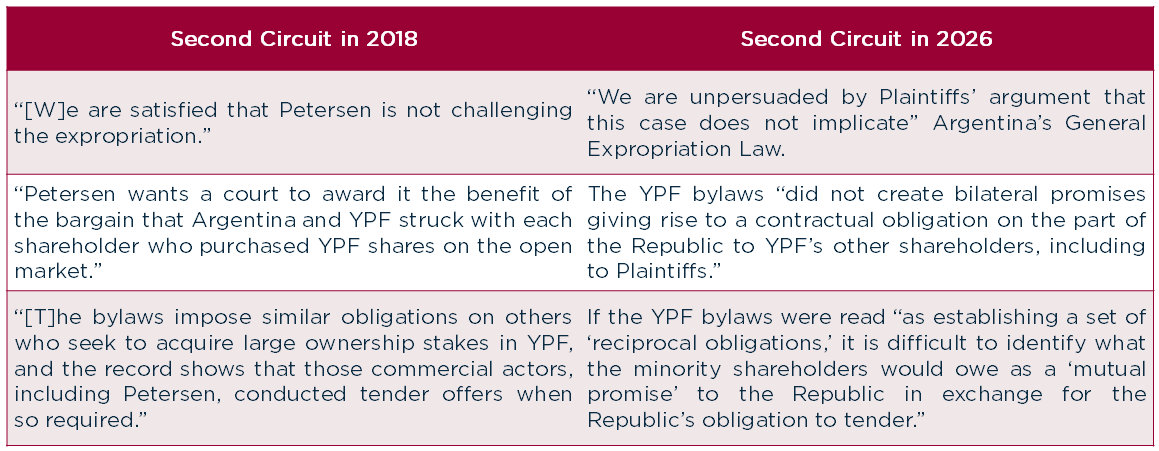
That tension is particularly notable given that both decisions were authored by Judge Denny Chin, who took a relatively quiet role during oral argument in 2025. Since the text of the relevant documents did not change between 2018 and 2026, the principal intervening development was the entry of a $16.1 billion judgment in 2023, a point Judge Chin highlights in the opening sentence of the opinion by noting that the award "equals approximately 45% of the Republic's entire national fiscal" budget.
Turning to the substance of the Second Circuit's decision, the majority articulated two alternative bases for its decision to reverse the district court's judgment. First, the court concluded that, as a matter of Argentina law, the YPF bylaws were not an enforceable contract. The majority's contract-law analysis and discussion appears to rest on two grounds that: the bylaws' text does not create the "reciprocal obligations" required for an enforceable contract, and, as a broader matter, Argentina law does not treat corporate bylaws as enforceable contracts. Second, the majority held that even if the YPF bylaws would otherwise be enforceable as a contract, their application in this case—i.e., rending Argentina liable for billions of dollars—would displace ordinary Argentine contract-law principles in favor of Argentina's General Expropriation Law.
In addition to rejecting Plaintiffs' contract claim, the panel majority also held that Plaintiffs' promissory estoppel claim was not viable. Plaintiffs advanced this claim only in the alternative, given that promissory estoppel is generally unavailable where an enforceable contract exists. The majority concluded that although the YPF bylaws were not sufficiently contractual to support a breach-of-contract claim, they were sufficiently contractual to foreclose promissory estoppel—without citing any authority for that distinction. The opinion similarly acknowledges that Argentina committed a "knowing and flagrant violation of the promises it made to foreign investors" while concluding shortly thereafter that Plaintiffs had failed to identify a promise adequate to support promissory estoppel.
Even though there are certain aspects of the panel majority's reasoning that are open to question, the decision will likely have the final word in the case. Further appellate review—from either the Second Circuit en banc or the Supreme Court—will be difficult to obtain, as such review typically is not granted merely to correct an arguably erroneous decision. Instead, litigants generally must identify an important, recurring legal issue or an issue about which courts have reached conflicting results, but disputes regarding the content of Argentine law are unlikely to recur in U.S. courts.
And while Judge Cabranes' choice to write a dissent might, in isolation, be viewed as a potential sign favorable to Plaintiffs, his opinion does not call for the case to receive certiorari or en banc review and says only that the panel should have deferred to Judge Preska's analysis given her familiarity with the case. Finally, although there is evident tension between the panel majority's opinion and the earlier FSIA decision, it would be an atypical basis to obtain en banc consideration when both opinions were authored by the same judge.
That said, en banc review and certiorari are not entirely impossible. One potential hook is the fact that panel majority stated multiple times that the relevant principles of Argentine law "mirror those of U.S. common law." And there is substantial U.S. case law holding that corporate bylaws can be binding contracts, which Plaintiffs may argue both undermines the panel's reasoning and implicates an issue that will come before U.S. courts in future cases. Plaintiffs might also argue that the panel's application of Argentina's General Expropriation Law to permit Argentina effectively to avoid its obligations undermines one of the purposes of the Foreign Sovereign Immunities Act, holding foreign sovereigns accountable for their non-sovereign, commercial acts.
In any event, the reversal of the district court's judgment likely renders moot most, if not all, of the post-judgment enforcement issues that were also on appeal and had been scheduled for consolidated oral argument—possibly before a different Second Circuit panel—on April 16. At most, Plaintiffs might be able to recover attorney's fees incurred in litigating enforcement issues and persuade the court to stay the consolidated enforcement-related appeals, rather than dismissing them outright, pending resolution of petitions for rehearing en banc and certiorari.
Supreme Court Arbitration Cases
In other news, the Supreme Court in recent weeks heard two cases raising issues concerning arbitration. One arbitration-related case considered by the Supreme Court was Jules v. Andre Balazs Properties, which involves recognition of arbitral awards under the FAA. In a 2022 opinion authored by Justice Kagan, Badgerow v. Walters, 596 U.S. 1 (2022), the Supreme Court held that federal courts must have an "independent jurisdictional basis" to confirm or vacate an arbitral award under Chapter One, Sections 9 and 10 of the FAA (domestic arbitrations). Under Badgerow, federal question jurisdiction over the underlying dispute subject to arbitration does not suffice; rather, the court must assess jurisdiction based solely on the face of the confirmation or vacatur application, treating award enforcement as a separate proceeding (by contrast, federal question jurisdiction exists to confirm international arbitrations under Chapter Two's enabling legislation of the New York Convention).
The issue in Jules is whether an "independent jurisdictional basis" nevertheless exists when a federal court has compelled arbitration in a case in which it had subject-matter jurisdiction and has stayed—rather than dismissed—the action pending arbitration. In that posture, the Court is confronted with whether a stayed federal action provides continuing jurisdiction to confirm the resulting award, or whether enforcement must still independently satisfy Badgerow based on the four corners of the petition to confirm or vacate the award.
At oral argument, an ideologically diverse set of Justices appeared somewhat sympathetic to arguments that a pending federal action is sufficient to establish federal jurisdiction, but Justice Kagan strongly and vocally disagreed. It is not entirely clear how that conflict will be resolved, but the fact that Jules is essentially a successor to an earlier opinion authored by Justice Kagan, her views are likely to receive considerable weight. See our previous articles on this matter here and here.
The other arbitration-related case considered by the Supreme Court was Flowers Foods, Inc. v. Brockne, where the Court is addressing whether Section 1 of the Federal Arbitration Act—which indicates that the FAA does not apply to employment contracts of transportation workers "engaged in foreign or interstate commerce"—applies to workers who operate locally but who deliver goods that have previously crossed state lines to their final destination. At oral argument, Justices Alito and Kagan both appeared inclined to rule that so-called "last mile" delivery drivers are "engaged in" interstate transport, of goods, suggesting that there is some support on the Court to hold that Section 1 of the FAA applies to them.
We will keep you posted each first Tuesday of the month.