Overview
An active election year is the perfect time for in-house counsel to conduct a "health check" on their company's corporate political law compliance program to ensure it's rightsized for the evolving political law landscape.
Failure to comply with the broad suite of political laws – covering electoral engagement, lobbying compliance, pay-to-play laws and government ethics rules – can result in fines, effective debarment or suspension from seeking government contracts, and reputational risk.
Electoral Engagement
This year presents a busy election year not only with midterm elections at the federal level, but many state and local elections. So far, 65 statewide ballot measures in 32 states have been certified for election in 2026. There are 36 gubernatorial seats up for grabs, and 88 of 99 state legislative chambers across 46 states are holding regular legislative elections.
Cities and counties will also have elections around the country – at least 22 mayorships in the country's top 100 populous cities will be up for election, including Los Angeles, Newark, and the District of Columbia.
Companies may get involved directly in many states that allow direct corporate contributions, through a corporate political action committee (PAC), or trade association engagement, as well as other vehicles.

As part of your political law compliance program health check, in-house counsel should ask: Does your company have a federal or any state PACs? Is this the time to create or enhance your existing PAC's activity with more fundraising? When was the last time the PAC manual and policies were refreshed? Do you know who your active executives are, and are they familiar with company policies on individual giving and hosting fundraisers?
In addition, the elections occurring this year are likely to prompt more executive engagement in elections, which can have implications for the company.
If your company has or seeks contracts with federal, state, or municipal governments, pay-to-play laws may result in personal political activity being attributed to the company and serious business losses for any inadvertent violations. Penalties for noncompliance can be severe, including monetary fines, voided or cancelled government contracts, and even temporary or long-term bans on bidding for or receiving future government business. Similar restrictions may apply to companies engaged in lobbying.
Lastly, given the number of state and local elections, corporations should consider their policies with respect to employees seeking public office, and balance campaign finance, pay-to-play, and reputational risks against state employment laws.
In-house counsel should ask: If the company has government contracts, have you identified the employees and consultants that are covered by any applicable pay-to-play laws? Are they aware of the restrictions on their personal political activities? Do you have the resources to conduct pre-clearance of political contributions and political fundraising activity? And are your internal and external lobbyists aware of their obligations under pay-to-play laws? Does your conflicts of interest policy clearly indicate that employees seeking public office should flag their activities to compliance?
Lobbying, Including Seeking Government Contracts
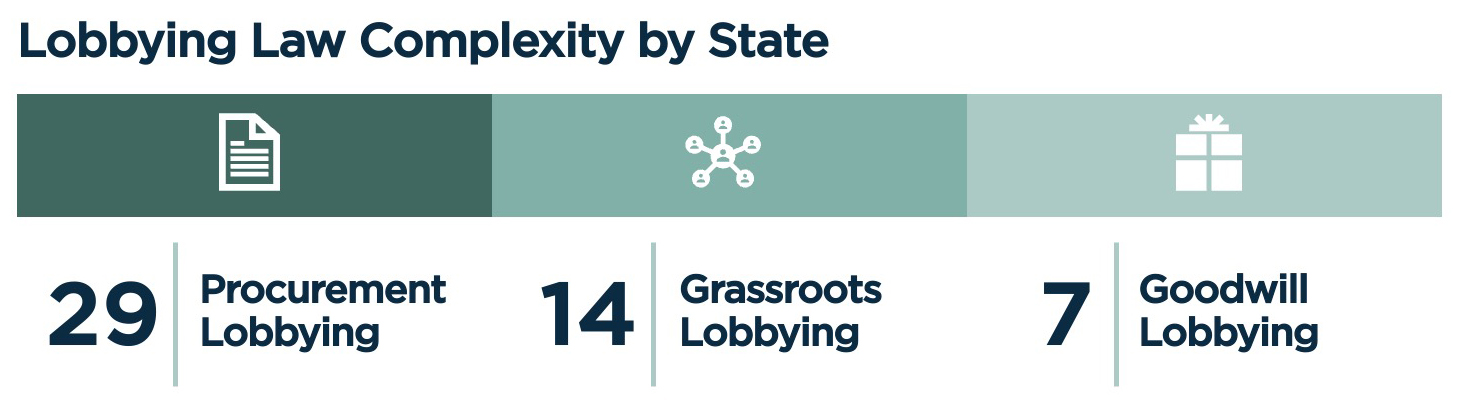
Many states and municipalities have complex lobbying registration and reporting requirements, and these laws may be triggered not just by direct engagement with legislators, but also by seeking government contracts (known as procurement lobbying), outreach to the general public or a segment of the population, such as employees or customers (known as grassroots lobbying), and providing gifts or benefits to public officials (known as goodwill lobbying).
Key changes in 2026 include Idaho's expansion of its lobbying law to include grassroots or "indirect" lobbying and associated reporting requirements and Montana's lower lobbying registration threshold.
There are now 29 states with procurement lobbying laws, 14 with grassroots lobbying reporting requirements, and 7 states require registration as a lobbyist for giving gifts to covered public officials (i.e., building "goodwill").
In-house counsel should ask: Do you know who in your company is engaging with public officials on a regular basis? Is the C-Suite and senior management aware of their obligations when engaging with public officials? Is there appropriate Board oversight over political activities and related risk?
Special Considerations for Foreign-Headquartered Companies and Companies With Foreign Exposure
States have also been actively passing "baby-Foreign Agents Registration Act (FARA)" laws and foreign national contribution bans. Six states have enacted legislation similar to FARA, requiring individuals lobbying on behalf of foreign governments or principals to register with the state.
These laws, in short, typically require a domestic entity to register and report if they are acting on behalf of a foreign government, political party, business, or individual while engaging in lobbying and similar "influence" activities.
For example, Louisiana's "baby-FARA" law requires those who engage in lobbying on behalf of a "foreign adversary" to register with the state, which includes China, Cuba, Iran, North Korea, Russia, and Venezuela's Maduro government. Entities headquartered or with their principal place of business in those countries are also required to do so. There is no minimum activity or spending threshold for registration, and there are no exemptions available, meaning any lobbying on behalf of such entities triggers the requirement.
Additionally, over half the states have codified a foreign national contribution ban with varying restrictions, from banning foreign funds from supporting ballot measure campaigns to restricting foreign nationals from being involved in any decision-making regarding another's election-related activities.
Foreign national contribution bans create extra hurdles for politically active US subsidiaries of foreign corporations, and even for companies that simply receive foreign sources of revenue.
In-house counsel should ask: Have you conducted an assessment of whether any of these new laws apply to your company's activities? Do you have sufficient insight into the lobbying and influence activities undertaken at the state level by your public affairs personnel and executives?
Special Considerations for Financial Institutions
Asset managers and any financial institution seeking investment from government investors, such as public pension funds, are subject to a myriad of complex laws when soliciting such investment or to otherwise provide services to government institutions.
Global Political Laws
Lobbying and campaign finance laws are not only a compliance issue in the US; at least 29 countries now have lobbying laws aimed at transparency and minimizing influence on government processes. Many other countries have a version of campaign finance laws ranging from contribution restrictions to oversight and reporting requirements.
In-house counsel should ask: If your company is active in other countries, do any of its activities trigger these laws?
What Can You Do Now To Protect Against Political Law Risk?
Now is the time to address your political law compliance program to ensure its readiness for this election season.
- Conduct a Political Law Program Health Check: Take time to review applicable policies, PAC procedures, and refresh political law trainings to capture changes in the law.
- Enhance Pre-Clearance Controls: Revisit pre-clearance procedures for political contributions, gifts, travel, and entertainment to ensure internal controls are aligned with updated rules.
- Review the Government Sales teams' activities: Refresh training and programming to ensure all sales teams are identified and mapped to jurisdictions with procurement or goodwill lobbying.
- Check-in with Senior Management: Understand what the C-Suite is planning for officeholder engagement in 2026 and how your teams can affirmatively support those efforts.
- Plan for Election-Year Activity: Anticipate the increased pace of political engagement, including campaign contributions, fundraisers, and political advocacy, to ensure your organization can respond quickly to political compliance challenges.
Steptoe's Campaign Finance and Political Law practice is ready to assist you and your entity during this election season to ensure your political compliance program is ready for 2026 with cost-efficient options in line with market best practices.