Overview
On October 28, two US shrimpers asked the US International Trade Commission (ITC) to bar shrimp from an Indian processor under Section 337 of the Tariff Act of 1930. Their claim is that the Indian company uses forced labor in its operations to hold down costs, that this is an "unfair act" in importation, and that the ITC should therefore exclude the goods.
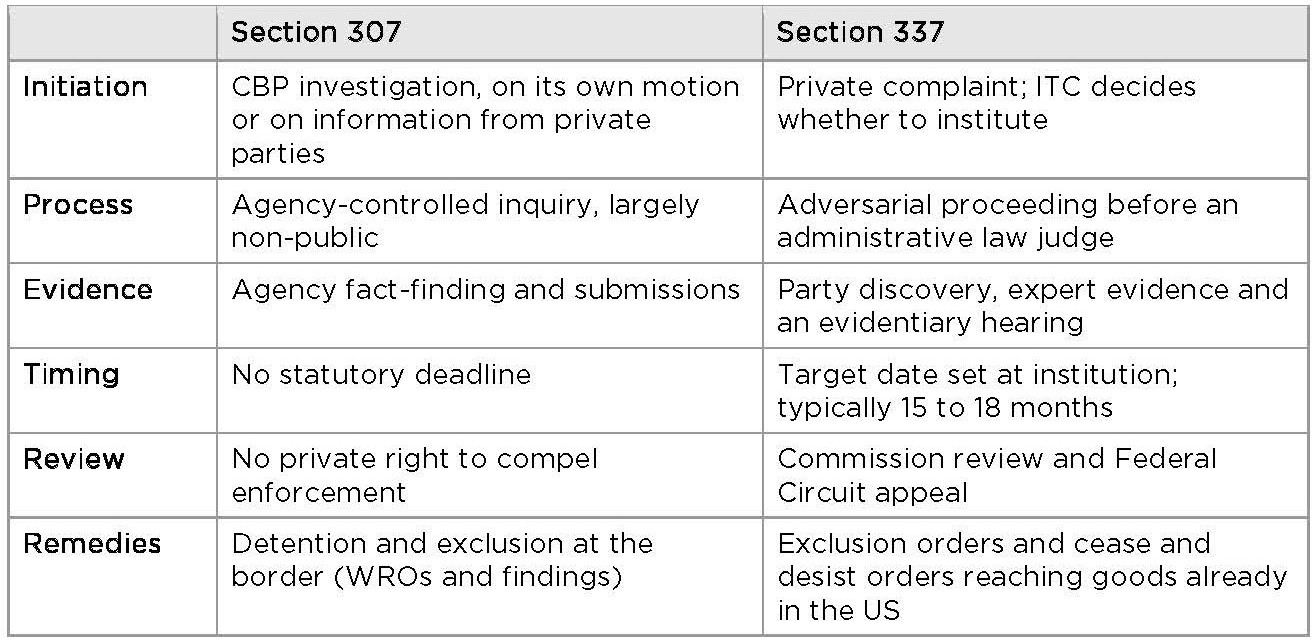
The complaint is novel in two respects. In the United States, it is the first attempt to plead forced labor as an unfair act under Section 337, a statute used almost entirely for patent and trade secret disputes, and so to supplement the government-enforced import ban in Section 307 with a private remedy. Globally, it has no counterpart. Every forced labor import regime, from Section 307 and the Uyghur Forced Labor Prevention Act (UFLPA) to the EU Forced Labour Regulation, India's new prohibition, and the market-withdrawal power the UK announced this month, is enforced by a public authority. If the Commission agrees with the complainants, private parties would gain something Section 307 has never offered them: a proceeding they control, on a fixed timetable, with discovery and a reasoned decision at the end.
This piece describes the complaint, the legal theory behind it, the hurdles it faces, and what importers and retailers should do while the Commission decides.
The complaint
The complainants allege that the company's processing operations in Andhra Pradesh depend on forced labor. They describe a largely migrant and female workforce subject to restricted movement, withheld wages, unpaid overtime, and recruitment debt. The allegations draw on Corporate Accountability Lab's 2024 investigation, reporting by the Associated Press, CNN, and the Outlaw Ocean Project, and the Department of Labor's 2024 listing of Indian shrimp as a good produced with forced labor. The company has denied the allegations.
Forced labor, the complainants say, lowers the company's costs and allows it to undersell domestic product. The complaint names six further respondents: a US seafood distributor, three US retail operating companies, and two foreign retail parents. It seeks a limited exclusion order against company shrimp, cease and desist orders against downstream sellers, and a bond on imports during the presidential review period.
Forced labor enforcement has been government-driven
The complaint comes amid a broader expansion of forced labor trade measures. CBP stopped 7,325 shipments in fiscal year 2025, a 50% increase over the prior year. The EU Forced Labour Regulation will apply from December 2027, while the UK has recently committed to legislation requiring mandatory human rights due diligence and authorizing the removal of forced labor goods from its market. In July 2026, the Office of the US Trade Representative (USTR) imposed Section 301 tariffs on 60 economies for failing to impose or enforce forced labor import bans. The USTR investigations have spurred countries, including India, to adopt import bans. USTR's rationale for the Section 301 tariffs echoes the complaint: forced labor imports give producers an unfair cost advantage over law-abiding competitors.
Every one of these measures is enforced by government. Private parties can petition US Customs and Border Protection (CBP) to act under Section 307 but cannot compel it. In International Rights Advocates v. Mullin, the Federal Circuit affirmed the dismissal, for lack of standing, of a suit seeking to force CBP to act on petitions concerning Ivorian cocoa. This complaint tries a different door: domestic producers asserting their own competitive injury before an agency that must decide.
The legal theory
Section 307 prohibits importing goods made wholly or in part with forced labor; CBP enforces it through investigations, withhold release orders, and findings. Section 337 prohibits "unfair methods of competition and unfair acts" in importation that threaten to destroy or substantially injure a US industry.
The complainants' theory is that a violation of Section 307 is an unfair act under Section 337. They rely on TianRui Group Co. v. ITC for the proposition that unfairness is judged under a uniform federal standard, and on the statute's open-ended language, its legislative history, and past ITC proceedings predicated on other federal statutes. They must also prove injury: that forced labor gives the Indian company an artificial cost advantage that is undercutting domestic shrimpers.
Hurdles
Four questions will decide whether the theory survives.
- Institution. Section 307 gives no private right of action. In Amarin Pharma v. ITC, the Federal Circuit upheld the Commission's refusal to institute a complaint that would have required it to apply the Food, Drug, and Cosmetic Act, which the FDA alone enforces and which the FDA had asked the ITC to leave alone. The complainants can distinguish Amarin: Section 307 contains no express reservation of enforcement to the government, and their claim is that forced labor is itself unfair, not that the ITC should enforce Section 307. Whether CBP weighs in, and on which side, may matter as much as the doctrine.
- Antidumping and countervailing duty overlap. Section 337(b)(3) bars the Commission from proceeding on matters based solely on acts within the antidumping and countervailing duty laws. Indian shrimp has been subject to antidumping duties since 2005 and countervailing duties since 2024. The complainants' strongest answer is that those orders address pricing and subsidies, not coercion.
- Proof and attribution. The complainants must connect forced labor at specific facilities to the Indian company's supply chain and to the shrimp entering the US Attribution, traceability, and the weight given to worker testimony and NGO investigations will all likely be contested. So will the scope of any remedy—whether enforced against all the company's shrimp, or only shrimp shown to be made with forced labor (and how CBP would tell the difference).
- Injury. The complainants must show that the specific company's imports, not Indian shrimp generally, substantially injure or threaten the domestic industry. The volume of those imports, and how much of the industry's decline is attributable to them rather than to other sources or market conditions, will be central.
Whatever the Commission decides, the comparison below explains why the complainants chose this route.
Implications for importers and retailers
If the theory holds, the exposure of companies selling into the US changes in five ways.
- Wider reach. Importers, distributors, and parent companies can be named as respondents for forced labor at facilities they neither own nor operate.
- No knowledge defense. Section 337 relief attaches to the goods, not to the importer's state of mind. Due diligence may prevent and detect abuse; it does not shield merchandise from exclusion.
- Diligence files become evidence. Supplier selection records, audit findings, internal warnings, and corrective action plans will be the subject of discovery, depositions, and testimony. Sensitive investigations should be run through counsel to preserve privilege.
- Spillover. A public ITC record can feed CBP enforcement and civil claims under the Trafficking Victims Protection Reauthorization Act.
- Commercial disruption. Exclusion and cease and desist orders interrupt inventory, distribution, and sales. Affected companies would need to identify exposed suppliers, price replacement product, and assess whether existing supply commitments can be met.
Practical steps for companies
Companies need not wait for the Commission or final court review.
- Map exposure. Identify Indian shrimp in the supply chain by producer, processor, importer, and retailer, and repeat the exercise for other high-risk goods that compete with domestic production.
- Preserve documents. Where a supply chain touches a named respondent or implicated merchandise, assess preservation obligations and implement holds where litigation is reasonably anticipated.
- Review the record. Examine existing audits, worker interviews, certifications, internal warnings, and corrective action plans with counsel, and place new supplier inquiries under privilege.
- Connect trade compliance and human rights due diligence. These functions usually run separately. This proceeding shows why sourcing, human rights, and trade teams should assess and remediate risk together.
- Check contracts. Supplier agreements should carry audit rights, prompt notice of labor violations, cooperation with investigations, traceability, and enforceable remediation, with indemnity and termination rights that cascade upstream.
What to watch
The Commission's institution decision, expected by November 27, is the first milestone. If it institutes, watch the scope of the notice of investigation, whether a threshold issue goes to the 100-day early disposition program, and whether CBP, USTR, or the Department of Labor submit views. If it declines, the reasoning matters: under Amarin, a refusal for failure to state a cognizable claim is reviewable by the Federal Circuit, and a later CBP finding on the same supply chain could support a renewed complaint.
Whatever the outcome, the complaint is an attempt to recast forced labor as a competitive harm as well as a human rights one, and to give the companies that bear that harm a forum of their own.