Overview
Over a decade after the first generation of smart glasses earned its wearers the nickname “glassholes,” smart glasses[1] are making a comeback, and this fall brings a highly anticipated wave of product launches.[2] The pitch for this generation of smart glasses is that they do not look like smart glasses, and manufacturers are teaming up with established eyewear brands to achieve a more ordinary look. Another interesting, perhaps counterintuitive, trend is the deliberate omission of certain features such as cameras and speakers to enhance user privacy.
These two design objectives seem difficult to protect through intellectual property: it is hard to claim a negative, or the absence of certain hardware, in a conventional utility patent claim, and it would seem even harder to establish novelty when the goal is to make the remaining hardware look ordinary and as close to the prior art as possible. Yet the glasses’ design, rather than their technologically sophisticated “smart” features, is at the center of a recent design-patent dispute between Even Realities and XGIMI’s MemoMind brand.[3]
Even Realities launched its second-generation G2 glasses in November 2025.[4] The G2 glasses are lightweight and look like ordinary glasses, and they lack a camera and speakers to address privacy concerns. They rely on green micro-LED text projected into the wearer’s field of view, enabling features like live translation and transcription, turn-by-turn navigation, a teleprompter, calendar and message notifications, and an AI assistant that answers questions in text you can read without looking down at a phone. The glasses retail for $599, or roughly $850 with the R1 control ring.[5] These glasses quickly gained popularity among smart glasses enthusiasts and have a dedicated subreddit.[6]
In late June of this year, XGIMI launched a Kickstarter campaign under its new MemoMind brand for the “MemoMind One.”[7] Like Even Realities’ G2, the MemoMind One includes lightweight frames, omits a camera (though it includes a speaker), and displays green micro-LED text for translation, navigation, etc. Customers immediately recognized that the MemoMind One competes directly with Even Realities’ G2, with one reviewer calling it the G2’s “long lost cousin,”[8] though the initial introductory price of $399 (with no control ring) is significantly lower.[9] The campaign drew over $1.2 million from over 2,670 backers with a scheduled close of August 27,[10] and XGIMI seeded review units to YouTubers and tech press months in advance, feeding the hype.[11]
On August 11, 2026, two Even Realities design patents issued: U.S. Design Patent Nos. D1,140,996 (round frame) and D1,140,997 (rectangular frame), each claiming a relatively ordinary looking “ornamental design for smart glasses.” Nine days later, on August 20, Even Realities sent cease-and-desist letters to both XGIMI and Kickstarter, alleging that the MemoMind One glasses infringe its patents and asking Kickstarter to halt the campaign and hold funds.[12] After XGIMI refused, on August 25, Even Realities filed suit in the Eastern District of New York, naming both XGIMI and Kickstarter as defendants, and applied for a temporary restraining order (“TRO”) and preliminary injunction (“PI”) barring Kickstarter from disbursing campaign proceeds to XGIMI and enjoining XGIMI from making, importing, or selling the accused MemoMind One glasses.
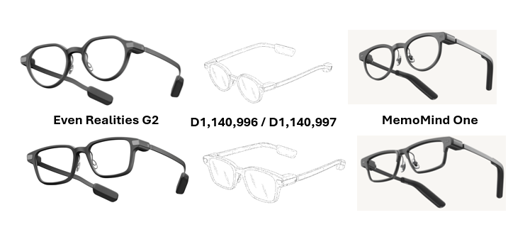
Even Realities’ TRO/PI brief characterized the accused frames as a “slavish copy” that replicates “the same frame geometries, proportions, and minimalist silhouette.”[13] Even Realities’ theory of urgency centered on Kickstarter’s payout schedule: once the campaign closed on August 27, the pledges would be charged and roughly $1.2 million would be wired to XGIMI on or about September 10.[14] By August 27, before XGIMI had filed any opposition, Kickstarter had suspended the campaign on its own under its policy for projects that are “the subject of an intellectual property dispute.”[15] The next day, on August 28, XGIMI opposed, leading with the point that the “entire theory of urgency” had evaporated with the suspension, and arguing that Even Realities’ infringement showing was a “bare side-by-side juxtaposition” that ignored the prior art.[16] In particular, XGIMI argued that eyeglasses are a ubiquitous article, so under Egyptian Goddess the comparison must be made through the eyes of an observer familiar with the prior art, with functional hardware and features common to all smart glasses factored out.[17] Even Realities then withdrew its TRO/PI application as moot and voluntarily dismissed Kickstarter from the case.[18] The patent infringement merits remain pending.
The first practical takeaway is that naming Kickstarter as a defendant in an infringement suit and pairing the complaint with a TRO/PI application can freeze a campaign before the accused infringer is heard and without a bond or merits ruling. However, in this case, that freeze proved only a minor obstacle to shipping glasses on schedule. XGIMI’s customer update redirected orders to its own MemoMind website, stated that Kickstarter pledges would not be charged, and promised that products to deposit holders and backers would ship first, confirming that orders outside the EU were “unaffected” and would begin shipping in September “as planned.”[19] The fan base appears to have followed, at least some of whom have blamed Even Realities for filing an anti-competitive lawsuit that is not based on real innovation.[20] In the end, Even Realities’ TRO/PI application cut out the middleman fundraising platform, not the sales, and risked generating unfavorable publicity. A patentee seeking both a campaign freeze and a broader sales injunction should consider sequencing and focus the injunction showing on the product and competitive harm, not only the crowdfunding proceeds.
A second, though potentially minor, takeaway is that proceedings in Germany produced a more immediate sales consequence. After initiating a lawsuit in Germany, Even Realities obtained an ex parte preliminary injunction from the Düsseldorf Regional Court on August 18 on its registered EU designs.[21] MemoMind then paused all EU shipments “[d]ue to a recent legal development in Germany,” estimating a three-to-five month delay.[22] This is a familiar playbook in the smart-glasses space: in XREAL’s (utility) patent fight with VITURE, the Munich Regional Court enjoined German sales of the VITURE Pro on November 13, 2025.[23]
A third potential takeaway this dispute raises, even though the Even Realities court never ruled on the merits of the TRO/PI application, is that design patents appear to be well-suited to emergency injunctive relief. Because a design patent claims an ornamental visual design, infringement under the ordinary-observer test can lend itself to a rapid visual side-by-side comparison where a judge can form a preliminary impression within minutes. In a product category where competitors are all attempting to resemble conventional eyewear, that first impression may favor substantial similarity, particularly before any detailed consideration of the prior art. Design patents can also issue more quickly than utility patents (here, the ’996 patent went from filing to grant in nineteen months, and from grant to a TRO motion in two weeks), and they are not vulnerable to the § 101 eligibility challenges that commonly threaten software claims.
The flip side is that an initial impression of substantial similarity at the preliminary TRO/PI phase may erode at later stages in the case once the prior art is considered in more detail. For example, round and rectangular frames are among the most heavily designed articles in commerce, so the analysis will come down to details that distinguish the frames from the prior art, like the keyhole bridge, the taper and thickness of the temples, and the placement and contour of the display and battery housings at the hinge and temple tip. While XGIMI identified differences in its lens shape,[24] a visual comparison of its design to the patents suggests other potential differences near the hinges and toward the back of the temples. Ultimately, the dispute sharpens a central tension: how much room for ornamental variation exists in a category whose customers want products that resemble, rather than depart from, a century of eyeglass design, particularly under the more flexible Graham obviousness framework that applies after LKQ?[25] But as discussed above, when a platform suspends a campaign as soon as a dispute is filed, the immediate leverage may depend less on patent strength than on filing speed.
And while this dispute involved the hardware design, future disputes are likely to move beyond the frames and toward the software that make the devices “smart.” But this poses a somewhat unique risk for existing customers, as software functionality can be remotely disabled from existing devices soon after a finding of infringement, [26] whereas purchasers typically retain use of the physical product even when the hardware itself is found to infringe. Purchase and subscription agreements for AI wearables (especially for large-scale/enterprise uses, such as in clinical settings) should therefore address feature-removal rights, notice, and remedies alongside data and security. For now, the Even Realities dispute is a reminder that design patents can have outsized practical force in markets where speed, platform access, and visual similarity matter. But in a product category where the design is built to disappear into a century of familiar eyewear design, the same features that make smart glasses commercially appealing may also make the ultimate design-patent merits fight much harder. Consumers should expect additional IP fights that move beyond the frames to the software, displays, batteries, and other technology that make the glasses “smart,” and buyers should account for the risk that key functionality could be disabled after purchase.
[1] These products generally fall into two categories: AI-focused smart glasses and augmented reality (“AR”) glasses. AI glasses typically integrate microphones, speakers, and often a camera into an otherwise ordinary-looking frame and connect those components to an AI assistant. Where AI glasses include a display, it is often limited to monochrome text or simple visual cues within the wearer’s field of view. By contrast, AR glasses generally feature color displays capable of presenting graphics, video, and other digital content overlaid onto the physical world. Increasingly, however, manufacturers are seeking to combine AI and AR capabilities into a single device.
[2] As just an example, Snap’s $2,195 Specs are on preorder for a fall delivery. https://www.androidauthority.com/snap-specs-features-3711990/.
[3] Shenzhen Yiwen Tech Ltd. (d/b/a Even Realities) v. XGIMI Tech Co., No. 1:26-cv-05220-AMD-PCG (E.D.N.Y.).
[4] See US D1,140,996 S (listing “Nov. 12, 2025” as the “earliest date available” for the G2 glasses and R1 control ring under “Other Publications”)
[5] https://www.evenrealities.com/store
[6] https://www.reddit.com/r/EvenRealities/
[7] See Shenzhen Yiwen Tech Ltd., No. 1:26-cv-05220-AMD-PCG, Dkt. 8 at 4.
[8] https://www.tomsguide.com/computing/smart-glasses/memomind-one-ai-smart-glasses-hands-on-review
[9] https://www.memo-mind.com/products/memomind-one-standard?variant=44015156134001
[10] See Shenzhen Yiwen Tech Ltd., No. 1:26-cv-05220-AMD-PCG, Dkt. 8 at 5.
[11] E.g., https://www.youtube.com/watch?v=6NITNMjBgY8; https://www.youtube.com/watch?v=NTrWi1at4-Q. MemoMind may also have had a dedicated subreddit, but it is currently banned.
[12] See Shenzhen Yiwen Tech Ltd., No. 1:26-cv-05220-AMD-PCG, Dkt. 8 at 6–7.
[13] See Shenzhen Yiwen Tech Ltd., No. 1:26-cv-05220-AMD-PCG, Dkt. 8 at 15.
[14] See Shenzhen Yiwen Tech Ltd., No. 1:26-cv-05220-AMD-PCG, Dkt. 8 at 6.
[15] See Shenzhen Yiwen Tech Ltd., No. 1:26-cv-05220-AMD-PCG, Dkt.17 at 3 & n.1., Dkt. 20 at 1–2; https://www.kickstarter.com/projects/1963472698/memomind-one-the-most-natural-ai-display-glasses.
[16] See Shenzhen Yiwen Tech Ltd., No. 1:26-cv-05220-AMD-PCG, Dkt.17 at 2-3.
[17] See Shenzhen Yiwen Tech Ltd., No. 1:26-cv-05220-AMD-PCG, Dkt.17 at 2, citing Egyptian Goddess, Inc. v. Swisa, Inc., 543 F.3d 665, 676-78 (Fed. Cir. 2008).
[18] See Shenzhen Yiwen Tech Ltd., No. 1:26-cv-05220-AMD-PCG, Dkt.20.
[19] https://www.memo-mind.com/blogs/news/memomind-one-kickstarter; https://www.reddit.com/r/SmartGlasses/comments/1wjpdcd/memomind_one_product_delivery_timeline/.
[20] https://www.reddit.com/r/SmartGlasses/comments/1vzw75z/boycott_even_realities/
[21] See Shenzhen Yiwen Tech Ltd., No. 1:26-cv-05220-AMD-PCG, Dkt. 17 at 2.
[22] https://www.memo-mind.com/blogs/news/memomind-one-kickstarter.
[23] See https://www.sotech-vision.com/From-the-CES-buzz-to-the-courtroom-AI-glasses-face-an-infringement-lawsuit-and-a-1-2-million-crowdfunding-campaign-falls-through-; https://tech.sportskeeda.com/wearables/xreal-vs-viture-lawsuit-everything-know-ar-patent-battle#:~:text=XREAL%20has%20filed%20a%20lawsuit%20against%20Viture%20in%20the%20US%20for%20patent%20infringement%20of%20the%20optical%20system%20used%20in%20AR%20glasses.id08499235.html#:~:text=subsequently%2C%20in%20February%20of%20this%20year%2C%20a%20fine%20of%20%E2%82%AC75%2C000%20%28approximately%20RMB%20587%2C000%29%20was%20imposed%20on%20a%20VITURE%20affiliate%20for%20failing%20to%20fully%20comply%20with%20the%20injunction.
[24] See Shenzhen Yiwen Tech Ltd., No. 1:26-cv-05220-AMD-PCG, Dkt.17.
[25] LKQ Corp. v. GM Global Technology Operations LLC, 102 F.4th 1280 (Fed. Cir. 2024); see https://www.steptoe.com/en/news-publications/step-into-ip-blog/two-years-after-lkq-how-courts-are-applying-the-new-design-patent-obviousness-framework.html.
[26] See, e.g., Inv. No. 337-TA-1191, Final Determination, (USITC January 6, 2022); https://www.usitc.gov/system/files/secretary/fed_reg_notices/337/337_1191_notice01062022sgl.pdf; Sonos, Inc. v. ITC, No. 22-1421 (Fed. Cir., Apr. 8, 2024). The Apple Watch/Masimo Dispute also shows how this can play out, although there, the ITC’s exclusion order expressly carved out watches consumers had already bought, and Apple quickly restored a redesigned version. Inv. No. 337-TA-1276, Limited Exclusion Order (USITC Oct. 26, 2023); https://www.usitc.gov/intellectual_property/exclusion_orders/337-ta-1276.pdf; https://www.cnet.com/tech/mobile/blood-oxygen-banned-apple-watch-health-stay.