Overview
This Halloween, we went looking through the more curious corners of patent history. Here are a few that felt right for spooky season.
Spookiest Prosecution History: The Ouija Board, U.S. Patent No. 446,054 (Feb. 10, 1891)
Elijah Bond filed a patent application on May 28, 1890 for what his specification called the “Ouija or Egyptian luck-board.”
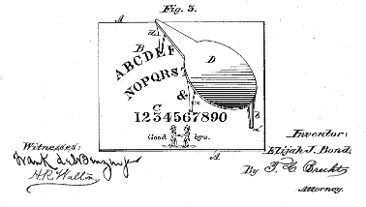
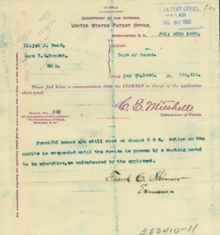
As legend tells it, the USPTO examiner initially rejected the application, prompting Bond and his sister-in-law, Helen Peters, to demonstrate the board in person at the Washington, D.C. Patent Office.[1] The chief examiner (or “chief clerk” at the time) offered the following deal: if the board could spell his name (which Bond and Peters supposedly didn’t know), they’d get their patent. With Peters on the planchette, the board spelled it, and a visibly shaken examiner granted the patent. An office action from the USPTO archives at least partially corroborates the lore behind this patent, stating “[a]ction on the merits is suspended until the device is proven by a working model to be operative, as volunteered by the applicant.”[2]
Actually Scary: Coffin Patents Addressing Live Burials and Stolen Bodies
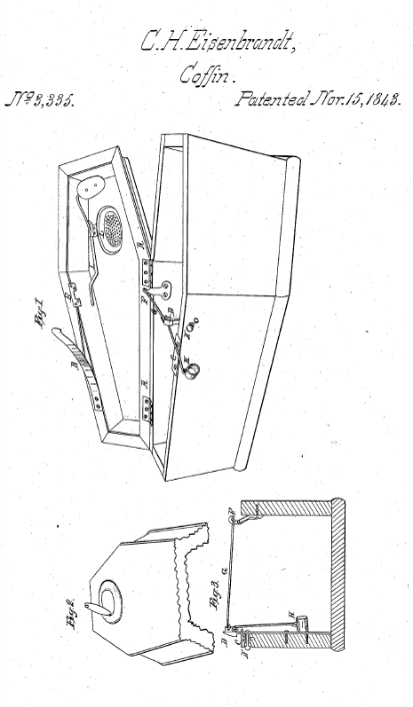
Fear of premature burial gripped the nineteenth century because medicine could not always tell a deep coma from death, and stories of coffins found with torn shrouds and scratched lids ran in the papers. Inventors responded with a minor industry of “safety coffins” complete with grave alarms and escape mechanisms. Examples include “Coffin To Be Used In Cases Of Doubtful Death,” U.S. Patent No. 3,335 (Nov. 15, 1843) (claiming a “life-preserving coffin” whose spring-loaded lid, held shut by a catch tied to the occupant’s finger, flew open at the slightest movement); “Improved Burial-Case,” U.S. Patent No. 81,437 (Aug. 25, 1868) (claiming a coffin with a ladder and a cord that rang a bell for help if the occupant woke); “Grave Alarm,” U.S. Patent No. 500,072 (June 20, 1893) (notifying cemetery officials and supplying fresh air until help arrived); “Device for Indicating Life in Buried Persons,” U.S. Patent No. 268,693 (Dec. 5, 1882) (claiming a T-shaped pipe the occupant’s hands could turn to signal passersby); and “Device for Indicating Life in Buried Persons,” U.S. Patent No. 371,626 (Oct. 18, 1887) (similar). Despite these patents, we have found no documented case of a safety coffin saving anyone.
The other Victorian burial fear was grave robbers digging up (actually dead) bodies for medical students. One Atlas Obscura reporter counted at least 12 bodies reported stolen in 1878,[3] among them that of former Ohio congressman John Scott Harrison (son of President William Henry Harrison and father of President Benjamin Harrison), which turned up at the Ohio Medical College in Cincinnati. Shortly after the Harrison scandal, Philip Clover filed his application for “Improvement in Coffin-Torpedoes,” U.S. Patent No. 208,672 (Oct. 8, 1878) to “prevent the unauthorized resurrection of dead bodies.” The device was essentially a small shotgun mounted inside the casket, rigged so that any attempt to remove the body fired the cartridge and caused “injury or death of the desecrator of the grave.” The specification helpfully instructs the undertaker to load the torpedo just before closing the casket and to conceal it in the casket trimmings or the clothing of the deceased. Thomas N. Howell followed with his own “Grave Torpedo,” U.S. Patent No. 9,719 (Reissued May 24, 1881), which worked more like a landmine wired to the coffin.
Virtually Scary: “Zombie” Technology
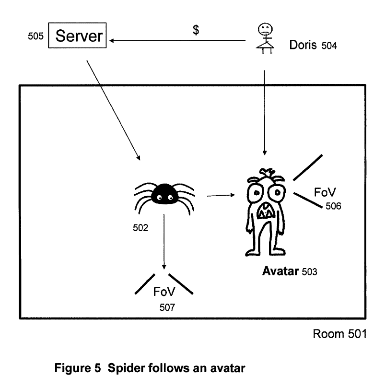
In technology, “zombie” often refers to something effectively dead or no longer useful but that lingers on a system and keeps consuming resources. “Identification and removal of zombie virtual machines,” U.S. Patent No. 9,959,133 (May 1, 2018), for example, describes a method for finding and removing “zombie virtual machines” that someone created for a temporary purpose and then forgot, leaving them idle but still drawing resources. “Method of detecting zombie breakpoints,” U.S. Patent No. 6,961,923 (Nov. 1, 2005) claims a method of detecting “zombie global breakpoints,” the lingering breakpoint events of breakpoints a developer has already removed, in debugging computer software. And “Ghost spiders and zombie avatars in the metaverse,” U.S. Patent No. 11,770,420 (Sept. 26, 2023) describes a “ghost spider” that scans virtual reality “rooms” for “zombie” avatars, the ones users abandon and leave motionless in the room indefinitely. These patents reflect that, even in the digital world, the things we leave behind can come back to haunt us.
Unsettling Creatures: The U.S. Department of the Interior’s “Control of Vampire Bats,” U.S. Patent No. 3,786,153 (Jan. 15, 1974)
Vampire bats pose a serious public health concern because they transmit rabies to cattle.[4] Rather than exterminate every bat, this patent claims a method of thinning vampire bat populations with a toxicant dosed to spare the host animal, such as cattle, but to kill the bats that feed on its blood. Vampire bats may not be all bad, though, as “Vampire bat salivary plasminogen activators,” U.S. Patent No. 5,830,849 (Nov. 3, 1998) claims their salivary plasminogen activators act as blood-thinning proteins.
Tricks by the Best: Patented Illusions
Some inventions in the archives are meant to entertain rather than to ward anything off, and patent readers get a look behind the curtain. The infamous Harry Houdini, for example, patented his “Diver’s Suit,” U.S. Patent No. 1,370,316 (Mar. 1, 1921), which joins two halves at the middle so a diver in danger can shed the suit underwater and escape to the surface. Engineer Henry Dircks and showman John Henry Pepper patented their “Apparatus for Exhibiting Dramatic and Other Performances” (i.e., “Pepper’s Ghost”), British Patent (1863), a classic stage illusion that angles a sheet of glass to project a “ghost” from a hidden room onto the stage.
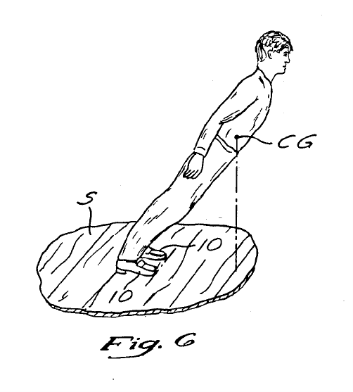
Last but not least, days before Halloween 1993, Michael Jackson and co-inventors Michael L. Bush and Dennis Tompkins received a patent for the shoes behind the gravity-defying lean in “Smooth Criminal,”[5] “Method and Means for Creating Anti-Gravity Illusion,” U.S. Patent No. 5,255,452 (Oct. 26, 1993). As the specification explains, cables and waist harnesses produced the gravity-defying lean on film, but neither could be hidden from a live audience. The patented solution was a V-shaped slot in the heel of each shoe that hooks onto a peg rising through the stage floor at just the right moment. The specification also distinguishes prior art footwear that anchors astronauts to a rail in zero gravity (in U.S. Patent No. 5,042,173).
The patent archives turn out to be a good place to spend Halloween. Happy Halloween from all of us at Step Into IP 😊
[1] https://www.thebanner.com/culture/arts/ouija-boards-john-waters-elijah-bond-green-mount-cemetery-R74NHTE2HFCIDLOML6DMAYJHHQ/; https://weirddarkness.com/ouija-board-dark-history-true-stories// ; https://www.smithsonianmag.com/history/the-ouija-board-cant-connect-us-to-paranormal-forces-but-it-can-tell-us-a-lot-about-psychology-grief-and-uncertainty-5860627/#ixzz2t35YW21m/
[2] See https://www.smithsonianmag.com/history/the-ouija-board-cant-connect-us-to-paranormal-forces-but-it-can-tell-us-a-lot-about-psychology-grief-and-uncertainty-5860627/#ixzz2t35YW21m. See also https://patents.harnessip.com/?m=201402.
[3] https://www.atlasobscura.com/articles/coffin-torpedos
[4] https://pmc.ncbi.nlm.nih.gov/articles/PMC4036541/
[5] https://aotus.blogs.archives.gov/2011/04/01/how-to-be-a-smooth-criminal