Overview
Companies are increasingly turning to private judges in lieu of state courts or arbitration. The Wall Street Journal recently wrote about the "little-known world of private judges for hire," and described the growing trend of businesses choosing private judges for cases that require speed, expertise, and/or increased privacy.1
In Texas, parties can hire a private or "special" judge to preside over and decide civil cases via bench trial.2 Referring a pending state court case to a private judge is straightforward: all parties must file a motion that (1) requests referral; (2) waives their right to a jury trial; (3) specifies the issues being referred; (4) lists the time and place for trial; and (5) includes the name of the private judge and their fee.3 Upon approval, the referring judge passes the case and stays proceedings in the referring court.4 Texas's rules do not contemplate litigants fully circumventing the state court system and using a private judge before initiating a lawsuit; the rules only allow cases to be referred to a private judge after filing, as set out above.
A private or "special" judge in Texas must be a retired judge who served as a judge for at least four years, developed "substantial experience" in his or her area of specialty, has not been removed from office or resigned while under a disciplinary investigation, and completes regular continuing legal education courses.5 A private judge has all the powers of the referring judge, but cannot hold any parties in contempt, only witnesses.6 The same rules of evidence and procedure that apply in the referring judge's court, including trial procedures, apply to proceedings before the private judge.7 And parties may appeal a private judge’s ruling as they would a normal trial court decision, with the appeal going to the same court of appeals that reviews decisions from the referring judge's court.8 The parties must evenly share the cost of the private judge,9 although each side must separately pay for the cost of their own experts or other witnesses.10
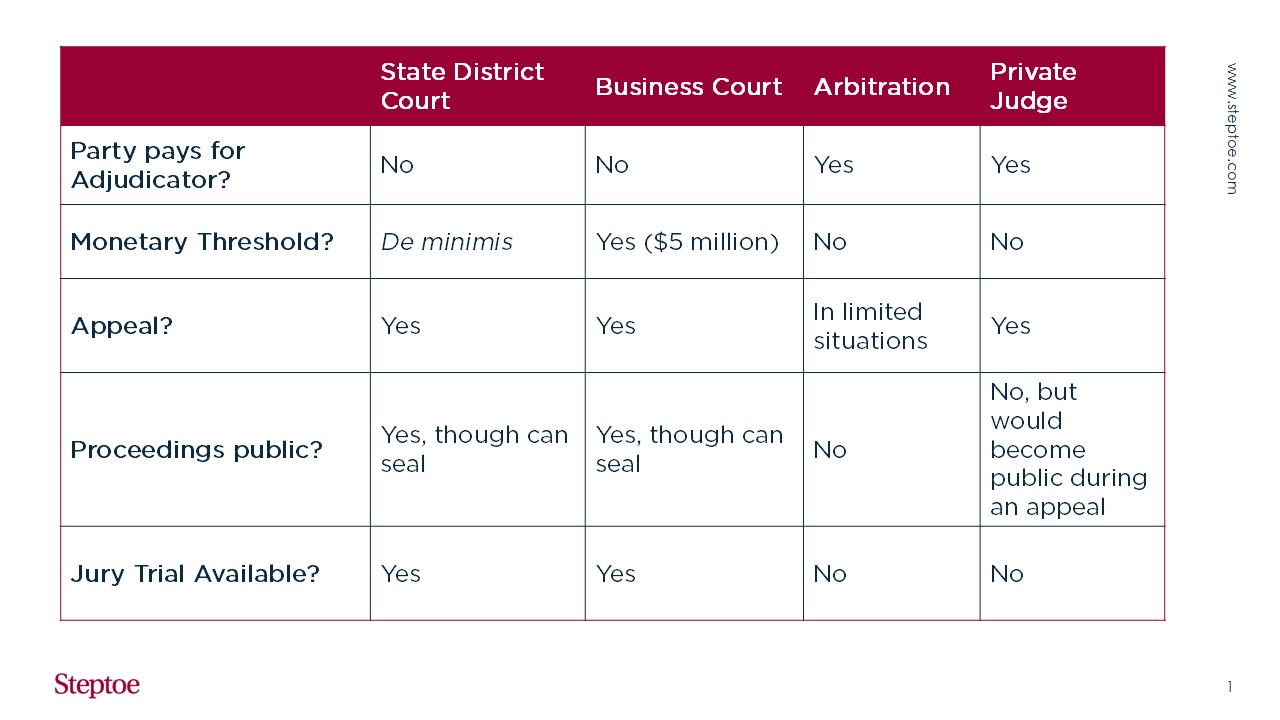
Using a private judge has several advantages. Private judges are generally faster—sometimes significantly faster—than the state court system because they have a smaller docket and a financial incentive to provide efficient service. Hearing and trial dates are less likely to be moved and can potentially be coordinated to suit the parties' schedules. Parties may also pick private judges who have more experience handling their type of dispute than a randomly-assigned state court judge. Private judges do not have a monetary jurisdictional threshold, unlike the Texas Business Court, which has a $5 million threshold and other limitations on its jurisdiction. Private judges use the rules of civil procedure and evidence, which some parties prefer over the rules of arbitration. And unlike arbitration, which generally offers limited options for appeal, a private judge’s decision can be appealed. Proceedings before a private judge happen outside of a public courtroom and docket, and are accordingly confidential, similar to arbitration. However, the proceedings could be made public upon appeal.
Conversely, there are disadvantages to a private judge. The most significant is the cost of retaining one. Opposing parties must also agree on which private judge to retain, which could be difficult. And some parties may be more comfortable appearing in front of an elected or appointed official, who is generally subject to a higher level of oversight and accountability. A table of the different characteristics of each option to resolve disputes is provided below.
One example where a private judge may be especially well suited is for companies engaging in operations or business deals in Mexico. After Mexico implemented its controversial judicial reform in 2024,11 many companies began choosing to bypass the Mexican court system by entering into contracts that require arbitration in Houston. Private judges could be a useful alternative for those companies that prefer a litigation-style approach instead of arbitration but want more certainty and control than the Texas courts may be able to offer litigants or cannot meet the Business Court’s jurisdictional threshold of $5 million in controversy. Steptoe has consulted with many companies on crafting dispute resolution provisions that best address the business's needs and concerns, whether that means litigating in the courts, via arbitration, or via private judges.
The decision to retain a private judge is situation dependent. In some cases, the parties may want to consider a private judge after litigation has begun, based on the judge the parties draw, or other considerations. In other cases, the parties may determine during the business relationship that they want any future litigation to proceed with a private judge; in such situations, they might include provisions in their contracts requiring such agreement and even identifying a particular private judge to resolve their disputes.
In any event, although Texas law has permitted parties to hire private judges for many years, the procedure has not been widely used, but that is changing. Companies operating or doing business in Texas should consider private judges, both in their contractual dispute resolution clauses and as a viable alternative to state court or arbitration.
1 Corinne Ramey, Inside the Little-Known World of Private Judges for Hire, Wall St. J. (Nov. 12, 2025), https://www.wsj.com/us-news/law/inside-the-little-known-world-of-private-judges-for-hire-0850e336.
2 Tex. Civ. Prac. & Rem. 151.001.
3 Tex. Civ. Prac. & Rem. 151.002.
4 Tex. Civ. Prac. & Rem. 151.001.
6 Tex. Civ. Prac. & Rem. 151.006(b).
7 Tex. Civ. Prac. & Rem. 151.005; 151.006(a).
8 Tex. Civ. Prac. & Rem. 151.013.
9 Tex. Civ. Prac. & Rem. 151.009.
10 Tex. Civ. Prac. & Rem. 151.009.
11 https://www.steptoe.com/en/news-publications/stepwise-risk-outlook/stepwise-risk-outlook-deep-dive-mexican-judicial-reform-ramifications-for-global-markets-and-us-investors.html; see also https://www.steptoe.com/en/events/mexicos-judicial-reform-considering-the-impact-implications-and-options-moving-forward.html.