Overview
On October 5, 2026, Chairman Michael S. Selig used his remarks at the Fordham Law Blockchain Regulatory Symposium to introduce an advance notice of proposed rulemaking (ANPRM) on Regulation Crypto Asset Transactions (Regulation CTX) and Regulation Crypto Asset Markets (Regulation CAM)[1].
The same day, Chairman Selig made the case to a broader audience in a Wall Street Journal op-ed, "CFTC's New Rules for Crypto." He called the ANPRM the CFTC's "first round of regulations for crypto markets" and ended with a line that sums up the agency's position: "The last chapter of crypto regulation was written by crisis. The new frontier of finance will be written by opportunity, innovation and clear rules."
The ANPRM rests on section 2(c)(2)(D) of the Commodity Exchange Act (CEA). That provision covers retail commodity transactions offered on a leveraged, margined or financed basis. The prior administration used it mainly as an enforcement tool; the Commission now proposes to use it to write "fit-for-purpose" rules.
The ANPRM interprets section 2(c)(2)(D) of the Commodity Exchange Act with respect to transactions and markets in crypto assets (as defined in the ANPRM) to "provide notice of its intent to establish a comprehensive regulatory framework comprised of fit-for-purpose rules concerning section 2(c)(2)(D)" with respect to "Crypto Asset Transactions," or the retail commodity transactions described in 2c2d that involve crypto assets. The ANPRM provides a history of the CFTC's regulation of crypto assets and 2c2d transactions in several phases: (i) early commission approach to crypto asset markets (2014-2020), (ii) regulation by enforcement (2021-2024), (iii) President Trump’s working group on Digital Asset Markets (2025) and (iv) regulatory clarity for crypto asset markets. Part (iv) highlights the work of Chairman Selig and the harmonization between the SEC and the CFTC this year.
The ANPRM then details the history, application and scope of Section 2(c)(2)(D) in connection with retail commodity transactions offered with leverage, providing that “section 2c2d(ii) excepts certain classes of contracts of sale that demonstrate typical cash market activity rather than mimicking the economic substance of an open futures contract, including a contract of sale that ‘results in actual delivery within 28 days or such longer period as the Commission may determine … based upon the typical commercial practice in cash or spot markets for the commodity involved (the ‘actual delivery exception’).” The ANPRM then discusses the controlling actual delivery exception case law. Market participants have been seeking guidance on the actual delivery exception to facilitate novel products in the digital asset space for the last few years.
Regulation CTX would interpret key statutory terms, chiefly "offer" and "actual delivery," as they apply to crypto assets and would treat trading on or subject to DCM rules of certain transactions involving crypto assets that are leveraged, margined or financed (or offered on such a basis) as covered transactions under CEA Section 2(c)(2)(D). Regulation CAM would create a new category of designated contract market (DCM), the crypto asset market (CAM), with rules tailored to these transactions – a subcategory of DCM that would be limited to markets that trade only in covered transactions under Reg CTX. The ANPRM states that the Commission preliminarily believes that Reg CAM would permit a DCM to offer crypto asset transactions (CTXs) under its current registration.
State Law: The ANPRM states that "The Commission preliminarily believes that in subjecting 2(c)(2)(D) transactions, and thus CTXs, to such comprehensive regulation, Congress made clear that varying state laws did not apply to the operating of trading facilities that offer CTXs” and takes issue with the current state money transmitter licensing and regulations and suggests a strategy similar to that taken in prediction markets cases." Of note, the ANPRM states, "The Commission preliminarily believes that in subjecting 2(c)(2)(D) transactions, and thus CTXs, to such comprehensive regulation, Congress made clear that varying state laws did not apply to the operating of trading facilities that offer CTXs."
The CFTC has requested comments as to whether the current registration requirements apply and how such platforms should comply with the CFTC’s core principles.
Significance for Market Participants: Exchanges could gain an optional federal registration to be used instead of having to comply with state law. Retail customers gain exchange-level market integrity and FCM-level asset protections. Onchain and self-custodial activity gets clearer treatment through the actual delivery exception.
Chairman Selig stressed that the regime is optional for spot-only exchanges, comparing it to the choice between a state and a national bank charter. What triggers the CFTC's exclusive jurisdiction is offering retail customers leverage, margin or financing. He described the result as a three-rung ladder:
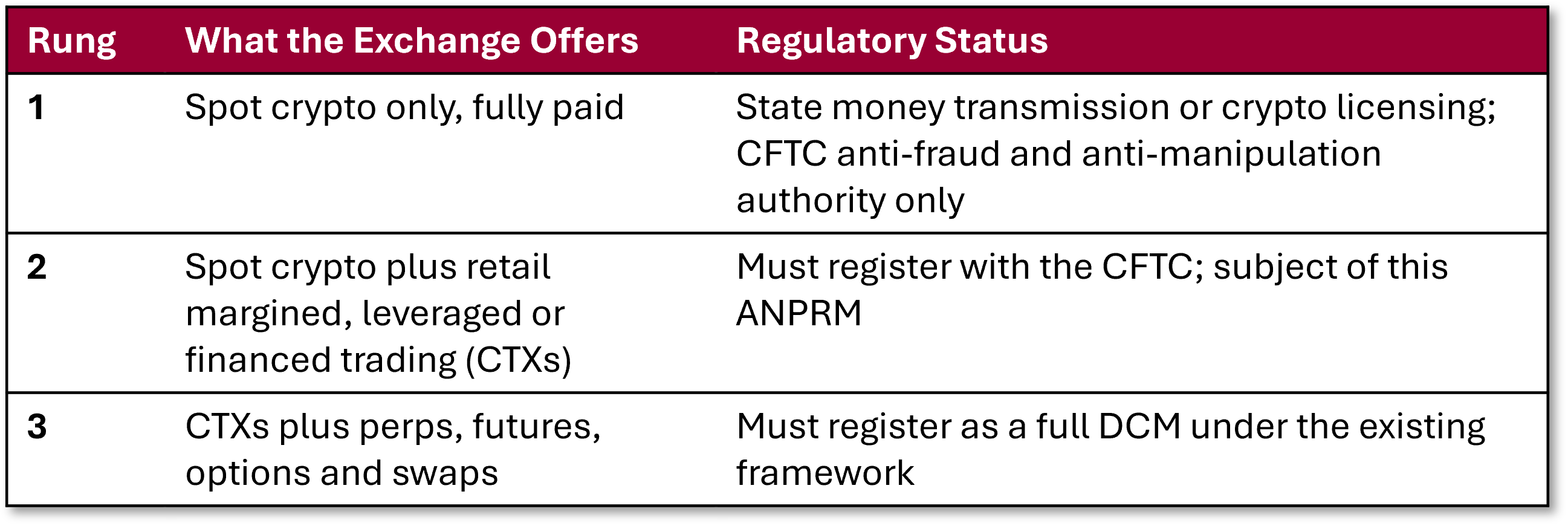
Regulation CTX: What Counts as a Covered Transaction. A CTX is a 2(c)(2)(D) retail commodity transaction involving a crypto asset. Any crypto asset other than a GENIUS Act payment stablecoin from a permitted issuer could be a commodity for this purpose. Two preliminary interpretations do most of the work:
- "Offer." A covered offer of leverage can be made through standard customer documentation, such as onboarding documents, exchange terms or margin agreements. It can apply to every transaction on an exchange or in an account. Financing arranged, marketed, revenue-shared or otherwise materially assisted by the exchange counts as “acting in concert.”
- Fully paid trades are swept in. Once a covered offer exists, it attaches to all transactions the customer could have financed, including those the customer pays for in full. A fully paid, open CTX held only as a book entry on the exchange stays inside the futures-style framework until actual delivery occurs.
Regulation CAM: Where CTXs Can Trade. The CAM is a new subcategory of DCM for platforms that list only CTXs. A CAM must meet the 23 statutory DCM core principles, implemented through a tailored set of "CAM Core Principles." Unlike a futures DCM, a CAM lists the crypto asset itself, not a contract referencing it. Existing DCMs could instead add CTXs under their current registration, with possible targeted relief. The ANPRM provides that a core motivation for the CAM Proposal is to address certain differences between a typical CTX and a typical futures contract.
CAM Core Principles – the ANPRM sets forth its preliminary understanding of how certain regulatory obligations under the DCM Core principles could be modified and solicits comments, including with respect to listing standards, susceptibility to manipulation and prevention of market disruption, position limits and accountability levels, trade information reporting and recordkeeping, trade execution, operational risk and system safeguards, proof of reserves.
The ANPRM also accommodates the integrated model crypto exchanges already use. Appendix A sketches four registered structures:
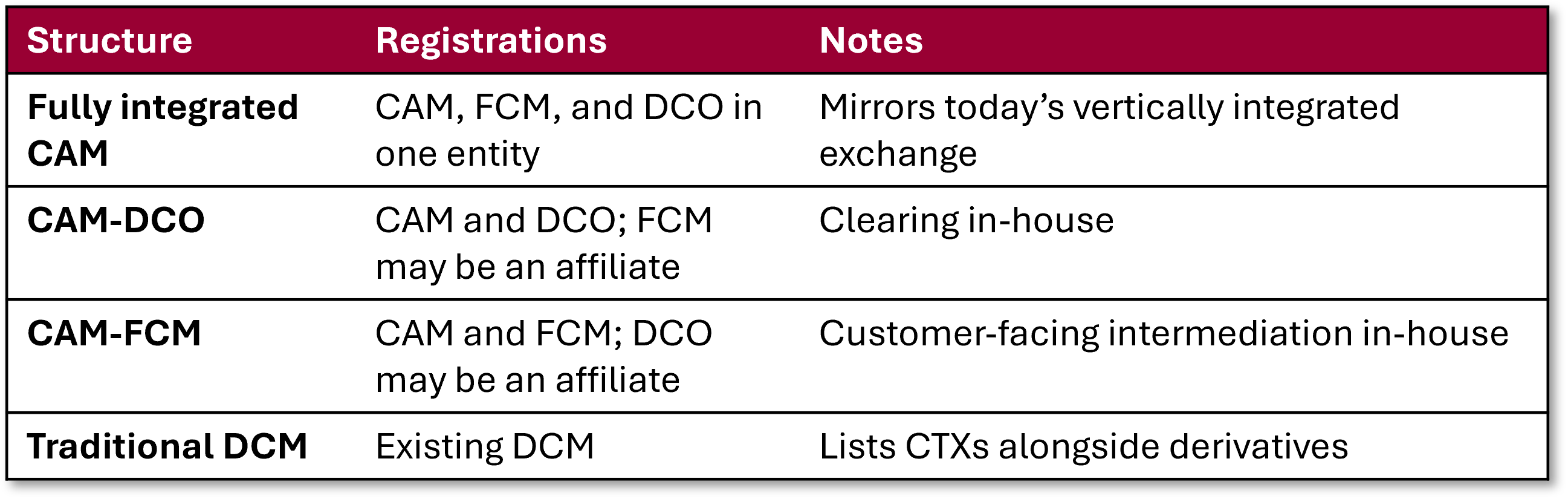
A standalone CAM is also permitted. Appendix A separately notes that CTXs executed through onchain protocols typically result in actual delivery and fall outside the regime.
The Commission requests comment on every aspect of Regulation CTX and Regulation CAM, and also poses specific questions. These questions, which are listed and paraphrased in Exhibit A below, cover a number of topics, including "offer," "actual delivery," listing standards, surveillance and market disruptions, position limits, reporting and recordkeeping, trade execution, proof of reserves, leverage arrangements, the CAM margin regime, FCM and IB intermediation, clearing and settling CTXs, multiple registrations, and CAM designation, exemptions, and eligible assets.
ANPRM Benefits for Certain Market Participants
Centralized Crypto Exchanges. The CAM gives them a registration built to address spot markets. It also lets them keep the integrated exchange, broker, clearing and custody model that existing CFTC rules do not easily accommodate. The CFTC's framing points toward one national regime in place of multistate licensing, and the ANPRM expressly asks what state requirements could frustrate that goal. Exchanges that do not want federal oversight can stay spot-only under state law. The Commission asks whether the "offer" interpretation leaves that option commercially viable.
Existing DCMs and FCMs. Registered DCMs can add CTXs under their current designation, with possible targeted relief, so they can compete with crypto-native platforms without re-registering. FCMs gain a new line of business: intermediating CTXs, extending financing and sponsoring bank leverage providers. A limited-purpose FCM category could lower the cost of entry for firms that only want to intermediate CTXs.
Banks. Depository institutions get a defined role as FCM-sponsored leverage providers, a natural fit for prime brokerage and lending businesses.
DeFi Protocols, Wallet Providers and Self-Custody Users. The Commission preliminarily views onchain protocols that deliver assets to the user's wallet as satisfying actual delivery, even with protocol-level liquidation mechanics. That view reverses the theory behind the Uniswap and other DeFi orders. Combined with Selig's stated intent to protect developers who publish code without controlling execution or holding assets, it gives builders a clearer answer than they have had. A March 2026 staff no-action position for a self-custodial wallet provider already points in that direction.
Retail Customers. Customers who trade on leverage would get exchange-level protections that state money transmission law does not provide: manipulation-resistant listings, surveillance, segregation, net capital, proof of reserves and FCM disclosures. The ANPRM cites FTX's CFTC-registered entity, whose customer assets stayed segregated, as evidence that this framework works. Customers who want to hold their own keys can still take actual delivery and leave the regime.
Token Projects. The listing factors give a forward-looking checklist: unrestricted circulating supply, decentralized control, open-source code and network resilience. Projects that meet them will be easier to list on a CAM.
Open Issues:
The ANPRM is an early-stage notice, not a rule, and several issues will shape whether the regime is commercially usable.
- The “offer” interpretation cuts both ways. If a covered offer in onboarding or margin documents pulls every transaction on an exchange into the CFTC's jurisdiction, including fully paid trades, an exchange offering any retail leverage effectively moves its whole book under federal oversight. That supports a single national regime. But it also raises the stakes of Rung 2, and it makes how exchanges structure affiliated lending and "vault" products critical. The ANPRM asks whether onchain vaults reached through an exchange interface could themselves be a covered offer.
- Liens and actual delivery. The ANPRM states its view of Monex inconsistently. Section IV says actual delivery may occur even while a lien or security interest remains outstanding; Section V.H says it may not. This needs clarification in comments, because it decides whether margined onchain purchases fall outside the regime.
- FCM fit. Section 4d segregation, Regulation 1.30 on FCM loans, Regulation 1.56's ban on guarantees against loss, permitted depository rules and net capital were all built for futures. Securing a leverage provider's lien on CTX assets is a particular problem: under current rules a creditor cannot hold a security interest in an FCM segregated account. How much relief the Commission grants will largely decide whether the model works.
- Conflicts in integrated structures. A combined CAM, FCM and DCO would set margin that drives its own trading revenue and act as lender and liquidator to its own customers. The ANPRM flags these conflicts, linking them to the August 2026 Conflicts and Affiliations proposal, but does not resolve them.
- Durability and preemption. The regime rests on interpretation of existing law, not new legislation. A future Commission could narrow it, and states may resist federal exclusivity over spot-held CTX assets. Selig concedes the point in his op-ed: the CFTC hasn't "solved every problem, nor can agency action substitute indefinitely for a statutory framework passed by Congress."
- What is not covered. The ANPRM addresses Rung 2 only. Perps and other derivatives continue under the existing DCM framework. Securities-status questions and NFTs are raised for comment but not answered, and the developer safe harbor Selig described is outside this notice.
Next Steps. Comment period and next steps are due 60 days after the ANPRM is published in the Federal Register. The Commission seeks comment on every aspect of the notice. It specifically invites responses from state-regulated exchanges, DCMs, FCMs, DCOs, banks, technology firms, trade associations, and investors.
Because this is an advance notice, comments will shape the actual proposed rules. Market participants considering a CAM, CAM-FCM or integrated structure, or a DCM looking to list CTXs, should engage now on the issues that most affect them: FCM relief, the margin regime, and clearing through a limited guaranty.
Please reach out to Alexandra C. Scheibe if you have any questions about the ANPRM or its implications for your business.
Exhibit A: List of ANPRM Questions
Below is a list of the questions which the CFTC asks in the ANPRM, paraphrased in the order the ANPRM presents them, next to the topic each addresses.
CFTC questions on "offer" (ANPRM Section IV.B):
- Would the proposed interpretation of "offer" give firms that choose to offer CTXs a workable way to do so under CFTC regulation?
- Would it still leave exchanges a commercially viable way to decline to offer CTXs and remain under state regulation?
- What novel forms of leverage, margin or financing in crypto markets should the Commission consider? For example, is giving customers access to onchain "vaults" through the same interface where they buy crypto a covered offer?
Actual delivery. Under Regulation CTX, actual delivery requires that the customer obtain meaningful possession and control, which may mean holding the private keys. For assets with governance or staking rights, delivery may also require direct access to those rights without intermediary fees. The Commission's preliminary view is that onchain protocols typically settle in a way that satisfies this standard, even when a protocol-level lien supports a margined purchase. Once actual delivery occurs, only the CFTC's anti-fraud and anti-manipulation authority continues to apply.
CFTC questions on "actual delivery" (ANPRM Section IV.C):
- Is the proposed interpretation of "actual delivery" right in all respects?
- Do onchain trading protocols typically settle in a way that gives the buyer possession and control, and so results in actual delivery? How should the case-law distinction between an outstanding lien or security interest and meaningful possession and control apply?
- What technological features of crypto assets, such as governance rights or staking entitlements, should the Commission take into account when deciding whether actual delivery has occurred?
Crypto-specific listing standards. For Core Principle 3, the Commission proposes four preliminary factors for deciding whether a crypto asset is readily susceptible to manipulation:
- Economically available and unrestricted circulating supply, plus other liquidity dynamics.
- Economic, operational and governance control of the underlying blockchain.
- Whether the source code is open source and publicly available.
- The reliability, resilience and security of the network.
CAMs may have to publish "crypto asset disclosures" focused on manipulation risk. The ANPRM says expressly that these would not serve as issuer-style merit disclosures. It also asks whether the Part 40 self-certification process works for CTX listings.
CFTC questions on listing standards (ANPRM Section V.B.1):
- Are the four preliminary factors the right ones for judging whether a crypto asset is readily susceptible to manipulation? What other factors should apply?
- What should the proposed crypto asset disclosures contain, given that their purpose is manipulation risk rather than issuer-style merit disclosure?
- Does the existing Part 40 listing process work for CTXs, or is a modified listing mechanism needed? If so, what changes?
Surveillance, reporting and system safeguards. The ANPRM asks how CAMs should surveil both the CTX market and underlying spot markets, including offshore venues and pricing oracles. It also asks whether public blockchain data can help satisfy reporting and recordkeeping under Core Principles 8, 10 and 18. It invites comment on crypto-specific disruptions such as forks, chain reorganizations, congestion and oracle failures. It asks whether validator diversity and self-run nodes should inform operational risk under Core Principle 20, and how 24/7 trading fits core principle obligations.
CFTC questions on surveillance and market disruptions (ANPRM Section V.B.1, continued):
- How should the Commission assess a CAM's ability to surveil both the CTX market and the underlying spot markets? To what extent should a CAM bring in pricing and trading data from other venues, including offshore ones, and which tools, such as pricing oracles, should be allowed?
- Should the CAM rules specifically address crypto-specific disruptions, such as network congestion or downtime, forks and chain reorganizations, or oracle failures?
- How should market surveillance and trade monitoring work in CTX markets, including through blockchain-based tools?
CFTC questions on position limits (ANPRM Section V.B.2):
- Should the Commission set position limits for particular crypto assets or classes of assets, as it does for certain agricultural, metals and energy contracts?
- If not, should it issue guidance on how CAMs set position limits and accountability levels? How should that guidance differ from DCM practice for traditional asset classes?
CFTC questions on reporting and recordkeeping (ANPRM Section V.B.3):
- How can blockchain technology help CAMs meet Core Principles 8, 10 and 18? When would public blockchain data be enough to monitor trading?
- What compliance challenges do these core principles raise for CTX markets that traditional derivatives markets do not face, and what rule changes would address them?
- If a CAM relies on public blockchain data, should it be required to maintain policies on financial reporting, valuation and reconciling its internal ledgers to the chain? How should those obligations be structured?
- How should the 24/7 nature of crypto markets be treated under core principle obligations?
CFTC questions on trade execution (ANPRM Section V.B.4):
- How do typical crypto execution methods differ from those in traditional markets? Which are incompatible with the order-book-based DCM framework, and is any guidance under Core Principle 9 needed?
- Do crypto markets have counterparts to permitted off-exchange transactions such as transfer trades, exchanges for related positions and block trades? Are rule changes needed?
- Should the Commission confirm that a CAM or DCM may use a blockchain as its matching and execution layer? If so, what compliance procedures should be required?
- How should the Commission evaluate a CAM's controls over smart contracts that run without human intervention? Should it require pre-deployment testing, formal verification, audits or fail-safes?
- How should the Commission assess a CAM's reliance on cryptography and economic incentives, rather than contractual recourse, to secure the functions it performs?
- How should a CAM handle the absence of service-level agreements, guaranteed throughput or negotiated pricing for networks it does not control? What disclosures, capacity planning and contingency measures are needed for throughput limits and fee volatility?
Proof of reserves. The ANPRM notes the common practice of omnibus custody and asks what third-party attested proof-of-reserves practices should be built into the regime.
CFTC questions on proof of reserves (ANPRM Section V.B.6):
- What risks arise from crypto exchanges' typical custody practices, including omnibus accounts?
- Which proof-of-reserves practices, including those using blockchain technology, should be built into the CAM framework?
Leverage only through eligible providers. Financing would be available only from an FCM or an FCM-sponsored depository institution, under leverage arrangements listed in the CAM's rulebook. A sponsored bank would have to represent in writing that it will follow FCM rules for administering leverage. The margin regime is open: the Commission could leave margin to the DCO, as in futures, or prescribe requirements, possibly delegated to NFA. Questions cover collateral eligibility, rehypothecation and programmatic auto-liquidation.
CFTC questions on leverage arrangements (ANPRM Section V.C):
- Should anyone other than an FCM or FCM-sponsored bank qualify as an eligible leverage provider? If so, with what qualifications?
- Is it appropriate to require a sponsored bank to give the FCM a written representation that it will follow FCM rules on administering leverage? What else should govern the FCM-bank relationship?
- What other financing structures should the Commission consider?
- Under Core Principle 2, what practices or terms in offering financing should be treated as abusive?
CFTC questions on the CAM margin regime (ANPRM Section V.D):
- Should the Commission set CTX margin requirements directly, rather than leaving them to DCOs? If so, what should they be, how should they change in volatile markets, and should authority be delegated to NFA (as for RFEDs) or to the Division of Clearing and Risk?
- Given that futures-style margin may not fit CTXs, what margin regime or alternative structures should apply?
- What lessons from supervising crypto futures, including cash-settled, physically settled and perpetual contracts, should shape principles-based margin, clearing and operational standards? Which existing margin rules fit CTXs?
- What role should the Commission or self-regulatory organizations play in deciding which crypto assets are eligible margin collateral? May leverage providers or SROs set their own criteria?
- Should certain crypto assets be barred as collateral, for example those below minimum market capitalization or daily trading volume thresholds?
- What are the benefits and risks of continuous margining, auto-liquidation and other programmatic risk management, and what regulatory structures would give confidence that they work?
- What other operational, credit or market risk mitigants should apply to leveraged positions?
- Should rehypothecation of customer crypto assets be permitted? If so, how should it be limited to avoid under-segregation, and do Part 190 or the Bankruptcy Code pose problems?
- How should custody and segregation work for fully paid, open CTXs, and what insolvency issues arise if those positions are not held in customer segregated accounts?
- Are traditional DCM emergency powers and DCO liquidation authority, including porting, adequate for leveraged spot positions, or is a different approach needed?
Mandatory FCM intermediation. All CTXs would be intermediated by an FCM, operating under a modified “FCM CTX regime” that may become a limited-purpose registration category. That brings section 4d segregation, net capital, risk management, NFA membership and BSA/AML obligations. FCMs would give customers risk disclosures and asset-specific disclosures covering the underlying technology, utility, governance, trading volume and volatility, and the FCM's own conflicts. The ANPRM asks for input on custodians, permitted depositories and RFED-style capital as an alternative.
CFTC questions on FCM and IB intermediation (ANPRM Section V.E):
- What form and content should FCM risk disclosures and asset-specific disclosures take?
- When, if ever, should retail customers be allowed to trade CTXs on a CAM without an FCM?
- What relief from current FCM obligations would be needed, particularly section 4d segregation and customer protection rules? What changes to Part 190 would be required?
- Is the Commission correct that a section 4d segregated account holding CTX proceeds falls within its exclusive jurisdiction under CEA section 2(a)(1)(A)?
- Should the Commission clarify how FCMs may use blockchain technology to accept customer orders and funds? Which FCM obligations would get in the way?
- How should Regulations 1.20 (segregation) and 1.49 (denomination and location of customer funds), including the permitted-depository requirement, apply to CTXs?
- What conditions should apply when an exchange uses a custodian, and how should they differ from those in traditional futures markets?
- What role should introducing brokers play in CTXs, and do IB rules need to change?
- Is NFA's FCM framework compatible with the CAM proposal, and what changes would be needed?
- Is the FCM risk management framework compatible, and which obligations should be amended?
- Should there be a limited-purpose FCM registration for firms that intermediate only CTXs? What added risks arise when one FCM handles both CTXs and traditional futures?
- How should the Commission reconcile an FCM's obligations under the CTX regime with its obligations for traditional futures? Commenters are asked to identify specific conflicts.
- How would FCM net capital rules apply, what changes are needed, and would the RFED capital regime be a viable alternative?
Tailored clearing. CTXs must clear through a DCO under Core Principle 11. The ANPRM recognizes that a typical CTX has two parts: a spot leg that may settle on the CAM's books, and a separate financing agreement. It asks whether a DCO's limited guaranty, rather than full novation, could cover residual risk on leveraged positions. It also raises how CTXs would be treated in an FCM bankruptcy under Part 190, including whether UCC Article 8 could serve as an alternative.
CFTC questions on clearing and settling CTXs (ANPRM Section V.F):
- Is the DCO framework fit for CTXs? Which rules need amending or exemptive relief, and on what conditions?
- What alternative clearing and settlement processes should be considered for the spot leg, and how can they meet the CEA's customer protection and risk management goals?
- How may a DCO use blockchain technology in clearing and settling the spot leg, and which rules would need to change?
- Could a DCO's limited guaranty of leveraged positions satisfy Core Principle 11 and address residual risks, including member default?
- How would a limited guaranty interact with the DCO requirement to hold resources sufficient to cover the default of its largest clearing member (Regulation 39.11(a))?
- Are there circumstances where mutualizing losses on leveraged positions would be appropriate?
- How could a DCO provide multilateral settlement or netting for CAM transactions, and would that be separate from settlement of the underlying spot sales?
- If FCM-intermediated CTXs are not cleared by a DCO, how could they qualify as "commodity contracts" so that the crypto assets an FCM holds count as customer property under Part 190? Alternatively, could an arrangement built on UCC Article 8 substitute for those bankruptcy protections?
- Should platforms be required to disclose how their insolvency would affect customer assets, and how would that differ from current disclosures?
Multiple registrations under the CAM Proposal and conflicts. The ANPRM allows a CAM to register as, or affiliate with, an FCM and a DCO. In an integrated group, the affiliated FCM may underwrite customer loans, sponsor bank lenders, liquidate positions and make crypto disclosures. An affiliated DCO may supervise bilateral loans and set maintenance margin that drives its affiliates' revenue. It discusses CAM-FCM Integration, CAM-DCO Integration,
CFTC questions on multiple registrations (ANPRM Section V.G):
- Is relief needed from duplicative requirements, including reporting and capital? Should FCM capital and financial reporting rules apply to a CAM, or should an alternative approach be used?
- Does the CAM proposal raise new conflicts of interest, and how should they be mitigated?
- Does the proposal create problems for FCMs that are also SEC-registered broker-dealers?
- In a CAM-FCM structure, do the FCM’s lending, sponsorship, liquidation and disclosure activities create conflicts that call for new rules?
- Does Regulation 1.30 on FCM loans need to be revisited, and does the proposal implicate Regulation 1.56’s prohibition on guarantees against loss?
- In a CAM-DCO structure, what conflicts arise from a DCO supervising individualized loans and setting margin that affects its affiliates’ revenue and unaffiliated participants' liquidations?
CAM designation and exemptions. The Commission preliminarily supports exempting trading facilities whose CTX volume or leveraged notional falls below a threshold that commenters are asked to propose.
CFTC questions on CAM designation, exemptions and eligible assets (ANPRM Section V.H):
- Would the CAM proposal let market participants meet the on-exchange requirement under a single uniform federal framework? Which requirements of other jurisdictions could undermine that?
- How can the Commission promote fair competition between DCMs and CAMs, for example through targeted relief or by letting DCMs adopt selected parts of the CAM framework for CTXs?
- Does the proposal leave crypto exchanges a commercially viable path to stay under the state spot-market regime?
- Is the Commission correct that typical onchain applications result in actual delivery? How should the lien-versus-control distinction apply to CTXs offered through onchain applications?
- Is a de minimis exemption from CAM registration appropriate, and what threshold should apply?
- What securities-law issues arise where a crypto asset underlying a CTX is claimed to be a security or part of an investment contract?
- Given that commodities are typically fungible, how should NFTs be treated under the CFTC's jurisdiction?
[1] RIN 3038-AF80.