Overview
Introduction
The first year of President Trump's second term marked a significant shift in the enforcement of the Foreign Corrupt Practices Act (FCPA) and broader corporate enforcement policy. In February 2025, President Trump issued an Executive Order directing the US Department of Justice (DOJ) to pause enforcement of the FCPA for a 180-day period and directed a review of existing cases to ensure that their continued pursuit aligned with the administration's policy priorities.1 In the Executive Order, the President directed the Department to issue updated FCPA enforcement guidelines on the types of cases to pursue in alignment with the President's "America First" agenda.
In June 2025, the enforcement pause ended, and DOJ released updated FCPA enforcement guidelines focusing on a non-exhaustive list of factors to pursue cases that:
a. have a connection to cartel or TCO activities, including cases where the only connection to a TCO is that a foreign official who was involved separately received bribes from cartels or TCOs;
b. vindicate US businesses' interests if US businesses lost revenue as a result of the bribery scheme;
c. advance US national security interests, particularly, where critical infrastructure or assets are at issue-such as critical minerals,2 ports, defense, technology, and other strategically significant assets,3 or
d. involve serious misconduct, rather than routine business practices.4
The Guidelines noted that the DOJ will also consider whether cases may be appropriate for enforcement under the Foreign Extortion Prevention Act (FEPA), which criminalizes foreign officials' receipt of corrupt payments.5
The FCPA Guidelines operate alongside the DOJ's Corporate Enforcement and Voluntary Self-Disclosure Policy (CEP), which was updated in May and governs charging and resolution decisions in all DOJ corporate criminal cases.6 The updated CEP reaffirmed the importance of cooperation and self-disclosure to the DOJ, stating that the Criminal Division will decline to prosecute a company when the following conditions are met: (i) the company voluntarily self-disclosed the misconduct; (ii) the company fully cooperated with the investigation; (iii) the company timely and appropriately remediated the misconduct, and (iv) there are no aggravating circumstances related to the nature and seriousness of the offense, the harm caused, or similar criminal resolutions within the past five years. Even if aggravating factors are present, prosecutors retain discretion to recommend a CEP declination based on the company's cooperation and remediation.7
In May 2025, the DOJ also expanded the Corporate Whistleblower Awards Pilot Program, which was begun under the prior administration. Under this program, the DOJ has discretion to provide financial awards to whistleblowers who report corporate misconduct that results in a forfeiture of funds or other assets to the Department in cases where the matter would not have fallen within the scope of an already-existing whistleblower program, such as the long-standing program administered by the SEC. With respect to foreign corruption matters, this means that whistleblowers who provide tips relating to privately held companies engaging in bribery under the FCPA, as well as tips involving violations of FEPA, are potentially eligible for rewards under the DOJ program.8
Also in May 2025, a new memorandum on monitorships altered Criminal Division policy to be more restrictive in terms of whether to impose a monitorship and to limit the scope where one was required.9
In addition to these policy changes, there have also been changes within the enforcement agencies responsible for FCPA enforcement. While the DOJ's FCPA Unit remains in place and continues to be led by a veteran DOJ official, it is reportedly operating with a reduced headcount. Although the SEC has not formally disbanded its FCPA Unit, there has been no publicly identified unit or unit leadership since the departure of the head of that unit in early 2025, suggesting a practical de-emphasis on FCPA matters within the Commission. Indeed, the SEC has recently closed several FCPA-related matters involving Calavo Growers,10 GE Healthcare,11 Inotiv,12 and Stryker.13 And in early 2026, the new SEC Head of Enforcement announced her intended departure unexpectedly.
Overall, 2025 reflects a recalibration of FCPA enforcement policy and practice. While the administration has articulated a more limited as well as policy-driven approach to foreign bribery enforcement—one that emphasizes US competitiveness, national security, and efficient use of enforcement resources—core elements of the enforcement framework, including individual accountability, cooperation incentives, and whistleblower engagement, remain in place. Moreover, 2026 has already seen new cases brought against multiple individuals. In March, the DOJ indicted two individuals associated with an alleged scheme to bribe a physician at a French state-owned hospital in connection with purchases of medical devices, while at the same time agreeing to a formal declination for the individuals' employer, a medical device company headquartered in France. Under the declination, which the DOJ stated was based on the company's voluntary disclosure and other factors under the DOJ's Corporate Enforcement Policy, the company agreed to disgorge $1.2 million in alleged ill-gotten gains. In parallel, the company entered into a settlement with the French authorities. That same month, the DOJ indicted a Houston oil industry consultant for allegedly conspiring to bribe an official at Mexico's state-owned oil and gas company, PEMEX, to obtain a contract worth several hundred million dollars to supply equipment.
Taken together, these developments suggest that FCPA enforcement risk has not been eliminated, and indeed at least in the near term it may be more difficult to predict how the Department will approach particular cases. It will be important to observe how the DOJ applies its current approach over time and across different scenarios. This reinforces the need for companies to maintain robust corruption and anti-bribery compliance programs.
1 Exec. Order No. 14209, Pausing Foreign Corrupt Practices Act Enforcement to Further American Economic and National Security, 90 Fed. Reg. 9587 (Feb. 10, 2025), https://www.whitehouse.gov/presidential-actions/2025/02/pausing-foreign-corrupt-practices-act-enforcement-to-further-american-economic-and-national-security/.
2 The list of critical minerals, as defined by the Secretary of the Interior acting through the US Geological Survey, can be found in the Federal Register: https://www.federalregister.gov/documents/2022/02/24/2022-04027/2022-final-list-of-critical-minerals.
3 This is consistent with an earlier memorandum revising national security and counter-narcotics strategies: Memorandum from the Att'y Gen., Total Elimination of Cartels, and Transnational Criminal Organizations (Feb. 5, 2025), https://www.justice.gov/ag/media/1388546/dl?inline.
4 Memorandum from the Deputy Att'y Gen., US Dep't of Justice, Guidelines for Investigations and Enforcement of the Foreign Corrupt Practices Act (FCPA) (June 9, 2025), https://www.justice.gov/dag/media/1403031/dl.
5 Iris E. Bennett et al., DOJ's New FCPA Enforcement Guidelines: Continuity with a Twist, Steptoe (June 16, 2025), https://www.steptoe.com/en/news-publications/dojs-new-fcpa-enforcement-guidelines-continuity-with-a-twist.html#_ftn9.
6 US Dep't of Justice, Criminal Division, Criminal Division Corporate Enforcement and Voluntary Self-Disclosure Policy (May 12, 2025), https://www.justice.gov/criminal/media/1400031/dl?inline.
7 Id. The key tenets of this Criminal Division policy were subsequently expanded to apply across the whole Department in March 2026.
8 Press Release, US Dep't of Justice, Criminal Division, Criminal Division Corporate Whistleblower Awards Pilot Program, (updated May 12, 2025), https://www.justice.gov/criminal/criminal-division-corporate-whistleblower-awards-pilot-program.
9 Memorandum on Selection of Monitors in Criminal Division Matters, US Dep't of Justice (Feb. 5, 2025), https://www.justice.gov/criminal/media/1400036/dl?inline.
10 Calavo Growers, Inc., Form 10-Q for the quarter ended July 31, 2025 (filed Sept. 9, 2025), https://ir.calavo.com/static-files/f3ab7116-2aad-4de9-9963-1949a8a79c87.
11 GE HealthCare Technologies Inc., Form 10-Q for the quarter ended June 20, 2025 (filed July 30, 2025), https://www.sec.gov/Archives/edgar/data/1932393/000193239325000049/gehc-20250630.htm.
12 Inotiv, Inc., Current Report (Form 8-K) (June 2, 2025) (filed June 4, 2025), https://content.edgar-online.com/ExternalLink/EDGAR/0001628280-25-029227.html?hash=3716d08b53ba6d073fb15032e89dfb5e1814a1bce6f71f582b8dd6abb10c9e9f&dest=notv-20250602_htm#notv-20250602_htm.
13 Stryker Corp., Form 10-K.(Feb. 11, 2026), https://www.sec.gov/ix?doc=/Archives/edgar/data/310764/000031076426000010/syk-20251231.htm.
The overall numbers for 2025 were down, as reflected in the chart below reflecting DOJ and SEC cases over the past ten years:
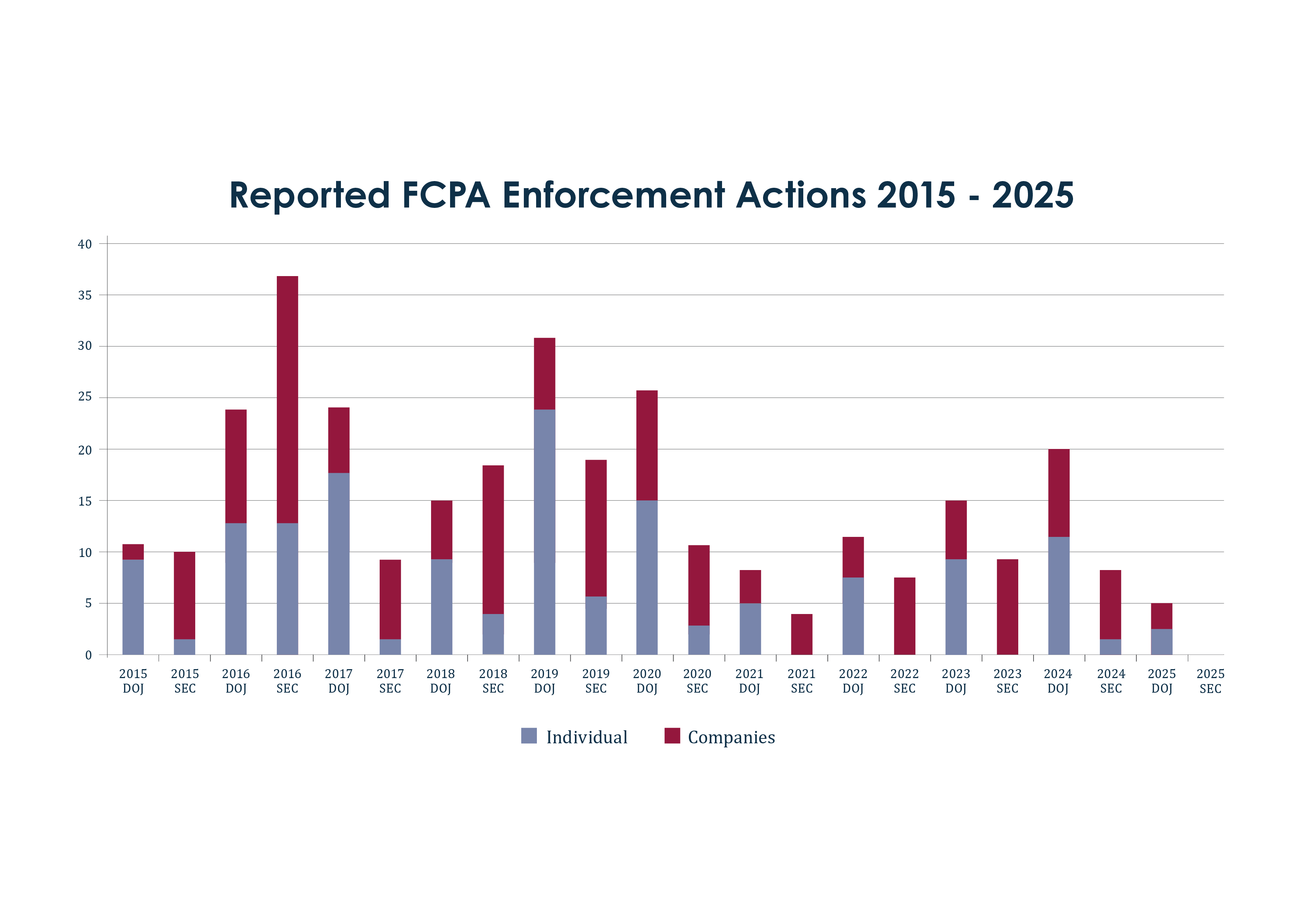
*Formal declinations under the DOJ’s Corporate Enforcement Policy are not included in this graph.
A. New Corporate Cases
1. Smartmatic
In October 2025, the DOJ brought criminal charges against SGO Corporation Limited (also known as Smartmatic), adding the company as a defendant in an ongoing FCPA matter arising from alleged bribery connected to election contracts in the Philippines.1 The indictment alleges that Smartmatic and certain executives conspired to violate the FCPA and committed related money-laundering offenses by paying more than $1 million in bribes to a senior Philippines election official to obtain and retain government contracts and associated business advantages related to the country’s 2016 elections, and concealing those payments through inflated contracts, fraudulent agreements, coded communications, and international bank transfers.2 Notably, the charges against Smartmatic mark the first time in more than a decade that the DOJ has brought a grand jury indictment against a corporate entity under the FCPA rather than resolving the allegations through a settlement with the company. Smartmatic is actively litigating the matter, and as of this writing, it has not yet been resolved.
2. TIGO Guatemala
The DOJ resolved charges against Communicaciones Celulares S.A. (dba TIGO Guatemala) through a deferred prosecution agreement in a matter that was voluntarily self-disclosed by the company in 2015 and reopened in 2020 following the emergence of new evidence from external sources.3 The agreement resolved allegations that the company participated in a bribery scheme orchestrated by its then-shareholder and other senior personnel who made monthly cash payments to members of the Guatemalan Congress or members of their security team in exchange for support for legislation that benefited TIGO Guatemala and other advantages to the company’s telecommunications business. Some of the cash allegedly used to pay bribes consisted of laundered proceeds of narcotics.4 The DOJ credited the company for its voluntary self-disclosure, sustained cooperation with the agency over an extended period, and remedial measures.5 Those factors resulted in a two-year DPA period with self-reporting and no independent monitor.
3. Liberty Mutual
The DOJ declined to prosecute Liberty Mutual for alleged FCPA violations committed by the company’s subsidiary in India.6 The DOJ investigation found evidence that employees of the Indian subsidiary paid approximately $1.47 million in bribes to officials at six state-owned banks to secure customer referrals, and concealed payments by classifying the payments as marketing expenses and using third-party intermediaries.7 The DOJ declined to prosecute because the company (i) voluntarily self-disclosed the conduct in 2024; (ii) fully and proactively cooperated with the DOJ’s investigation; (iii) provided appropriate remediation through early acceptance of responsibility and separation from personnel involved in the misconduct; and (iv) made enhancements to its compliance program and internal controls, including as related to third parties. The DOJ also concluded that there were no aggravating circumstances.8As part of the resolution, Liberty Mutual agreed to disgorge nearly $4.7 million.9
B. Modification of Prior Corporate Resolutions
Illustrating the current administration’s perspective on monitorships and ongoing obligations after the resolution is reached, in five FCPA corporate resolutions reached in 2022-2023, the DOJ moved to end the ongoing reporting or monitorship.
Glencore had agreed to two independent monitorships of three years as part of its resolution of antibribery and commodity price manipulation. Both monitorships were terminated more than a year early.10
Stericycle, which had agreed to an independent monitorship of three years following resolution of antibribery and accounting violations, had its monitorship terminated over six months early due to the monitor certifying early that the compliance program was reasonably designed and implemented.11
Albemarle resolved antibribery violations with the DOJ in 2023, which included a three-year self-reporting obligation as to the ongoing enhancements to its compliance program.12 The NPA was terminated over a year early.13
ABB resolved antibribery and accounting violations with the DOJ in 2022 and agreed to self-report on improvements to its compliance program for the three-year period of its DPA.14 The DOJ terminated the DPA six months early.15
UOP (Honeywell) entered into a DPA with the DOJ in an FCPA matter in 2022 and agreed to report to the DOJ on its compliance program enhancements for a three-year period.16 In July 2025, the DOJ asked a court to terminate the DPA five months early as the company had satisfied the terms of its agreement.17
C. Corporate Cases with Non-Modified DOJ Agreements:
Several companies continue to operate under ongoing agreements, perhaps because these settlements were more recent and therefore less time has passed to enable implementation of compliance program improvements. For example:
- In March 2024, Gunvor S.A., pled guilty to conspiracy to violate the anti-bribery provisions of the FCPA and entered into a three-year plea agreement with the DOJ.18
- In October 2024, Raytheon Company entered into a deferred prosecution agreement with the DOJ for alleged violations of the anti-bribery provisions of the FCPA and alleged conspiracy to violate the Arms Export Control Act, and agreed to a settlement with the SEC for alleged books and records and internal controls violations related to the bribery allegations.19
The company also entered into a separate DPA related to alleged overbilling of the US government in connection with the sale and maintenance of anti-missile systems.20
In February 2026, the company disclosed that a single monitor had been appointed in connection with all three settlements.21 - In December 2024, McKinsey & Company Africa pled guilty to conspiring to violate the anti-bribery provisions of the FCPA and entered into a three-year deferred prosecution agreement with the DOJ.22
D. New Individual Cases:
1. Avila Lizarraga and Rovirosa Martinez
In August 2025, the DOJ charged Mexican citizens Ramon Alexandro Rovirosa Martinez and Mario Alberto Avila Lizarraga with FCPA and conspiracy charges related to a 2019-2021 bribery scheme with officials at Mexico’s state-owned oil company.23 Rovirosa owned and controlled several Mexican energy companies and employed Avila. Rovirosa and Avila paid bribes totaling approximately $150,000 in exchange for obtaining $2.5 million in contracts.24Proceedings against the defendants were severed as Avila was (and remains) a fugitive.25 In December 2025, a federal jury convicted Rovirosa on conspiracy to violate the FCPA and two FCPA violation charges.26
2. Carlos Leopoldo Alvelais Alarcon
In October 2025, Carlos Leopoldo Alvelais Alarcon pled guilty to conspiracy to violate the FCPA.27The Information and Plea Agreement related to this case are under seal.28
3. United States v. Nazar Mohamed and Azruddin Mohamed
In October 2025 the DOJ charged Guyanese citizens Nazar Mohamed and Azruddin Mohammed with conspiring to commit mail and wire fraud, four counts of wire fraud, five counts of mail fraud, and conspiring to commit money laundering.29 While this case is not being prosecuted under the FCPA, the underlying facts involve allegations of corruption. Both conspiracy charges relate to bribery schemes with Guyanese government officials, which allegedly enabled the defendants to avoid paying $50 million in tax and royalties to the Guyanese authorities.30 Furthermore, in June 2024, the US placed sanctions on both individuals and their company under the Magnitsky Act.31These sanctions also relate to the Mohammeds’ participation in corruption in Guyana.32
E. Already Indicted Cases (pre-Executive Order):
1. United States v. Gordon Coburn and Steven Schwartz
In February 2019, the DOJ charged US citizens Gordon Coburn and Steven Schwartz with conspiring to violate the FCPA, three counts of violating the FCPA, seven counts of falsifying books and records, and one count of circumventing internal accounting controls.33Both Coburn and Schwartz had been executives of Cognizant Technology Solutions Corporation. According to the indictment, Coburn and Schwartz allegedly participated in a bribery scheme to pay approximately $2 million to Indian government officials to obtain construction planning permits.34The SEC opened parallel proceedings against Coburn and Schwartz in February 2019.35The SEC charged Coburn and Schwartz with violating the anti-bribery, books and records, and internal accounting controls provisions of the Securities Exchange Act.36 In 2025, both the DOJ and SEC dismissed their actions against Coburn and Schwartz.37
2. United States v. Carl Zaglin, Aldo Marchena, Francisco Cosenza
In November 2023, the DOJ charged Carl Alan Zaglin, Aldo Nestor Marchena, and Francisco Roberto Cosenza Centeno with various counts related to allegations of bribing Honduran government officials to win contracts from 2015-2019.38 The DOJ charged (i) Zaglin and Marchena with conspiring to violate the FCPA; (ii) Zaglin with violating the FCPA; (iii) Zaglin, Marchena, and Cosenza with conspiring to commit money laundering; (iv) Marchena and Cosenza with money laundering; and (v) Marchena and Cosenza with engaging in transactions in criminally derived property.39 In September 2025, a federal jury convicted Zaglin of conspiring to violate the FCPA, violating the FCPA, and conspiring to commit money laundering.40 Both Marchena and Cosenza had already pled guilty at the time of the trial, in June 2025 and August 2025 respectively.41
3. Hobson
In 2022, the DOJ charged Charles Hunter Hobson, a former coal company vice president, with conspiring to violate the FCPA, violating the FCPA, conspiring to launder money, laundering money, and conspiring to commit wire fraud.42These charges were based on allegations that Hobson participated in a bribery and money laundering scheme from late 2016 to early 2020.43The indictment alleged that Hobson paid bribes to Egyptian government officials connected to an Egyptian state-owned chemicals company.44In exchange for these bribes, Hobson won over $140 million in contracts for his employer.45Hobson was convicted at trial in early 2026.46
4. United States v. Asante Kwaku Berko
In August 2020, the DOJ charged Asante Kwaku Berko, a dual citizen of the US and Ghana, with (i) conspiring to violate the FCPA, (ii) violating the FCPA, and (iii) conspiring to commit money laundering.47 These charges relate to allegations of Berko paying over $700,000 in bribes to Ghanian government officials between December 2014 and March 2017 in exchange for winning business from the Republic of Ghana.48 Berko worked at Goldman Sachs during the period in question. Berko allegedly agreed to pay bribes on behalf of Turkish Energy Company—a client of Goldman Sachs—to help the energy company win business and on the understanding the energy company would reimburse Berko for the bribes.49 In addition to repayment for the bribes, Berko and his co-conspirators also planned to collect payments from the Turkish Energy Company through Ghanian consulting companies.50 In January 2026, a federal court set a tentative trial date for Berko of July 27, 2026.51
5. United States v. Adani, et al.
In October 2024, the DOJ charged Gautam S. Adani and seven other individuals with FCPA-related offenses in connection with high-value solar energy supply contracts with the Indian government.52 This matter was dismissed as a matter of prosecutorial discretion in 2026.53In a separate matter, the SEC brought charges against Mr. Adani and certain of his associates with securities fraud offenses.54 The SEC matter was resolved with a total of $18 million in civil penalties.55
1 Superseding Indictment, United States v. Donato Bautista, No. 24-20324-CR-Williams(s) (S.D. Fla. Oct. 16, 2025), ECF No. 264, https://www.law360.com/articles/2400682/attachments/0.
2 Id.
3 Press Release, US Dep’t of Justice, Office of Public Affairs, TIGO Guatemala Paid Over $118M to Resolve Foreign Bribery Investigation, (Dec. 12, 2025), https://www.justice.gov/opa/pr/tigo-guatemala-paid-over-118m-resolve-foreign-bribery-investigation.
4 Id.
5 Id.
6 Letter from US Dep’t of Justice, Criminal Division, Fraud Section, to Counsel for Liberty Mutual Insurance Co. (Aug. 7, 2025), https://www.justice.gov/criminal/media/1410761/dl?inline.
7 Id.
8 Id.
9 Id.
10 Consent Motion to Modify Conditions of Probation, United States v. Glencore Int’l AG, No. 22-CR-00297 (S.D.N.Y. Mar. 20, 2025), ECF No. 63, https://www.courtlistener.com/docket/63333987/63/united-states-v-glencore-international-ag/. Memo Endorsement, United States v. Glencore Int’l AG, No. 22-CR-00297 (S.D.N.Y. Mar. 20, 2025, ECF No. 63.
11 Motion to Dismiss Information, United States v. Stericycle, Inc., No. 22-CR-20156, (S.D. Fla. Apr. 25, 2025), ECF No. 21, https://files.lbr.cloud/public/2025-04/21%20-%20DOJ%20motion%20to%20dismiss%20Stericycle%20DPA%2021%20April%202025.pdf?VersionId=AqQp5fCVxd6Kw7MHh1EnfwQVQaR.G3BP.
12 Non-Prosecution Agreement, In Re Albemarle Corp, (Sept. 28, 2023), https://www.justice.gov/d9/2023-09/alb-npa-9.28.23-fully-executed.pdf.
13 US Securities and Exchange Commission, Albemarle, Form 10-Q (Apr. 30, 2025), https://www.sec.gov/Archives/edgar/data/915913/000091591325000084/alb-20250331.htm.
14 Deferred Prosecution Agreement, United States v. ABB Ltd., No. 22-CR-220, Deferred Prosecution Agreement (E.D. Va. Dec. 2, 2022), ECF No, 16, https://www.justice.gov/media/1263851/dl?inline.
15 Government’s Unopposed Motion to Dismiss Information, United States v. ABB Ltd., No. 22-CR-220, (E.D. Va. June 18, 2022)), ECF. No. 23. Order, United States v. ABB Ltd., No. 22-CR-220, (E.D. Va. June 20, 2022), ECF No. 24.
16 Deferred Prosecution Agreement, United States v. UOP LLC d/b/a HONEYWELL UOP, No. 22-CR-624, (S.D. Tex. Dec. 19, 2022), ECF No. 10, https://www.justice.gov/media/1265661/dl?inline.
17 Unopposed Motion to Dismiss, United States v. UOP LLC d/b/a HONEYWELL UOP, No. 22-CR-624, (S.D. Tex. July 2, 2025), ECF No. 24.
18 Press Release, US Dep’t of Justice, Commodities Trading Company Will Pay Over $661M to Resolve Foreign Bribery Case (Mar. 1, 2024), https://www.justice.gov/criminal/case/united-states-v-gunvor-sa.
19 Deferred Prosecution Agreement, United States v. Raytheon Co., 24-CR-399, (E.D.N.Y Oct. 16, 2024), ECF No. 5, https://www.justice.gov/media/1373661/dl?inline.
20 Press Release, US Dep’t of Justice, Raytheon Company to Pay Over $950M in Connection with Defective Pricing, Foreign Bribery, and Export Control Schemes (Oct. 16, 2024), https://www.justice.gov/archives/opa/pr/raytheon-company-pay-over-950m-connection-defective-pricing-foreign-bribery-and-export.
21 US Securities and Exchange Commission, RTX Corporation, Form 10-K (Feb. 6, 2026), https://investors.rtx.com/static-files/48441476-cd9c-4a6e-b153-8e739cb3b4d9.
22 Press Release, US Dep’t of Justice, McKinsey & Company Africa to Pay Over $122M in Connection with Bribery of South African Government Officials (Dec. 5, 2024), https://www.justice.gov/archives/opa/pr/mckinsey-company-africa-pay-over-122m-connection-bribery-south-african-government-officials.
23 Indictment, United States v. Rovirosa and Avila, No. 4:25-cr-00415 (S.D. Tex. Aug. 6, 2025) at 12, ECF No. 1, https://www.justice.gov/criminal/media/1417286/dl?inline.
24 Id. at 14.
25 Press Release, US Dep’t of Justice , Texas Businessman Convicted for Scheme to Bribe Mexican Government Officials (Dec. 5, 2025), https://www.justice.gov/opa/pr/texas-businessman-convicted-scheme-bribe-mexican-government-officials.
26 Id.
27 Order, United States v. Carlos Leopoldo Alvelais, No. EP:25-cr-02512(1)-KC (W.D. Tex. Oct. 24, 2025), ECF No. 22.
28 Id. ECF No. 24
29 Indictment, United States v. Nazar Mohamed and Azruddin Mohamed, No. 1:25-cr-20441-KMW (S.D. Fla. Oct. 2, 2025), ECF No. 1, https://www.justice.gov/criminal/media/1416731/dl?inline.
30 Id.
31 Press Statement, Matthew Miller, US Dep’t of State, Imposing Sanctions on Corrupt Actors in Guyana (June 11, 2024), https://2021-2025.state.gov/imposing-sanctions-on-corrupt-actors-in-guyana/.
32 Id.
33 Indictment, United States v. Gordon Coburn and Steven Schwartz, 18 USC. § 371 (D.C.N.J. Feb. 14, 2019), ECF. No. 1, https://www.justice.gov/media/989856/dl?inline.
34 Id. at 1.
35 Press Release, SEC, SEC Charges Cognizant and Two Former Executives With FCPA Violations (Feb. 15, 2019), https://www.sec.gov/newsroom/press-releases/2019-12.
36 Id.
37 SEC Also Dismisses Enforcement Action Against Coburn and Schwartz, FCPA Professor (July 16, 2025), https://fcpaprofessor.com/sec-also-dismisses-enforcement-action-against-coburn-and-schwartz/.
38 Indictment, United States v. Carl Zaglin, Aldo Marchena, Francisco Cosenza, No. 1:23-CR-20454-BB, (S.D. Fla. Nov. 28, 2023), ECF No. 3, https://www.justice.gov/media/1330111/dl?inline.
39 Id.
40 Press Release, US Dep’t of Justice, CEO of Georgia Company Convicted in International Bribery and Money Laundering Scheme (Sept. 15, 2025), https://www.justice.gov/opa/pr/ceo-georgia-company-convicted-international-bribery-and-money-laundering-scheme.
41 Id.
42 Press Release, US Dep’t of Justice, Former Coal Company Vice President Arrested and Charged with Foreign Bribery, Money Laundering, and Wire Fraud (March 31, 2022), https://www.justice.gov/archives/opa/pr/former-coal-company-vice-president-arrested-and-charged-foreign-bribery-money-laundering-and.
43 Id.
44 Id.
45 Id.
46 Press Release, US Dep’t of Justice, Former Coal Company Executive Convicted in International Bribery and Money Laundering Scheme (Feb. 19, 2026), https://www.justice.gov/opa/pr/former-coal-company-executive-convicted-international-bribery-and-money-laundering-scheme.
47 Indictment, United States v. Asante Kwaku Berko, No. 20-CR-00328 (E.D.N.Y. Aug. 26, 2020), ECF No. 3, https://www.justice.gov/media/1267761/dl?inline.
48 Id at 13.
49 Id at 13-20.
50 Id at 18.
51 Stewart Bishop, Ex-Goldman Exec Faces July FCPA Trial Over Ghana Deal, Law360 (Jan. 12, 2026), https://www.law360.com/articles/2429078/ex-goldman-exec-faces-july-fcpa-trial-over-ghana-deal.
52 Indictment at 1, United States v. Adani, et al., No. 24-CR-433 (E.D.N.Y. Oct. 24, 2024), https://www.justice.gov/media/1377741/dl.
53 Motion to Dismiss, United States v. Adani, et al., No. 24-CR-433 (E.D.N.Y. May 18, 2026), ECF No. 23. The DOJ moved to dismiss the case in May 2026.
54 Indictment, SEC v. Adani, et al., No. 1:24-cv-08080 (E.D.N.Y. Nov. 20, 2024), ECF. No. 1, https://www.sec.gov/files/litigation/complaints/2024/comp-pr2024-181.pdf.
55 Press Release, SEC Litigation Release No. 26554, SEC Files Proposed Final Judgments Against Gautam Adani and Sagar Adani (May 14, 2026), https://www.sec.gov/enforcement-litigation/litigation-releases/lr-26554.
A. China
Anti-corruption enforcement in China continued apace in 2025, reaching senior officials and maintaining a dual focus on both taking and offering bribes. Authorities pursued cross-border enforcement and concentrated enforcement efforts on the healthcare sector and the financial sector. In addition, regulatory updates were passed, designed to tighten standards and promote more consistent investigations.
1. Anti-Corruption/Bribery Enforcement
In January 2026, the Supreme People's Procuratorate (SPP) reported that from January through November 2025, procuratorates indicted around 26,000 suspects for criminal offenses committed by public officials or other persons exercising public power in connection with their official duties.1 Within this total, 6,749 individuals were reportedly prosecuted for corruption‑related offenses. In keeping with the policy of pursuing both bribe‑taking and bribe‑giving, procuratorates also prosecuted 2,982 individuals for offering bribes. Priority areas identified for anti‑corruption enforcement included finance, healthcare, construction, and the public procurement process.
Sky Net 2025 Campaign. In March 2025, Chinese authorities launched Sky Net 2025, a nationwide campaign aimed at locating and repatriating "corruption fugitives" and recovering illicit proceeds transferred abroad. The initiative is jointly led by multiple agencies, including the National Commission of Supervision and the Ministry of Public Security, and continues China's coordinated approach to cross‑border anti‑corruption enforcement through international cooperation, extradition, and asset recovery mechanisms.2 According to official statistics released subsequently, between January and November 2025, enforcement authorities repatriated 782 fugitives and recovered RMB 23.66 billion (approximately USD 3.4 billion) in illicit funds, reflecting sustained operational activity throughout the year. As of 2025, China has entered into anti-graft cooperation arrangements with more than 150 countries and over 30 international organizations.3
Healthcare Sector. On January 14, 2025, the State Administration for Market Regulation published the Compliance Guidelines for Healthcare Companies to Prevent Commercial Bribery Risks, which identify nine high-risk business scenarios across the lifecycle of pharmaceutical and medical device operations.4 To provide additional clarity, in April 2025, the Shanghai Administration of Market Regulation released a casebook of representative enforcement cases that illustrate how the nine high-risk scenarios may arise in practice.5 In parallel, the National Healthcare Security Administration further tightened its credit evaluation system for drug pricing and procurement in May 2025, increasing debarment and suspension risks for companies implicated in bribery violations.6
From an enforcement perspective, local media reports indicate that as of October 2025, authorities nationwide had investigated approximately 12,000 disciplinary and illegal cases in the medical sector, involving more than RMB 870 million (approximately USD 125 million), with corruption cases primarily concentrated in the procurement of pharmaceuticals and medical consumables.7
Financial Sector. The financial sector remained a top enforcement priority in 2025. On December 15, 2025, the Supreme People's Court and the Supreme People's Procuratorate stressed that corruption in the financial sector "severely disrupts financial order" and unveiled six landmark duty crime cases.8 In one case, a former bank president was sentenced to death with a two-year suspension of execution (and possibility of commutation to life imprisonment if no new offenses) for accepting more than RMB 132 million (approximately USD 19 million) in bribes, embezzling RMB 508 million (approximately USD 73 million) in public funds, and illegally issuing large volumes of loans and guarantees to benefit specific entities.9 Parallel enforcement featured multiple investigations and punishments of senior executives at major state-owned banks and insurers, including Bank of China Zhejiang Branch president Jun Cheng (Dec. 2025), China Construction Bank Guangxi Branch president Siying Li (Sept. 2025), and Agricultural Bank of China Zhejiang Branch president Jianlong Feng (May 2025), while local media reports indicate that 90 officials in the finance sector had been investigated by late October 2025.10
2. New Rules and Guidance11
Amendments to the Regulation on the Implementation of the Supervision Law (Effective June 1, 2025). The National Supervision Commission issued a revised Regulation on the Implementation of the Supervision Law, effective June 1, 2025, which seeks to expand and clarify procedural rules governing detention, compulsory appearance, and orders to await investigation, among other items. The Regulation is intended to increase nationwide consistency in handling corruption cases.12
Anti‑Unfair Competition Law Revision (Effective October 15, 2025). The Standing Committee of the 14th National People's Congress adopted amendments to the Anti‑Unfair Competition Law (AUCL), which took effect on October 15, 2025.13 The revised law seeks to strengthen China's framework governing commercial bribery and related market conduct by:
- Raising the maximum administrative fines for commercial bribery by business operators;
- Providing extraterritorial jurisdiction for unfair competition conducted outside the territory of China where the conduct disrupts the market competition order within China or damages the lawful rights and interests of Chinese business operators.
Evidence Guidelines for Investigating New and Disguised Forms of Corruption. On December 24, 2025, the General Office of the Central Commission for Discipline Inspection and the General Office of the State Supervision Commission jointly issued the Evidence Guidelines for Investigating New and Disguised Forms of Corruption.14 The Guidelines aim to strengthen evidentiary rigor and promote more consistent and legally sound handling of complex corruption cases, particularly where corruption is conducted covertly through ostensibly legitimate arrangements.
3. Regulatory Constraints on Foreign-Led Investigations
Investigations in China increasingly face significant legal and practical constraints, particularly where foreign authorities seek documents, data, or cooperation connected to mainland China. Over the past several years, China has taken a more assertive position in response to the extraterritorial reach of foreign courts, regulators, and law enforcement agencies. This posture is often framed in terms of protecting judicial sovereignty, data security, and national interests. As a result, foreign-led investigations, whether arising from criminal enforcement regulatory inquiries or civil litigation, may encounter substantial roadblocks when attempting to obtain information located in China or held by China-based entities.
A central challenge arises from China's restrictive framework governing cross-border data transfers. Multiple layers of regulation apply in the investigation context, including the PRC Data Security Law, the PRC Personal Information Protection Law, the PRC Law on Guarding State Secrets, and the International Criminal Judicial Assistance Law. Taken together, these regimes limit the ability of companies and individuals in China to provide documents or assistance directly to foreign judicial or law enforcement bodies and impose heightened scrutiny on the handling and transfer of personal, sensitive, or strategically significant information.
B. Hong Kong SAR
Hong Kong's anti-corruption landscape in 2025 showed a modest decline in complaints alongside stable prosecution activity, with cases spanning public works, banking, air cargo, and misuse of a Small and Medium-sized Enterprises (SME) loan guarantee scheme. The Independent Commission Against Corruption (ICAC) advanced sector-focused enforcement while operationalizing the Banking Industry Integrity Charter and expanding the Prevention of Bribery Ordinance (POBO) coverage to additional public bodies. International cooperation deepened through new bilateral frameworks, signaling continued emphasis on integrity governance, data handling discipline, and cross-border case coordination.
1. Complaints and Prosecutions Overview
Data released for the first eight months of 2025 indicate a modest decline in corruption‑related complaints and prosecutions: (1) corruption complaints were down by 17% in the same period; and (2) enforcement outcome remained stable with 120 individuals prosecuted in 56 cases.
2. Policies, Guidance, and International Collaboration
International Cooperation through Bilateral Frameworks. In February 2025, Hong Kong strengthened its international anti‑corruption cooperation by entering into a Memorandum of Understanding between the ICAC and the UAE Accountability Authority.15 In September 2025, the ICAC also exchanged a Memorandum of Understanding (MoUs)with the Integrity Authority of Hungary at the Belt and Road Summit.16 The MoUs establish a sustained framework for joint initiatives, including training, seminars, and cooperation in combating transnational corruption, and form part of a broader push under which the ICAC has entered into nine MoUs with overseas anti‑corruption agencies and international organizations since 2024 to foster cross‑border collaboration.17
Expansion of Public Bodies under the POBO. In 2025, Hong Kong expanded the scope of the POBO (Cap. 201) through the Gazette of the Prevention of Bribery Ordinance (Amendment of Schedules 1 and 2) Order 2025, which designated four companies as "public bodies" for the purposes of the POBO, namely Hong Kong Investment Corporation Limited, Hong Kong FMI Services Limited, OTC Clearing Hong Kong Limited, and CMU OmniClear Limited.18
With effect from June 20, 2025, the amendment brought these entities and relevant personnel within the POBO's anti‑bribery regime.
Banking Industry Integrity Charter. Building on its launch in October 2024, the ICAC's Banking Industry Integrity Charter became operational in 2025 with the first cohort of participating authorized institutions and dedicated training for designated Integrity Officers. Supported by the Hong Kong Monetary Authority (HKMA) and the Hong Kong Association of Banks, the Charter requires participating banks to adopt integrity policies, assign integrity governance roles, implement anti‑corruption training, and promptly report suspected corruption to the ICAC. In April 2025, the HKMA issued a circular encouraging wider industry participation and highlighting the Charter as a key mechanism to address emerging corruption risks in banking operations.19
C. India
In 2025, India's anti-corruption framework underwent notable institutional, legislative, judicial, and enforcement-related developments. A key structural reform occurred in June 2025, when India's anti-corruption ombudsman—the Lokpal—announced the creation of its long-awaited prosecution wing, more than a decade after Parliament enacted the Lokpal and Lokayuktas Act. The Act mandates the establishment of a prosecution unit to pursue cases against public officials. Despite the formal announcement, however, the operational rollout has been slow. Media reports indicate that the prosecution wing remains largely non-operational, with key posts—including the Director of Prosecution and other senior positions—yet to be filled and prosecution work continuing to be handled by the Central Bureau of Investigation (CBI).20
Alongside these institutional developments, India also saw legislative initiatives aimed at addressing political corruption. On August 20, 2025, Home Affairs Minister Amit Shah introduced the Constitution (130th Amendment) Bill, 2025, consistent with the Modi government's stated objective of combating corruption at the highest levels of government. The bill seeks to bar individuals holding key constitutional offices—including the Prime Minister, Chief Ministers, and Ministers of the central and state governments—from exercising official functions while in jail.21It further provides that officials who fail to secure bail within 30 days would be removed from their positions.22 While the bill has been welcomed by the ruling Bharatiya Janata Party (BJP), opposition leaders have voiced concerns that it could be deployed as a political tool against opposition-led state governments.23
Critics point to a perceived erosion of institutional integrity in federal investigative agencies, alleging that such bodies have been leveraged by the Modi government to pressure political rivals. As of the publication of this report, the bill remains under consideration and has not yet been passed by either house of Parliament.
Judicial developments in 2025 reinforced the evidentiary thresholds and expanded the scope of accountability under India's primary anti-corruption statute, the Prevention of Corruption Act, 1988 (PCA).24 In State of Lokayuktha Police v. C.B. Nagaraj (2025 SCC OnLine SC 1175), the Supreme Court reaffirmed the centrality of demand in bribery prosecutions, upholding the acquittal of a public official accused of demanding and accepting a bribe. The court found that material contradictions and inconsistencies in the complainant's testimony undermined proof of the alleged demand. Emphasizing that a conviction under the PCA requires a complete evidentiary chain of demand, acceptance, and recovery, the Court held that this threshold cannot be met where the existence of a demand itself is doubtful.
In a separate ruling, P. Shanthi Pugazhenthi v. State (2025 SCC OnLine SC 1091), the Supreme Court clarified the liability of private individuals who facilitate corruption by public officials. Dismissing the appeal of the spouse of a public official convicted for abetment, the Court held that individuals who induce or assist officials in committing corruption-related offenses may be prosecuted under Section 12 of the PCA. Noting that the appellant had actively assisted in the acquisition of assets disproportionate to known sources of income, the Court upheld her conviction, underscoring that anti-corruption enforcement extends beyond public officials to encompass private actors who enable or benefit from corrupt conduct.
Enforcement activities in 2025 reflected heightened scrutiny of corruption risks in sectors involving discretionary regulatory authority. In October 2025, India's Ministry of Finance directed the Department of Revenue to investigate bribery allegations against customs officials in Chennai following claims by a logistics company, Wintrack, Inc., that officials demanded bribes in exchange for clearing shipments and retaliated when those practices were publicly exposed.25 The allegations, aired through social media and widely circulated, prompted an official response from Chennai Customs disputing the claims and citing regulatory non-compliance by Wintrack. In another instance, in June 2025, CBI registered cases alleging that officials and intermediaries linked to India's medical education regulator, the National Medical Commission (NMC), accepted bribes to manipulate inspections and regulatory approvals for private medical colleges, leading to coordinated raids at approximately 15 locations across multiple states in November 2025.26
Complementing these enforcement efforts, the Indian government continued to advance technology-driven governance reforms under its Digital India Initiative, with a focus on reducing human discretion and increasing transactional transparency.27 These efforts include the expansion of digital payments, direct benefit transfers, faceless customs and tax administration, and online public procurement platforms such as the Government e-Marketplace. In parallel, the government has begun deploying AI-enabled analytics on a pilot basis to identify irregular transaction patterns in real time and flag potential corruption risks before they escalate. Together, the new measures reflect a broader shift toward preventive, technology-enabled anti-corruption controls designed to curb bribery and fraud across government operations.
D. Australia
In August 2025, Australia's National Anti-Corruption Commission (NAAC) published its Corporate Plan 2025 to 2029, setting a four-year blueprint aimed at detecting, deterring, and preventing serious or systemic corrupt conduct across the Commonwealth public sector through investigations, referrals, strategic intelligence, and targeted education.28 Focusing on corruption controls, the plan reaffirms the Commission's mandate to investigate serious or systemic corruption involving Commonwealth officials, to oversee or refer matters to other agencies where appropriate, and to publish prevention guidance aimed at high-risk corruption areas, while prioritizing outcome-based performance measures over volume metrics to ensure resources target the most serious threats.
In November 2025, the NAAC issued a targeted guide for Commonwealth Government Business Enterprises (GBE) that maps corruption risks at the public–private interface and explains how the NACC Act applies to GBE directors, officers, employees, contractors, consultants, and advisers.29
The guide highlights high‑risk sectors such as procurement and contracting, interference in decision‑making, and misuse of official information, and it sets out practical prevention steps and governance expectations for boards and executives.
On the enforcement front, in December 2025, the NAAC reported that it was conducting 30 preliminary investigations and 38 corruption investigations, with four matters before the courts, and that a total of eleven convictions had been secured from investigations the Commission had commenced or30
E. Indonesia
Indonesia's long‑running palm oil export permits case culminated in a Supreme Court reversal of prior acquittals in 2025. The case centers on allegations that, during the 2022 cooking oil shortage, major producers including Wilmar International Limited (Wilmar) secured or exploited export permits in breach of government controls, causing significant state losses and prompting a corporate corruption probe. After a lower court acquitted the companies, three trial judges were arrested in April 2025 amid reports of bribery connected to the favorable verdicts.31 The arrests triggered a cassation appeal by the Indonesian Attorney General's Office. On September 15, 2025, the Supreme Court overturned the acquittals and imposed a fine of IDR 1 billion (approximately USD 59,000) on each of five Wilmar subsidiaries and ordered compensation for state losses totaling approximately IDR 11.9 trillion (approximately USD 709 million).32
F. Malaysia
In August 2025, the Malaysian Anti‑Corruption Commission (MACC) announced that it had seized assets valued at more than RM 31.4 billion (approximately USD 7.8 billion) over the past five years.33The recovered assets ranged from cash and real estate to luxury vehicles, watches, and handbags, and were linked to investigations involving alleged smuggling syndicates, misappropriated infrastructure funds, and large-scale financial misconduct. Reflecting the complex local landscape, early in 2026 the MACC itself came under scrutiny, because of allegations that members of the commission had themselves engaged in corrupt conduct by using their positions to assist certain businesspeople in obtaining control over companies under investigation.34
Malaysia moved toward adopting a deferred prosecution agreement framework in 2025. The Special Cabinet Committee on National Governance, chaired by the Prime Minister, agreed in principle to the legal framework, and it is expected to be considered by the legislature in 2026.35
Malaysia also advanced a major procurement reform in 2025 through the Government Procurement Bill, which the Prime Minister described as a measure designed to eradicate corruption and prevent misuse of public funds.36 The bill imposes "full accountability" on all parties involved in procurement using public money and applies across federal, state, and local levels as well as to statutory bodies and government-linked companies. It seeks to strengthen disclosure requirements and mandates declarations of interest while promoting open tender procedures to curb unfair practices. It also establishes review panels and an independent appeal tribunal intended to improve oversight and reduce opportunities for misconduct.
G. Singapore
In 2025, Singapore made strides in terms of policy enhancements and enforcement, including in its first use of a deferred prosecution agreement, which related to conduct outside of Singapore.
On the policy side, various agencies updated internal anti-corruption frameworks and guidance during 2025. For example, the Ministry of Defense reiterated a zero-tolerance posture, mandatory declarations, personnel vetting, and whistleblowing protections in a July update that situates Corruption Practices Investigation Bureau's (CPIB) independent mandate within a broader system of controls.37
In July 2025, Singapore introduced its first use of a deferred prosecution agreement in a corruption matter when the Public Prosecutor and Seatrium Limited entered into a DPA over alleged corruption offences that occurred in Brazil, including improper payments connected to securing business with Brazilian state-linked entities.38 Under the terms announced, Seatrium agreed to pay a financial penalty of USD 110 million in Singapore, with up to USD 53 million creditable against penalties paid to Brazilian authorities under related leniency settlements, and to implement further enhancements to its ethics and compliance program. In parallel, the company disclosed that its Brazilian settlements total about BRL 728.9 million (approximately USD 131 million) and noted that domestic authorities had concluded a joint probe by the Monetary Authority of Singapore and the Commercial Affairs Department,39 underscoring the cross-border scope and coordinated nature of the enforcement response.
Other notable enforcement examples include a corruption scheme involving Singapore Customs.40 Four Certis security officers and a civilian were accused of giving and receiving bribes to obtain sensitive checkpoint information and to secure the omission of enforcement actions, resulting in charges under the Prevention of Corruption Act, the Official Secrets Act, and the Customs Act. The authorities alleged that the corruption-related payments spanned multiple occasions and that the alleged disclosure of sensitive operational details was intended to help the civilian evade checks, illustrating how bribery can intersect with the misuse of official information and customs offenses in border settings.
1 Press Release, SPP, Report on the National Procurators General Conference (Jan. 19, 2026), https://www.spp.gov.cn/zdgz/202601/t20260119_716283.shtml.
2 China Global Television Network, China launches ‘Sky Net 2025' to hunt corruption fugitives, CGTN (Mar. 25, 2025), https://news.cgtn.com/news/2025-03-25/China-launches-Sky-Net-2025-to-hunt-corruption-fugitives-1C1rUjCpCow/p.html.
3 Yang Zekun, Campaign to bring back graft fugitives bears fruit, china daily (Jan. 7, 2026), https://www.chinadaily.com.cn/a/202601/07/WS695dadcaa310d6866eb325bc.html.
4 State Administration of Market Regulation, Compliance Guidelines for Healthcare Companies to Prevent Commercial Bribery Risks (Jan. 14, 2025), https://www.samr.gov.cn/zw/zfxxgk/fdzdgknr/jjjzs/art/2025/art_0cee28b1eba84820addc024b351b7bac.html.
5 China News, Shanghai released Casebook on the Compliance Guidelines for Healthcare Companies to Prevent Commercial Bribery Risks (Apr. 18, 2025), https://www.chinanews.com.cn/cj/2025/04-18/10402085.shtml.
6 National Healthcare Security Administration, Notice on Further Refining the Drug Pricing and Procurement Credit Evaluation System (May 20, 2025), https://www.nhsa.gov.cn/art/2025/6/5/art_104_16740.html.
7 Sina Finance, 2025 White Paper on Anti-Corruption in China's Medical Sector (Nov. 7, 2025), https://finance.sina.com.cn/roll/2025-11-07/doc-infwqerx4756615.shtml.
8 The Supreme People's Procuratorate of the People's Republic of China, Crackdown seeks to curb finance fraud (Dec. 15, 2025), https://en.spp.gov.cn/2025-12/15/c_1147829.htm.
9 Id.
10 Sina Finance, Financial Anti‑Corruption Drive Deepens, 90 Cadres Investigated (Oct. 29, 2025), https://finance.sina.com.cn/money/bank/bank_hydt/2025-10-29/doc-infvqfef3281389.shtml.
11 Steptoe does not provide legal advice on the laws of the People's Republic of China. This section summarizes research from publicly available sources and is provided for informational purposes only.
12 Regulation on the Implementation of the Supervision Law (2025 Revision), https://jcs.zbnc.edu.cn/neirong.jsp?urltype=news.NewsContentUrl&wbtreeid=1011&wbnewsid=2462.
13Anti-Unfair Competition Law of the People's Republic of China (2025 Revision), https://www.pkulaw.com/en_law/1d79285621ad7295bdfb.html.
14 Xinhua News, China issues guidelines for evidence collection in investigating new, disguised forms of corruption (Dec. 24, 2025), https://english.news.cn/20251224/7af6cf633020465b84e35569845e4d5b/c.html.
15 Press Release, ICAC, ICAC Chief visits Middle East to foster anti-graft collaborations (Feb. 28, 2025), https://www.icac.org.hk/en/p/press/index_id_2062.html.
16 Press Release, ICAC, ICAC exchanges MoU with Hungarian Integrity Authority at B&R Summit to strengthen anti-corruption cooperation (Sept. 10, 2025), https://www.icac.org.hk/en/p/press/index_id_2163.html.
17 Id.
18 The Government of the Hong Kong Special Administrative Region's Press Release, Prevention of Bribery Ordinance (Amendment of Schedules 1 and 2) Order 2025 takes effect upon gazettal (June 20, 2025), https://www.info.gov.hk/gia/general/202506/20/P2025061900246.htm.
19 Hong Kong Monetary Authority, Circular to All Authorized Institutions: Banking Industry Integrity Charter (Apr. 15, 2025), https://brdr.hkma.gov.hk/eng/doc-ldg/docId/getPdf/20250403-4-EN/20250403-4-EN.pdf.
20 The Wire Staff, Parliamentary Panel Asks Lokpal to Clarify Status of Its Inquiry, Prosecution Wings, The Wire, (Mar. 23, 2026), https://thewire.in/government/parliamentary-panel-asks-lokpal-to-clarify-status-of-its-inquiry-prosecution-wings.
21 Press Release, Ministry of Home Affairs, Union Home and Cooperation Minister Shri Amit Shah Introduces the Constitution (One Hundred and Thirtieth Amendment) Bill, 2025, the Union Territories (Amendment) Bill, 2025, and the Jammu and Kashmir Reorganisation (Amendment) Bill, 2025, in the Lok Sabha (Aug. 20, 2025), https://www.pib.gov.in/PressReleasePage.aspx?PRID=2158593®=3&lang=2.
22 Id.
23 Snigdhendu Bhattacharya, Modi Government's New Bill Can Kill India's Opposition Politics, The Diplomat, (Aug. 23, 2025), https://thediplomat.com/2025/08/modi-governments-new-bill-can-kill-indias-opposition-politics-heres-how.
24 Chambers and Partners, Anti-Corruption 2026: India, Trends and Developments (Dec. 4, 2025), https://practiceguides.chambers.com/practice-guides/anti-corruption-2026/india/trends-and-developments.
25 Arun Janardhanan, Wintrack Case Prompts Customs Shake-Up: Vigilance Probe Ordered, Officers Transferred After Company Made Bribery Claims, Indian Express, (Oct. 12, 2025), https://indianexpress.com/article/cities/chennai/wintrack-case-harrasment-customs-probe-ordered-bribery-claims-10302236.
26Anurag Dwary, Enforcement Directorate Raids in 15 Locations Across 10 States in Medical College Scam, NDTV, (Nov. 27, 2025), https://www.ndtv.com/india-news/enforcement-directorate-raids-in-15-locations-across-10-states-in-medical-college-scam-9712254.
27Educrat IAS Academy, Fighting the Invisible Enemy: How India's New Anti-Corruption Policies Are Transforming Future (Sept. 3, 2025), https://educratias.com/new-anti-corruption-policies.
28 National Anti-Corruption Commission, Corporate Plan 2025-29 (Aug. 17, 2025), https://www.nacc.gov.au/sites/default/files/documents/2025-08/National%20Anti-Corruption%20Commission%20Corporate%20Plan%202025-29.pdf.
29 National Anti-Corruption Commission, Government Business Enterprises – What the NACC means for you (Nov. 27, 2025), https://www.nacc.gov.au/sites/default/files/documents/2025-11/Government%20Business%20Enterprises%20What%20the%20NACC%20means%20for%20you.pdf.
30 National Anti-Corruption Commission, Monthly update: December 2025 (Dec. 10, 2025), https://www.nacc.gov.au/news-and-media/monthly-update-december-2025.
31 Indonesia's Supreme Court overturns acquittals of palm oil firms over misconduct, Reuters (Sept. 25, 2025), https://www.reuters.com/sustainability/society-equity/indonesias-supreme-court-overturns-acquittals-palm-oil-firms-over-misconduct-2025-09-25/.
32 Wilmar International Limited, Announcement of Update on Decision of the Indonesian Supreme Court (Sept. 26, 2025), https://links.sgx.com/FileOpen/WIL%20Announcement.Update%20on%20Indonesian%20Supreme%20Court%20decision.ashx?App=Announcement&FileID=860263.
33 MACC seizes over RM31 billion in assets over five years, New Straits Times, (Aug. 15, 2025), https://www.nst.com.my/news/nation/2025/08/1260480/macc-seizes-over-rm31-billion-assets-over-five-years.
34 Malaysia forms special committee to probe anti-corruption chief, says communications minister, Reuters, (Feb. 12, 2026), https://www.reuters.com/sustainability/boards-policy-regulation/malaysias-anti-graft-chief-says-open-probe-his-shareholding-after-media-report-2026-02-13/ ; Tom Redmond and Niki Koswanage, Malaysia: MACC Allegedly Working With Businessmen to Seize Control of Companies, Bloomberg (Feb. 11, 2026), https://www.bloomberg.com/news/features/2026-02-11/malaysia-macc-allegedly-working-with-businessmen-to-seize-control-of-companies.
35 Govt agrees to legal framework for deferred prosecution agreement, New Straits Times, (Oct. 1, 2025), https://www.nst.com.my/news/nation/2025/10/1285207/govt-agrees-legal-framework-deferred-prosecution-agreement.
36 Rahimy Rahim, et al., Govt Procurement Bill will curb corruption, stop leakages of public funds, says PM The Star, (Aug. 27, 2025), https://www.thestar.com.my/news/nation/2025/08/27/govt-procurement-bill-will-curb-corruption-and-stop-leakages-of-public-funds-says-pm.
37 Singapore Ministry of Defence, MINDEF/SAF adopts a zero tolerance policy towards bribery and corruption (July 27, 2025), https://www.mindef.gov.sg/defence-matters/mindef-policies/anti-corruption-policy/.
38 Singapore Attorney General's Chambers, Seatrium Limited To Pay Financial Penalty Of US$110m Under Deferred Prosecution Agreement For Corruption Offences In Brazil (July 30, 2025), https://www.agc.gov.sg/newsroom/seatrium-limited-to-pay-financial-penalty-of-us-110m-under-deferred-prosecution-agreement-for-corruption-offences-in-brazil/.
39 Press Release, Seatrium Limited, Update on signing of leniency agreements with Brazilian authorities and deferred prosecution agreement with Singapore authorities (July 30, 2025), https://investors.seatrium.com/newsroom/20250730_105442_5E2_8L3DPJO4N96LN5WE.1.pdf.
40 Joint Press Release by CPIB and Singapore Customs, Four Certis Officers and an Individual Charged with Alleged Corruption, Unauthorised Communication of Information and Customs Offences (Aug. 8, 2025), https://www.customs.gov.sg/files/2025_08_08_joint_media_release.pdf.
A. Mexico
In 2025, President Claudia Sheinbaum's administration took various steps that it maintains reflect a strong commitment to anti-corruption efforts. In January, the federal government announced the senior leadership team of the Ministry of Anti-Corruption and Good Governance (SABG), which was created in 2024 to centralize anticorruption oversight and enforcement over civil servants, public procurement, and federal administration within the executive.1 On September 5, 2025, the federal government published the Sectoral Program for Anti-Corruption and Good Governance 2025-2030,2 which articulates a strategic plan to modernize the executive branch, specifically the Federal Public Administration (APF), with the stated goals of improving efficiency and transparency while promoting oversight and accountability from the private sector and civil society. The current administration in Mexico also succeeded in accomplishing what has been viewed as the most significant change in the history of the country's judiciary, namely, a constitutional reform that replaced all judges then sitting in state and federal courts, including the Mexican Supreme Court, and instituted a new process for selecting judges through judicial elections. This judicial reform was initiated by President Sheinbaum's predecessor in office, who championed it as a pro-democratic measure, and was highly controversial. The full implications for the administration of justice in the country remain to be seen.
Mexico is a signatory to the OECD's Convention on Combating Bribery of Foreign Public Officials in International Business Transactions and, as such, is regularly evaluated by the OECD Working Group on Bribery. Mexico receives relatively high marks from the OECD for the country's anti-corruption legal framework and structures, but low marks for resourcing and implementation in practice.3Thus, concerns about the impunity of public officials persist.4 Anti-corruption investigations and enforcement operations have continued to yield limited prosecutions and convictions of public officials.
In July 2025, the Attorney General's Office (FGR) announced a criminal investigation into former president Peña Nieto based on allegations that he received about USD $25 million from Israeli businessmen to influence the Mexican procurement of Pegasus spyware and other security technologies. References in Israeli arbitration records to an "investment" in a senior Mexican official prompted the FGR to seek MLAT assistance from Israel; no charges have been filed, and the investigation remains ongoing. In August 2025, former PEMEX Director General Carlos Treviño Medina was arrested in the US based on a Mexican warrant in connection with an ongoing corruption investigation linked to Braskem/Odebrecht and is currently facing extradition. Prosecutors allege that he accepted more than MXN 4 million in bribes from Braskem, an Odebrecht subsidiary, in exchange for favorable treatment of contracts related to the company's Ethylene XXI petrochemical project. Finally, in September, Mexican authorities identified an alleged fuel‑smuggling scheme within the National Customs Agency (ANAM) implicating senior naval officers, government officials, and private actors, with conduct reportedly dating back to 2024.5
B. Cartel and TCO Designations and Implications for FCPA Enforcement
In January 2025, President Trump issued an Executive Order, declaring that drug cartels and transnational criminal organizations (TCOs) threaten the stability of the international order in the Western Hemisphere and constitute an "unusual and extraordinary threat" to US national security.6
1. Expansion of Jurisdictional and Substantive Enforcement Tools
The Executive Order authorizes the DOJ to rely more aggressively on extraterritorial jurisdiction, including through the Anti-Terrorism Act (ATA), material support statutes, and directs agencies to deploy authorities under the International Emergency Economic Powers Act (IEEPA) and the Immigration and Nationality Act (INA) to combat cartel operations. In practical terms, this framework enables US prosecutors to pursue conduct that may not traditionally have fallen within the core of FCPA enforcement, particularly where bribery, facilitation payments, or third-party arrangements intersect with cartel or TCO activity.
Implementing the Executive Order, the Department of Justice issued a memorandum on February 5, 2025 titled Total Elimination of Cartels and Transnational Criminal Organizations.7 That memorandum explicitly directed the DOJ's FCPA Unit to prioritize foreign bribery investigations that facilitate or enable the operations of cartels or TCOs.
2. Terrorism Designations and the Material Support Overlay
On February 20, 2025, the US Department of State designated eight drug cartels as both Foreign Terrorist Organizations (FTOs) and Specially Designated Global Terrorists (SDGTs),8 including the Sinaloa Cartel and the Jalisco New Generation Cartel. These designations materially alter the legal risk landscape for companies operating in cartel-affected regions, particularly Mexico.
Following the designations, the DOJ brought multiple indictments charging individuals with providing material support to designated FTOs under 18 USC. § 2339B, signaling that prosecutors intend to actively use terrorism statutes in cartel-related cases. While these early cases focused on individual defendants, the legal theories employed raise potential exposure for corporate actors whose conduct is alleged to have knowingly or recklessly facilitated cartel activity.
3. Intersection with FCPA Enforcement Priorities
The DOJ's June 9, 2025 FCPA Memorandum expressly incorporates cartels and TCOs into its enforcement priorities. Notably, the memorandum contemplates both direct and indirect connections, including: (i) third-party intermediaries, agents, or shell entities engaged in money laundering or logistics support for cartels; (ii) bribe payments to foreign officials or employees of state-owned enterprises with cartel affiliations; and (iii) corruption schemes that enable access to territory, infrastructure, permits, or protection that materially benefits cartel or TCO operations.
This guidance suggests that traditional FCPA fact patterns may now be scrutinized through a dual lens: anti-corruption enforcement and counterterrorism.
4. Practical Implications for Companies Operating in Latin America
While it remains to be seen how aggressively these theories will be applied to corporate defendants, the Executive Order, terrorism designations, and DOJ guidance collectively signal a reframing of certain Latin America-related corruption risks as national security concerns. For FCPA enforcement, this development reinforces the importance of risk-based compliance programs that integrate anti-corruption, sanctions, AML, and counterterrorism considerations—particularly for companies with operations or counterparties in Mexico and other high-risk jurisdictions.
Taken together, these developments indicate a meaningful shift in enforcement risk, particularly for companies operating in Mexico and other cartel-affected jurisdictions. Key implications include:
- Expanded liability exposure: Conduct historically evaluated solely under the FCPA may now implicate terrorism or sanctions statutes, with significantly higher penalties and reputational consequences.
- Heightened third-party risk: Relationships with distributors, customs brokers, security providers, and logistics firms in high-risk regions warrant enhanced diligence to assess potential cartel or TCO links.
- Enforcement selectivity: Consistent with broader 2025 trends, DOJ appears poised to pursue fewer but more national-security-focused corruption cases, prioritizing matters that intersect with cartels, TCOs, and broader US security interests.
1 Ale Huitron, Quiénes integran la nueva Secretaría Anticorrupción y Buen Gobierno que sustituirá al INAI, INFOBAE (Jan. 6, 2025), https://www.infobae.com/mexico/2025/01/06/quienes-integran-la-nueva-secretaria-anticorrupcion-y-buen-gobierno-que-sustituira-al-inai/.
2 Programa Sectorial de Anticorrupción y Buen Gobierno 2025–2030, Diario Oficial de la Federación DOF, Sept. 5, 2025 (Mx.), https://sidof.segob.gob.mx/notas/5767342.
3 Organisation for Econ. Co-operation & Dev. (OECD), Anti-Corruption and Integrity Outlook 2026: Mexico (2026), https://www.oecd.org/en/publications/anti-corruption-and-integrity-outlook-2026_0c8910f8-en/mexico_2c58f168-en.html ("Mexico fulfils 80% of criteria on the strength of strategic framework, but only 20% of criteria on practice, compared to the OECD averages of 38% and 32%, respectively.").
4 Id.
5 Carlos Carabaña, "The Mexican Navy's black week: Corrupt captains, fuel theft, and bags full of money" El Pais (Sept. 11, 2025),
https://english.elpais.com/international/2025-09-11/the-mexican-navys-black-week-corrupt-captains-fuel-theft-and-bags-full-of-money.html.
6 Executive Order 14157 (Jan. 20, 2025), Designating Cartels and Other Organizations as Foreign Terrorist Organizations and Specially Designated Global Terrorists, 90 Fed. Reg. 8439 (Jan. 20, 2025), https://www.federalregister.gov/documents/2025/01/29/2025-02004/designating-cartels-and-other-organizations-as-foreign-terrorist-organizations-and-specially.
7 Memorandum from the Off. of the Att'y Gen., US Dep't of Justice, Total Elimination of Cartels and Transnational Criminal Oranizations, (Feb. 5, 2025), https://www.justice.gov/ag/media/1388546/dl?inline#:~:text=On%20January%2020%2C%202025%2C%20President,change%20in%20mindset%20and%20approach.
8 Press Release, US Dep't of State, Designation of International Cartels (Feb. 20, 2025), https://www.state.gov/designation-of-international-cartels.
The UK continued to see limited enforcement activity in 2025 but was quite active in issuing laws and guidance designed to generate more investigation and enforcement activity in 2026 and beyond. The UK Serious Fraud Office (), the UK agency charged with investigating and prosecuting serious or complex fraud, bribery and corruption, has made a series of efforts to increase enforcement—committing to tackle bribery with other European enforcement agencies and releasing policies to encourage self-reporting—and made no secret of its desire to prosecute someone for the new "failure to prevent fraud offense" in 2026 and for someone to "feel the bite." The may prove to have more bark than bite as the Director announced unexpectedly that he plans to step down halfway through his tenure and other lead prosecutors also announced their intent to leave the Office. Despite the lackluster enforcement developments, the new offense and other guidance put pressure on companies to ensure their corporate compliance programs are fit for purpose. Also, the UK has focused on domestic bribery, which should prompt corporate compliance personnel to consider whether their program appropriately weights domestic risk.
The headline development in 2025 is the new failure to prevent fraud offense, which took effect on September 1, 2025. Under the new offense, larger companies and partnerships may commit a criminal offense where: (i) a specified fraud offense is committed by an associated person (an employee, agent or subsidiary, an employee of a subsidiary, or a person who otherwise performs services for or on behalf of the organization); (ii) for the organization's benefit; and (iii) the organization did not have "reasonable procedures" in place. Going into 2026, the revised UK Corporate Governance Code now requires boards of listed companies to make an annual declaration on the effectiveness of their "material" internal controls, including on compliance. These collective obligations demonstrate the UK's interest in ensuring companies have robust compliance programs.
The UK reinforced its commitment to combating bribery and corruption through several new initiatives. In addition to joining the joint task force with French and Swiss authorities, as mentioned above, it launched a new anti-corruption strategy in December.1 The strategy includes a commitment to a major new government review on asset and beneficial ownership to identify criminal vulnerabilities and the expansion of the Domestic Corruption Unit to investigate corruption cases nationwide.
Although the did undertake some enforcement activity in 2025, other UK agencies took the starring role in enforcement activity against individuals. The Crown Prosecution Service (CPS), the principal public agency for conducting criminal prosecutions in England and Wales, laid charges against 11 individuals in connection with an alleged bribery scheme in Turkey and against one individual in connection with an alleged bribery scheme in Malawi. In September 2025, the first UK politician was jailed for ten and a half years, having pleaded guilty to eight counts of bribery after taking payments in exchange for tabling motions, delivering speeches, and facilitating media access for individuals linked to pro-Russian interests.
In a surprise announcement at the start of 2026, Nick , the Director of the announced that he will be retiring from the agency two-and-a-half years before the end of his tenure. Since his appointment in September 2023, Mr. has made great strides to rebuild the reputation of the after a string of previous failures by the agency. He was expected to increase enforcement activity given his decades of experience in law enforcement. He also has strongly advocated for the introduction of a US-style whistleblower incentive scheme, which the UK government is now considering. All eyes are on the identity of his replacement and how he or she will make their mark on the in 2026.
A. Enforcement Activity against Corporates
On April 17, 2025, the charged UK insurance broker United Insurance Brokers Limited () with failing to prevent its associates from bribing Ecuadorian state officials between October 2013 and March 2016.2 The alleges that offered re-insurance services which insure against any losses caused by making significant and unexpected payouts for insurance policies, which were sold to state insurers covering parts of the Ecuadorian public sector, including the state water and electricity companies. received a $6.2 million commission to provide these services, of which $3 million was allegedly paid to intermediaries. The intermediaries are accused of subsequently paying bribes to an Ecuadorian official in exchange for the contracts. Representatives of are due to appear before the Court in May to face the charges.
Although not itself a bribery investigation, in July 2025, the Financial Reporting Council (), the UK independent regulator of auditors, accountants and actuaries, opened an investigation into the statutory audits conducted by of the financial statements of and Energy UK Limited for the financial years ended December 31, 2013 to December 31, 2020.3 The public announcement, which followed the global resolutions entered into by group companies in 2022 in respect of past activities in certain businesses related to bribery, indicated that the will investigate whether gave sufficient consideration to the risk of Glencore's alleged non-compliance with laws and regulations.
B. Individual Enforcement
On May 29, 2025, the CPS charged a British, Malawi-born businessman, Zuneth Sattar, for allegedly paying bribes to public officials in Malawi between December 2020 and September 2021. Mr. Sattar faces 18 charges of bribery for allegedly paying bribes of up to $50,000 to numerous public officials, in return for public contracts worth $56 million from the Malawian government for the provision of anti-riot gear, food ration packs, and armored personnel carriers. The public officials alleged to be involved include the late Vice President of Malawi, the president's former Chief of Staff, and the former Inspector General of Police. Mr. Sattar's trial is currently scheduled to begin in September 2027.4
Three months later, on August 28, 2025, the CPS charged 11 former executives of in connection with an alleged bribery scheme in Turkey, relating to a prior deferred prosecution agreement entered into by the company.5 In 2023, entered into a deferred prosecution agreement and paid a total of £615 million ($739 million) in penalties and disgorgement relating to the alleged failure of the company to prevent bribery. The charges against the 11 individuals include conspiring to defraud and to pay bribes, fraud and perverting the course of justice. The trials of the individuals are scheduled to take place in 2028 and 2029.
In November 2025, a former UK politician (Nathan Gill) was jailed for ten and a half years, having pleaded guilty to eight counts of bribery after taking around £40,000 ($54,000) in payments between 2018 and 2019 in exchange for tabling motions, delivering speeches, and facilitating media access for individuals linked to pro-Russian interests.6 Mr. Gill was the former leader of the Reform UK (Wales) political party and had represented Wales in the European Parliament from 2014 until the UK's departure from the EU in January 2020. Mr. Gill is the first UK politician to be jailed for an offense under the UK Bribery Act 2010.
Finally, in November 2025, four of the six former employees (Martin Wakefield, David Perez, Paul Hopkirk, and Ramon Labiaga) charged in connection with the awarding of oil contracts spanning Cameroon, Nigeria and the Ivory Coast from 2007 to 2014 entered not guilty pleas to all charges brought against them.7 The charges include conspiring to give corrupt payments to government officials as well as conspiracy to falsify documents relating to invoices purporting to show service fees were owed between 2007 and 2011. The remaining two former employees (Alex Beard and Andrew Gibson) have both indicated that they intend to plead not guilty. The trial of the six individuals is due to begin in October 2027 and is estimated to take up to six months.
C. Policy Updates
On April 24, 2025, the issued new "External Guidance on Corporate Cooperation and Enforcement in relation to Corporate Criminal Offending."8 The guidance sets out the factors which the will consider when deciding whether to charge a company or instead invite it to enter negotiations for a . A key consideration is whether, when, and how a company self-reports suspected offending, with failure to do so in a timely manner being a factor in favor of prosecution. In addition to self-reporting, the guidance makes it clear that self-reporting is not sufficient to be invited to enter negotiations and that a company must also provide genuine cooperation. Co-operation means providing assistance that goes above and beyond what the law requires and may include proactively and promptly preserving all digital and hard copy material; presenting the facts on the suspected criminal conduct; providing financial information regarding the benefit gained and/or harm caused by the offending; presenting a thorough analysis of the corporate's compliance program and procedures in place at the time of offending; and explaining how the corporate has remediated, or plans to remediate, any ongoing deficiencies.
On November 26, 2025, the released refreshed guidance on how it evaluates corporate compliance programs when making enforcement decisions. The Guidance clarifies when, why, and how the will examine an organization's compliance program including at the stage of investigations, prosecution decisions, , potential defenses to bribery and fraud charges, and sentencing.9
D. European Union and European Coordination
On December 2, 2025, the European Union (EU) reached a provisional agreement on the EU's first ever directive harmonizing criminal laws to fight corruption, strengthening efforts to prevent, prosecute, and punish corruption offences across the EU.10 The directive reinforces cooperation among national authorities and EU bodies. It also provides harmonized definitions for bribery offences and establishes a common level for sanctions for breach (ranging from maximum prison sentences of up to five years and corporate fines of up to 5% of global turnover). The directive will enter into force following formal approval by both the European Parliament and the Council, whereupon Member States will have two years to reflect the directive into their national laws.
In a significant demonstration of cross-border cooperation in the fight against corruption, in March 2025, the UK , France's Parquet National Financier and the Office of the Attorney General of Switzerland announced a new alliance to tackle international bribery and corruption, by way of a "new taskforce to strengthen collaboration."11 The aims of the taskforce include the strengthening of the relationship between the agencies, including the establishment of groups focused on the regular exchange of insight, strategy, and co-operation on cases.
Europe has also been busy on the enforcement front, with France, Belgium, the Netherlands and Switzerland all announcing enforcement actions and resolutions. Most significantly, in March 2025, police raided several locations in Belgium and Portugal as part of an investigation by prosecutors in Belgium into corruption within the European Parliament.
1 Policy Paper, Home Office, UK Anti-Corruption Strategy 2025 (accessible), (Mar. 23, 2026), https://www.gov.uk/government/publications/uk-anti-corruption-strategy-2025/uk-anti-corruption-strategy-2025-accessible.
2 Press Release, Serious Fraud Office, UK insurance broker charged with failure to prevent bribery (Apr. 17, 2025), https://www.gov.uk/government/news/uk-insurer-charged-with-bribery-in-ecuador.
3 Press Release, Financial Reporting Council, Investigation regarding the audit of and its subsidiary Energy UK Limited by (July 23, 2025), https://www.frc.org.uk/news-and-events/news/2025/07/investigation-regarding-the-audit-of-glencore-plc-and-its-subsidiary-glencore-energy-uk-limited-by-deloitte-llp/.
4 Jane Croft, et al., British businessman investigated over alleged Malawi corruption, ft professional (May 26, 2022), https://www.ft.com/content/31034a9b-c9f6-4387-a636-bd60d856bcad.
5 Rob Davies, owner's ex-CEO and others face charges including bribery and fraud, the guardian (Aug. 28, 2025), https://www.theguardian.com/uk-news/2025/aug/28/ladbrokes-entain-ceo-11-bribery-fraud-charges-gambling-turkey.
6 Press Release, CPS News Centre, Former jailed for taking bribes, crown prosecution service (Nov. 21, 2025), https://www.cps.gov.uk/cps/news/former-ukip-mep-jailed-taking-bribes.
7 SFO, Glencore Employees, serious fraud office (Nov. 10, 2025), https://www.gov.uk/sfo-cases/glencore-employees.
8 SFO, SFO Cooperation Guidance: Applies to England, Northern Ireland and Wales, serious fraud office (Apr. 24, 2025), https://www.gov.uk/government/publications/sfo-corporate-guidance/sfo-corporate-guidance.
9 Press Release, SFO, Refreshed guidance to evaluate corporate compliance, serious fraud office (Nov. 26, 2025), https://www.gov.uk/government/news/refreshed-guidance-to-evaluate-corporate-compliance.
10 Press Release, News: European Parliament, Agreement reached on the first EU-wide criminal law rules against corruption, parliament (Feb. 12, 2025), https://www.europarl.europa.eu/news/en/press-room/20251201IPR31697/agreement-reached-on-the-first-eu-wide-criminal-law-rules-against-corruption.
11 Press Release, SFO, UK, France and Switzerland announce new anti-corruption alliance, serious fraud office (Mar. 20, 2025), https://www.gov.uk/government/news/uk-france-and-switzerland-announce-new-anti-corruption-alliance.
The multilateral development banks (MDBs), led by the World Bank Group (WBG), continued their role of investigating and sanctioning companies and individuals for fraud, corruption, and other misconduct in connection with MDB-financed projects worldwide.
A. The World Bank Group1
Integrity Vice Presidency (INT). INT, the unit within the WBG responsible for investigating allegations of sanctionable practices, including fraud and corruption, in WBG-financed projects, received 4,268 complaint submissions in fiscal year 2025 (FY2025). Of these, INT determined that 371 (just under 9%) were actionable. INT opened 65 new investigations, which is an increase of approximately 16% compared to FY2024, and completed 54 existing external investigations.
Of the 54 investigations, 31 (57.4%) were deemed substantiated. Of the completed investigations, 32 (59.3%) took more than 18 months to complete, while 12 (22.2%) were completed in 12–18 months, and only 10 (18.5%) were completed within 12 months. At the end of FY2025, INT had 115 active investigations pending across all the World Bank’s regions, including International Finance Corporation (IFC) operations. Of these, 32 (27.8%) had been open for more than 18 months.
Practice Tip: INT does not investigate every complaint with the same level of intensity. It applies a risk-based approach that focuses on allegations that are serious, credible, and likely to have a significant financial or institutional impact. Identifying and assessing integrity risks in WBG–financed operations, and understanding those risks, is critical to responding effectively to an INT inquiry or investigation.
As a result of these and earlier INT-submitted cases and settlements, the World Bank debarred or otherwise sanctioned 32 firms and individuals in FY2025. More than half the cases included an allegation of fraud (22 of 32); corruption was involved in eight cases; collusion in 12; and obstruction in six. The WBG also recognized 20 cross-debarments from other MDBs and 26 WBG debarments were eligible for recognition by the MDBs that are parties to the cross-debarment agreement.
Interestingly, while fraud continues to account for most of the allegations, recent statistics show a rise in obstruction cases, with the percentage of cases involving obstruction increasing from 22% to 33% this past year.
In addition, in FY2025, INT issued 19 referrals to national authorities in 17 different countries, and at least two investigations were launched by national authorities in FY2025 based upon INT referrals.
A leadership transition is underway at INT. Mouhamadou Diagne, who served as Vice President of INT since September 2020, stepped down from his role in December 2025. Lisa Rosen, Head of Ethics, has been appointed as interim while the WBG conducts a search for a permanent successor.
Practice Tips: This suggests companies should carefully consider their cooperation with INT investigations, which can be fraught with challenges, particularly given the fact that recent statistics show a rise in obstruction cases
In addition, the revised Integrity Compliance Guidelines (discussed below) now require compliance programs to address the risk of obstructive practices in investigations, so companies should consider updating their compliance frameworks accordingly.
Office of Suspension and Debarment (OSD). OSD is the first level of review for substantiated investigations. In FY2025, INT submitted 19 cases and 19 Negotiated Resolution Agreements (NRAs) to OSD. OSD reviewed 20 cases (including several cases submitted in FY2024) and issued a determination in each case as to whether INT presented sufficient evidence for each allegation of a sanctionable practice. The Chief Suspension and Debarment Officer (SDO) referred 17 of the 20 cases back to INT after determining that there was insufficient evidence to support one or more of the allegations.
The SDO issued Notices of Sanctions Proceedings in 13 cases, which resulted in the temporary suspension of 18 respondents (16 firms and 2 individuals). In FY2025, OSD reviewed Explanations submitted by five respondents and reduced the recommended sanctions against one of the respondents. Furthermore, 12 of the 15 respondents whose appeal deadline fell in FY2025 did not appeal to the Sanctions Board, and the WBG imposed the SDO’s recommended sanction against those respondents. Also, during FY2025, the SDO issued Notices of Uncontested Sanctions Proceedings in nine cases, resulting in sanctions against 12 respondents for engaging in fraud, corruption, collusion, and obstruction.
Sanctions Board. The Sanctions Board, the independent administrative tribunal serving as the second level of review and final decision-maker in all contested cases of sanctionable misconduct, issued two decisions in FY2025.2 The cases involved allegations of fraud and implementation of contracts financed by IBRD and IDA. The Sanctions Board terminated the sanctions proceedings in both cases, based on insufficient evidence to establish liability.
Only 20% of respondents appealed their cases to the Sanctions Board. The Sanctions Board held hearings in both cases, one of which involved a respondent represented by counsel.
Additionally, the WBG published a revised version of its Sanctioning Guidelines—the first update since 2011. The Guidelines outline the factors that may influence the choice, severity, and proportionality of sanctions in individual cases and articulate the established practices of the Sanctions Board and other decision-makers.
Integrity Compliance Officer (ICO). The ICO engages with sanctioned entities on their conditions for release, which generally involve the development and implementation of an integrity compliance program or improvements to an existing one, often working with an independent compliance expert. In FY2025, the ICO notified 31 newly sanctioned entities of their conditions for release and engaged with 101 sanctioned entities. The ICO released 18 entities from sanction and converted one individual’s sanction of debarment with conditional release to a conditional non-debarment. Furthermore, one entity failed to meet its release conditions in a timely manner, so its sanction was converted from conditional non-debarment to debarment with conditional release.
In December 2025, the ICO unveiled revisions to its Integrity Compliance Guidelines, representing the first major update in 15 years. While aligned in part with guidance from authorities such as the U.S. Department of Justice and the UK Serious Fraud Office, the revised Guidelines are tailored specifically to companies bidding for or performing WBG-financed projects and significantly expand compliance expectations. Key changes include an explicit focus on preventing obstruction of investigations, mandatory integrity due diligence in mergers and acquisitions, and strengthened controls over business development and bidding processes.3
Along with the updates to the Integrity Compliance Guidelines, the ICO completed the Integrity Compliance Knowledge Sharing Platform. Launched in FY2023, the platform provides free resources, training modules, guidance tools, and interactive content to the public to help educate various beneficiaries on integrity risks and best practices. The platform is being piloted in 10 countries across Africa, Asia, and Europe.
Practice Tip: Companies working on any MDB-funded projects should consider reviewing their current compliance programs and internal controls as related to business and sales, and, whether as part of a risk assessment process or a separate review, consider the extent to which the current program may have gaps when compared to the updated WBG Guidelines.
B. Inter-American Development Bank Group (IDB)
Based on available statistics, the IDB appears to have slowed its output of cases in the last year. As of the end of January 2026, the IDB’s Office of Institutional Integrity had not posted an annual report covering 2024 or 2025. The last posted annual report, released in October 2024, highlights the performance of the Office of Institutional Integrity (OII), the Sanctions Officer (SO), and the Sanctions Committee for 2023. Thus, there are no available statistics relating to OII’s investigations.
Although the Sanctions Officer (SO), who is the first-tier of review, posted no case synopses for 2025 on the IDB website, the list of sanctioned firms and individuals indicates that the SO imposed four sanctions in two different cases – an 18-month debarment for fraud on an individual in Guatemala and 11-year debarments for a German company and two individuals for corruption, fraud, and obstruction in connection with a project in Ecuador.
The Sanctions Committee, which is the final decision-maker and includes both internal and external members, posted no case synopses for 2025 as of the end of January 2026. The list of sanctioned firms and individuals shows that the Sanctions Committee issued sanctions in one case―a seven-year debarment for a Danish company and individual for fraud in connection with a project in Haiti.
C. African Development Bank Group
In August 2025, the Office of Integrity and Anti-Corruption (PIAC) released its annual report covering its activities in 2024. PIAC received 98 complaints, an increase of more than 19% from the prior year. Of these, 59 complaints related to sanctionable practices and PIAC completed 29 cases. Most of the completed cases involved allegations of fraud (83%), followed by collusion (10%), and corruption (7%). None of the completed cases involved coercion or obstruction. PIAC filed eight Findings of Sanctionable Practices and concluded three Negotiated Settlement Agreements (NSA). While the number of cases with Findings of Sanctionable Practices doubled from the previous year, the number of NSAs increased by only one. The respondents in these cases ranged from multinational corporations to small and medium enterprises.
D. Asian Development Bank
The Office of Anticorruption and Integrity (OAI) is expected to release its annual report in April 2026. In the meantime, according to its website, as of December 2025, OAI had received 68 complaints – 38 (56%) from ADB staff, 19 (28%) from external parties, and 11 (16%) from anonymous sources. Of these complaints, the majority (65%) involve integrity violations in ADB-funded projects. There are currently 187 external subjects of ongoing investigations for integrity violations in ADB-funded projects. Most of those investigations involve allegations of fraud (70%), followed by collusion (11%), corruption (9%), and conflict of interest (6%).
1 World Bank, World Bank Group Sanctions System Annual Report for Fiscal Year 2025 (English), Washington, D.C.: World Bank Group, https://documents.worldbank.org/en/publication/documents-reports/documentdetail/099809112172525309.
2 World Bank Group Sanctions Board, Sanction Board Decision Nos. 144-145, World Bank Group, available at https://www.worldbank.org/en/about/unit/sanctions-system/sanctions-board/decisions.
3 See B. Benitez & C. Rajan, Key Changes In World Bank’s New Compliance Updates, Law 360 (Jan. 20, 2026), https://www.law360.com/articles/2425190/key-changes-in-world-bank-s-new-compliance-updates.




News & Publications
Publications
The Legal and Compliance Implications of the Supreme Court's Snyder Decision
The Anti-Corruption Report
September 13, 2024
By: Brigida Benitez, Iris E. Bennett, Patrick F. Linehan, Nicholas P. Silverman
Client Alerts
FCPA/Anti-Corruption Developments: 2023 Year in Review
April 12, 2024
By: Iris E. Bennett
Publications
Sanctions Aren't the New FCPA - They're Harsher
Control Risks
March 14, 2024
By: Wendy Wysong
International Compliance Blog
The Top Ten Asia-Pacific FCPA Enforcement Actions of 2023
January 12, 2024
By: Wendy Wysong, Wilson Zhao, Zoey Hong
Client Alerts
Fifth Circuit's Ruling in United States v. Rafoi
February 15, 2023
By: Iris E. Bennett, Patrick F. Linehan, Drew C. Harris, Meredith Lewis, Nicholas P. Silverman
Investigations & Enforcement Blog
January 31, 2023
By: Iris E. Bennett, Ali Burney, Brian J. Fleming, Patrick F. Linehan, Wendy Wysong
Publications
Una Visión Interdisciplinaria en el Combate a la Corrupción
December 20, 2022
By: Iris E. Bennett
Client Alerts
Hoskins II: Second Circuit Further Muddies Co-Conspirator/Agent Liability under FCPA
August 19, 2022
By: Iris E. Bennett, Patrick F. Linehan, Nicholas P. Silverman, Drew C. Harris
Publications
13 Compliance Questions to Enhance Diligence and Integration in Non-Controlling Transactions
The Anti-Corruption Report
July 20, 2022
By: Iris E. Bennett