Overview
Overview
On November 25, 2026, the Office of the United States Trade Representative (USTR) proposed additional tariffs on various trading partners resulting from investigations into the structural excess capacity and production of their manufacturing sectors under Section 301 of the Trade Act of 1974 (Section 301). These tariffs would affect imports from Bangladesh, Cambodia, China, the European Union, India, Indonesia, Japan, Korea, Malaysia, Singapore, Switzerland, Taiwan, Thailand, and Vietnam. The Section 301 excess capacity and production investigations with respect to Mexico or Norway are still pending.
Comments and requests to appear at a public hearing on these proposed tariffs are due January 5, 2027, with the hearing scheduled to begin January 25, 2027. Final tariffs could take effect soon after.
USTR is proposing tariffs ranging from 15-20% on most of the affected trading partners. However, because these tariffs would be net of duties imposed under a separate Section 301 investigation on forced labor, they would effectively result in an additional tariff of 2.5% to 10%, with the potential for an additional 22.5% tariff on imports from Vietnam. Tariff rates on some trading partners could be reduced if they finalize a trade agreement with the United States that addresses issues of concern.
As with other recent US tariff actions, the proposed tariffs would not apply to certain product categories such as many of the goods subject to Section 232 sectoral tariffs and goods not readily available from domestic sources. Proposed exemptions on imports from China would be more limited than for affected imports from other trading partners.
Findings and Context
USTR's proposed actions follows an investigation initiated on March 11, 2026 and a public consultation process including a May 5-8, 2026 public hearing.
USTR's press release noted that its investigations found that manufacturing overproduction and overcapacity in covered countries “...tilt the trade balance in their favor while eroding America's manufacturing base.” USTR issued reports for each trading partner, with the list of unreasonable acts, policies, and practices varying across countries, including the following:
- Failure to address global excess capacity and production, including through imports and foreign direct investment from non-market economies;
- Use of industrial plans, production incentives, and investment incentives for key sectors;
- Inadequate labor protections;
- Financial repression policies;
- Financial support or preferential lending for key sectors; and
- Sustained market access barriers.
To address these issues, USTR determined that additional tariffs are necessary to remedy this issue. The proposed tariff rates vary widely, with rates ranging from 15-35%. However, these tariffs would be net of the existing Section 301 forced labor tariffs of 10-12.5% that have been imposed on covered imports since July 2026. As a result, the effective tariff rates of this action would range from 2.5% - 8% on top of existing duties for most of the covered trading partners. Higher additional tariff rates of up to 10%, 15%, and 22.5% were proposed for China, India, and Vietnam, respectively, with USTR indicating the rates for India, Singapore, and Vietnam may be significantly reduced if they conclude a trade agreement with the United States. The specific rates for each trading partner are included in the table below.
While the specific focus of this investigation was on the issue of industrial overcapacity, these tariffs can be viewed as part of the Administration's attempts to reinstate the global “reciprocal” tariffs imposed under the International Emergency Economic Powers Act (IEEPA) in 2025. The US Supreme Court held those tariffs to be unconstitutional in February 2026.
Assuming the proposed tariff rates are finalized, the practical result will be that the United States will return to similar overall tariff treatment as under the IEEPA tariffs through Section 301 tariffs. As detailed below, these tariffs may be harder to be overturned by the courts or Congress.
This proposed action also indicates that the Administration intends to maintain the tariff rates it negotiated with key trading partners in Agreements on Reciprocal Trade (ARTs) as a response to the IEEPA tariffs. This may encourage ART partners and other countries to reprioritize trade negotiations with the United States to follow through on agreement finalization and implementation as a method to seek tariff reductions in the future.
Exemptions
Similar to the prior Section 301 forced labor, IEEPA, and the temporary Section 122 tariffs, the following categories of products are proposed to be exempted from the excess capacity tariffs:
- Certain (but not all) products subject to sectoral tariffs or investigations under Section 232 of the Trade Expansion Act of 1962 (Section 232);
- Products that could cause economy-wide disruption if subject to tariffs;
- Goods that cannot be produced in sufficient quantities in the United States, at reasonable prices, or sourced elsewhere;
- Products for which tariffs would be ineffective in addressing the excess production and capacity practices at issue in the investigation; and
- Certain country-specific products (e.g., certain wine and liquors from the EU).
However, for covered imports from China, USTR has proposed a separate and much narrower set of exemptions. For example, there is no exemption for goods covered by Section 232 actions. Instead, Annex B lists certain products drawn from the US import side of the US-China Board of Trade's “30-for-30” list that will be exempted from the tariffs. Products listed on Annex A of the China action would be mainly subject to a 10% tariff, as opposed to the 20% tariff on other covered imports.
A detailed list of exemptions and tariff treatment is available in the Annex of each Federal Register Notice included in USTR's press release.
Tariff Stacking and Country-Specific Treatment
USTR has proposed to effectively combine these tariffs with the existing Section 301 forced labor tariffs, and provided a new combined tariff rate for both actions in the November 25 announcement. Antidumping and countervailing, and other Section 301 duties (on imports from China) will stack on the proposed tariffs.
As was the case with the Section 301 forced labor tariffs, covered imports from the European Union, Japan, Korea, Switzerland, and Taiwan will generally receive a more preferential treatment consistent with US reciprocal trade agreements with those partners. For these imports, the combined Section 301 tariff rate will function as a cap. If the most-favored nation (MFN) tariff rate is at or above the Section 301 rate, no additional Section 301 tariff applies. If the MFN rate is below the Section 301 rate, the Section 301 tariff will fill the gap up to the relevant Section 301 level. For other countries, the Section 301 rates will stack on top of the MFN rates.
USTR also noted the possibility of reductions in certain countries' tariff rates depending on ART negotiations.
The table below outlines the resulting Section 301 forced labor and excess capacity tariffs rates, as well as a comparison with the prior IEEPA reciprocal tariff rates.
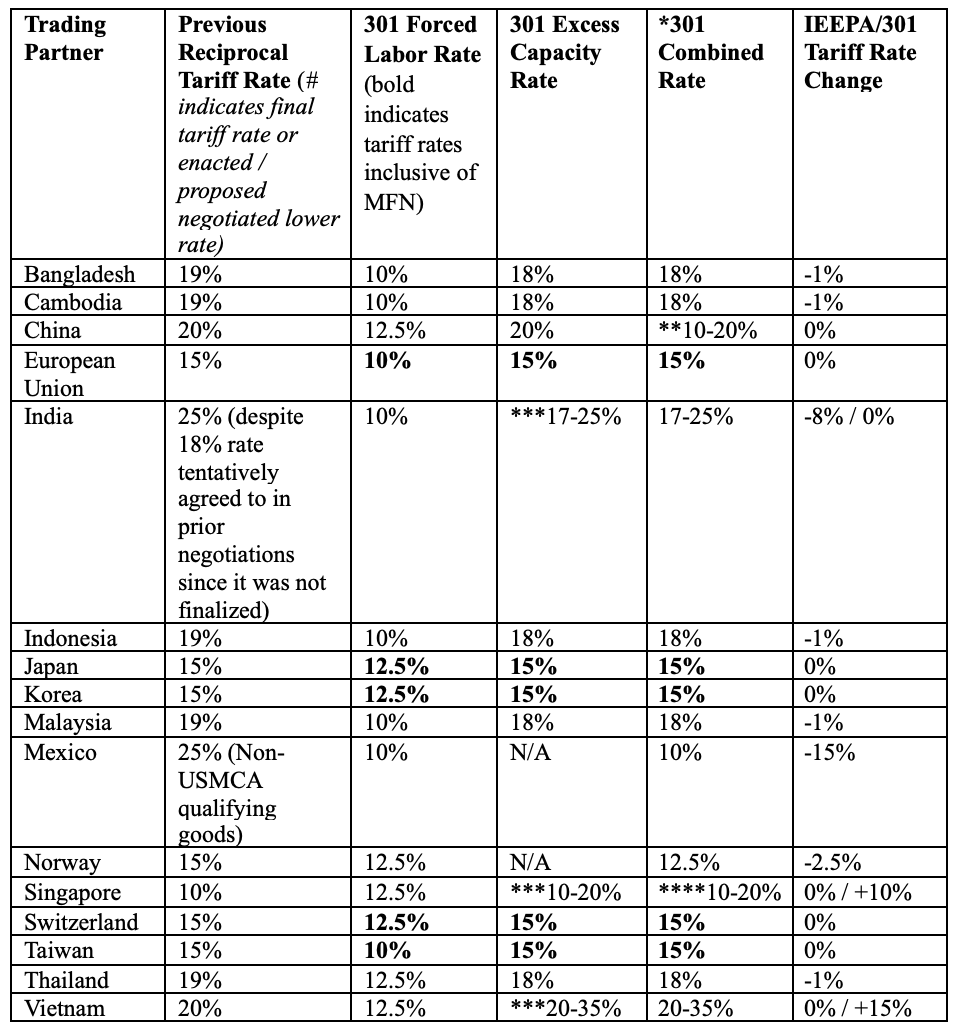
*USTR has indicated that the two Section 301 tariffs will be imposed concurrently, with relevant imports paying only the higher of the two tariffs.
**USTR has proposed to impose a 10% tariff on imports listed in Annex A of its China proposed action. Most of those products are currently exempt from the Section 301 forced labor tariff. For other covered imports from China, USTR has proposed to impose a 20% tariff.
***Lower tariff rates for these trading partners are contingent on concluding an ART with the United States that addresses the specific excess capacity and production issues of concern.
****USTR proposed to lower the combined tariff rate to 10%, were an ART to be finalized that addressed US concerns. This rate is lower than the existing forced labor Section 301 duty rate, which is 12.5%.
Potential Legal and Congressional Challenges
Although legal challenges against the proposed new tariffs are possible, a successful challenge may prove more difficult than recent challenges to other tariff actions.
Unlike the IEEPA tariffs that were struck down by the US Supreme Court, Section 301 explicitly authorizes the imposition of tariffs by USTR. In addition, USTR has complied with certain Section 301 statutory requirements related to this proposed action, including conducting an investigation, holding a public hearing, and receiving more than 1,000 comments from the public. In contrast to the prior forced labor Section 301 tariffs, which are currently being challenged at the Court of International Trade, USTR has issued country-specific reports (USTR’s issuance of a single report has been raised by the plaintiffs in the appeal of the forced labor Section 301 action).
Accordingly, these tariffs may be harder to challenge in court compared with the prior global tariff actions imposed under Section 122 and IEEPA. The outcome of the pending challenge to the forced labor tariffs imposed under Section 301 may be a good indicator of the potential outcome of a challenge to these excess capacity tariffs.
Alternatively, members of Congress could attempt to overturn the tariffs, but it is unlikely that such an attempt would be successful. Even if the Democratic-majority Congress voted to overturn this tariff action or to adjust Section 301 tariff authority more broadly, President Trump would veto such a bill. Since two-thirds of the members in both the House of Representatives and Senate would need to vote to overturn the veto, such a result would be unlikely unless significant numbers of Republicans voted with the Democrats.
In lieu of voting to overturn the tariffs, members of Congress may focus on procedural adjustments such as requiring a formal tariff exemption process or imposing congressional consultation requirements for future tariff actions. These steps could lead to limited adjustments to the Section 301 tariffs, but major shifts would be unlikely to occur barring a major policy change by the Administration.
Looking Ahead: Comment and Public Hearing Process
As with prior Section 301 actions, USTR is seeking public comments related to this proposed action and will hold a public hearing beginning January 25, 2027. Written comments and requests to appear at the hearing are due by January 5, 2027.
If the timeline mirrors the forced labor tariffs, excess capacity-related final tariffs could take effect as early as January or February.
Steptoe's International Trade team is closely monitoring ongoing tariff developments. If you need support evaluating what these developments mean for your business, our team is ready to help.